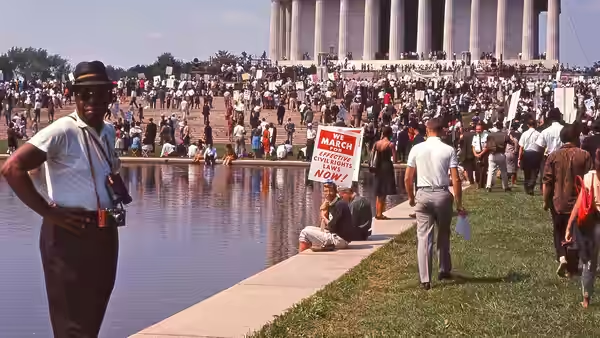
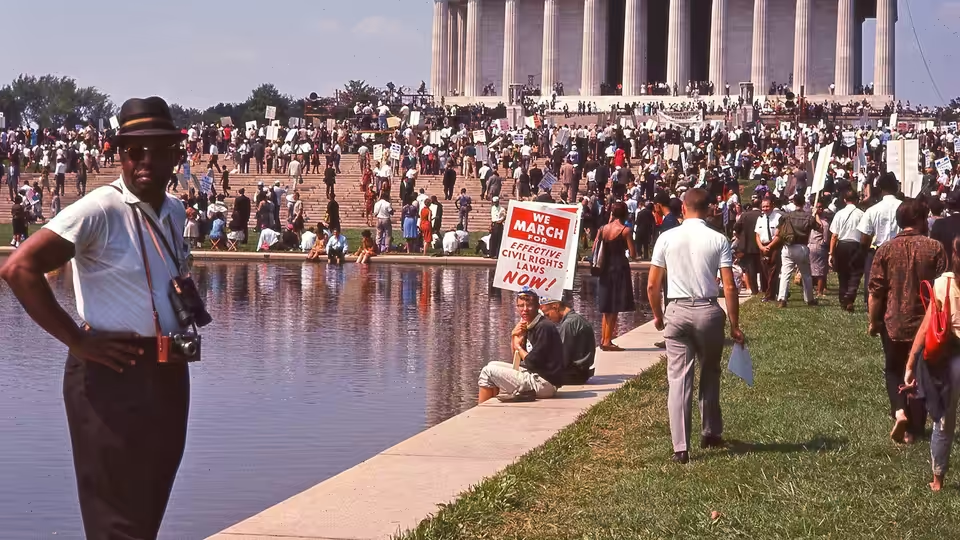
Man with camera stands by reflecting pool as large crowd gathers at Lincoln Memorial
Film review

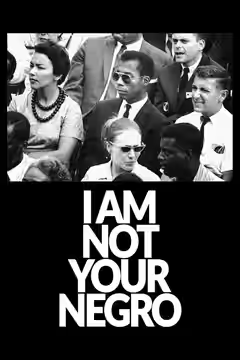
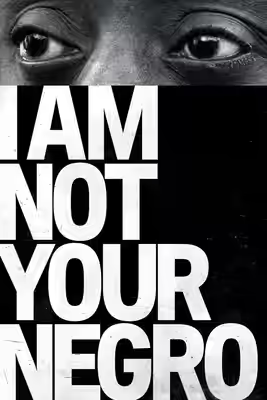
I Am Not Your Negro

2017 · Directed by Raoul Peck · 1h 33m · MPA R

In a sentenceBaldwin died with thirty pages written; the rest of the country is still catching up

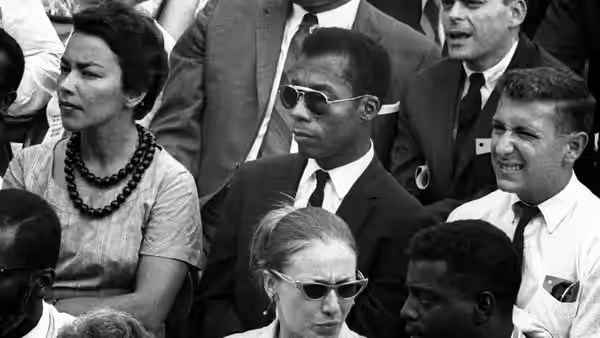
In 1979 James Baldwin writes to his literary agent proposing a book, Remember This House, about three friends murdered inside five years: Medgar Evers, Malcolm X and Martin Luther King Jr. He dies in 1987 having written thirty pages. Raoul Peck takes those pages, along with Baldwin’s essays, letters and television appearances, and builds a film in which no voice is heard but Baldwin’s own. Samuel L. Jackson reads the unfinished text; archive footage supplies Baldwin himself, on chat-show sofas and debating platforms in the 1960s. Around him Peck cuts Hollywood clips, newsreel of marches and police dogs, and present-day street footage, asking whether the country Baldwin described has changed at all.

Plays from YouTube when you press play; nothing loads from them until then.

Fi1m review

Raoul Peck gives James Baldwin the last word on America, and Samuel L. Jackson reads it as if he already knows nobody will listen. A hard, exact, beautifully cut film, weakened only when Peck adds a picture to a point Baldwin has already made.

In 1979 James Baldwin wrote to his agent proposing a book about Medgar Evers, Malcolm X and Martin Luther King Jr., three men he knew and outlived. He died in 1987 with thirty pages of it done. Raoul Peck has taken those pages, added Baldwin’s essays and letters, and made a film in which nobody speaks except Baldwin. Samuel L. Jackson reads the text; the archive supplies the man. It is superbly assembled, and it has one flaw, which is that Peck sometimes does not trust the words to land on their own.

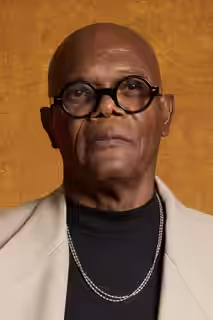
Jackson does not impersonate Baldwin. He reads low and slow, close to the microphone, with none of the bark he has traded on for thirty years, so that when Baldwin’s real voice arrives in a clip the difference is plain. Baldwin talked fast, in long turning sentences with a small laugh at the end of them. Jackson sounds like a man who read the sentence twice before he said it aloud. That gap is the film’s structure: one Baldwin alive and arguing, another looking back over his shoulder, and Jackson has the sense to stay out of the way of both.

The footage of Baldwin himself is where the film got to us. There is a 1968 appearance on The Dick Cavett Show in which an academic on the sofa beside him asks, in effect, why he insists on bringing race into everything, and Baldwin answers him in a single unbroken paragraph, without raising his voice, that the man cannot follow. We sat very still through it. It was not the argument, which Baldwin had clearly made a hundred times; it was that he was willing to make it again, patiently, to someone who was never going to hear it, and that we knew how the next fifty years would go.

Alexandra Strauss’s editing is the other reason to see it. Her best sequence takes Baldwin’s writing about Hollywood and lays it against the films: Doris Day, John Wayne, Sidney Poitier chained to Tony Curtis in The Defiant Ones, Rod Steiger chewing gum in In the Heat of the Night. Baldwin’s point, that these pictures taught white Americans a version of themselves and taught Black Americans they were not in the story, is made by the cuts rather than the narration. Billy Dee Williams turns up too, from the period Baldwin spent in Los Angeles trying to write a Malcolm X screenplay, and the scene is a small comedy about what a studio will and will not buy.

The present-day material is less sure. Turner Ross, Bill Ross and Henry Adebonojo shot new footage of American streets, and Peck cuts Birmingham police dogs against Ferguson police lines, Baldwin on the march against protesters with their phones raised. Once, it is a shock. By the third or fourth time the film is saying what Baldwin has just said, and saying it with pictures that are blunter than his prose. Alexei Aigui’s score does something similar, sitting under Jackson’s voice with strings and a slow pulse when the voice alone would carry. There are also two or three interludes of advertising imagery and bright consumer colour that feel like a different, angrier film has wandered in.

Peck made Lumumba (2000), and he has always been a director who trusts an argument more than a scene. Here the argument is someone else’s, and the discipline of using only Baldwin’s words has done him good; the film is 93 minutes and nearly all of them count. It is not a biography. You will not learn where Baldwin was born or whom he loved. You will learn what he thought, in the order he thought it, and that turns out to be the more useful thing.

See it, and see it with the sound up and the phone in another room. The certificate is 12A, which is right; there is footage of a lynching and there are the photographs from Ferguson, but nothing in it is as hard to sit through as Baldwin’s calm.
Critical consensus AI synthesised

87
Positive
23
Mixed
0
Negative
0

Every one of the 23 reviews is positive, and the praise gathers in the same places. Critics agree that Raoul Peck’s decision to draw the narration entirely from James Baldwin’s own writing is what gives the film its force, and Samuel L. Jackson’s reading is singled out again and again, with several calling it among his best work. The editing draws almost as much admiration: archive footage of the civil rights era cut against recent protests, and a passage picking apart Hollywood’s racial stereotypes, are the sequences most often named.

The reservations are few and small. The Hollywood Reporter finds the loose structure occasionally confusing, and The Guardian notes one flourish that imitates Baldwin’s anger without his elegance. A handful of reviews, Screen Daily and Film Comment among them, find the film despairing and wearying rather than rousing, though they admire it all the same. The spread is narrow: nobody dissents from the view that this is a serious, urgent piece of work.

Time Out
3 April 2017 · ★★★★★ · Joshua Rothkopf
100

The critic hails the documentary as masterful in addressing the American racial divide past and present. It singles out Samuel L. Jackson's narration as his finest performance, deepening the emotional frustration with its resigned delivery.

Read the full review →
IndieWire
2 February 2017 · Eric Kohn
90*

The review calls the film a brilliant essay that imagines Baldwin's unfinished book and weaves his words with images to examine race in America. It highlights the film's kaleidoscopic style and contemporary resonance as one of the year's most important works.

Read the full review →
Los Angeles Times
8 December 2016 · Kenneth Turan
90*

The film is a mesmerizing cinematic experience that uses every element of film language to create a powerful, painful essay on America’s racial crisis that remains urgently relevant. Turan singles out the opening montage linking Baldwin’s era to contemporary events like Ferguson as revealing the film’s essence.

Read the full review →
Sight and Sound
4 December 2017 · Violet Lucca
90*

The critic praises Raoul Peck's fluid documentary for using James Baldwin's timeless anger to animate a history of the black experience in America. It singles out the montage that deconstructs Hollywood stereotypes, racial forgiveness tropes and the function of the N-word.

Read the full review →
The AV Club
6 December 2016 · A- · Noel Murray
90

The critic praises the documentary for using Baldwin's eloquent words to compelling effect, creating a world-weary tone that underscores ongoing racial issues. It notes the film's strengths in narration and relevance to current events while acknowledging some challenging visuals.

Read the full review →
The New York Times
2 February 2017 · NYT Critic’s Pick · A.O. Scott
90*

The film is a thrilling posthumous collaboration between Peck and Baldwin that functions as both an introduction to the writer’s work and an advanced seminar in racial politics. It draws entirely on Baldwin’s words (voiced by Samuel L. Jackson) to connect the assassinations of Evers, Malcolm X and King to contemporary American life.

Read the full review →

Straight answers AI written, from our review

Is I Am Not Your Negro worth watching?
I Am Not Your Negro is worth watching for anyone who wants to hear what James Baldwin thought about America, in his own words and nobody else's, and we scored it 85. Samuel L. Jackson reads the unfinished text and the archive supplies the man. Our one reservation is that Raoul Peck sometimes adds pictures to a point Baldwin has already made.
How long is I Am Not Your Negro, and what is it rated?
I Am Not Your Negro runs 1h 33m and is rated R by the MPA in the US. It is a documentary film.
Where can I watch I Am Not Your Negro in the US?
I Am Not Your Negro is streaming on Amazon Prime Video in the US, and it is also available to rent from Amazon Prime Video and Apple TV from $2.99. Availability is checked daily; the links above go straight to each service.
How violent or frightening is I Am Not Your Negro, and is it suitable for children?
I Am Not Your Negro carries a UK 12A certificate, which we think is right, and it is a documentary about racism rather than a frightening film. There is footage of a lynching and there are photographs from Ferguson, so it is not for young children. Teenagers old enough to follow the argument will find nothing in it harder to sit through than Baldwin's calm.
How does I Am Not Your Negro compare to Sans Soleil?
I Am Not Your Negro and Sans Soleil are both essay films, but Peck's is tight and single-minded where Chris Marker's wanders. Marker follows travel and memory wherever they lead, and his commentary sometimes grows tiresome; Peck uses only Baldwin's words and nearly every minute counts. Watch Marker for curiosity and warmth, Peck for a hard, exact argument.
What should I watch after I Am Not Your Negro?
After I Am Not Your Negro, try 13th (2016, Fi1m 48): Ava DuVernay follows the same line from slavery to the prison yard, with more talking heads. Then Sans Soleil (1983, Fi1m 82): Chris Marker’s essay film, the form Peck is working in at its most free.

Cast

Awards

César Award for Best Documentary Film, 2018

Won
César Award for Best Documentary Film

If you liked this, try…

  1. The Black Power Mixtape 1967–1975 (2011) · not reviewed yetSwedish television footage of the movement, found in a basement and cut with restraint.

  2. 13th (2016, Fi1m 48)Ava DuVernay follows the same line from slavery to the prison yard, with more talking heads.

  3. Concerning Violence (2014) · not reviewed yetFanon’s words, Lauryn Hill’s voice, colonial Africa on film; the same method, harder edges.

  4. Sans Soleil (1983, Fi1m 82)Chris Marker’s essay film, the form Peck is working in at its most free.

  5. Take This Hammer (1963) · not on Fi1m yetBaldwin walks San Francisco for an hour and listens; the raw material, unmediated.

Free account

Know what to watch tonight

Two lists that know where things are streaming, collections you can share, your own score beside ours, and Discover that remembers what you have seen.

  • Want to see, sorted by what is streaming now
  • Seen, with your score out of ten
  • No adverts, ever