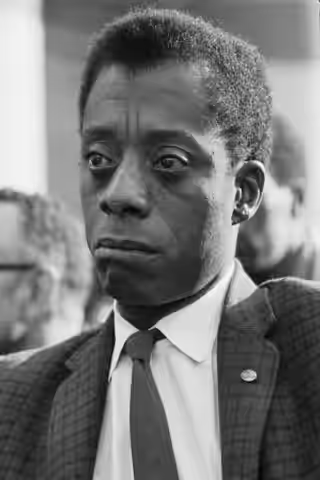
James Baldwin makes injustice personal without making it simple. His writing has served cinema well, though directors sometimes explain what his words, or the actors’ faces, have already told us.
Fi1m perspective
An academic asks James Baldwin why he keeps bringing race into everything, and Baldwin answers without raising his voice. The exchange appears in Raoul Peck’s I Am Not Your Negro (2017), in footage from a 1968 appearance on The Dick Cavett Show. We found his patience painful to watch, because he keeps trying to reach someone who seems unwilling to listen.
His writing moved between fiction and essays, from the first novel, Go Tell It on the Mountain (1953), to the essay collection Notes of a Native Son (1955) and beyond. The films draw on both forms, as well as work he wrote for the screen. An early screenplay written with Arnold Perl formed the basis of Spike Lee’s Malcolm X (1992), a thoughtful drama whose solemnity sometimes slows it down. Denzel Washington’s searching performance carries it, but we would not attribute every strength or weakness of the finished film to Baldwin.
In Peck’s film, an unfinished manuscript sits alongside essays and letters, with Samuel L. Jackson reading and archive footage supplying Baldwin himself. Jackson’s low, slow delivery gives the sentences room, without attempting to impersonate their author. Editor Alexandra Strauss sets Baldwin’s writing about Hollywood against the films he discusses, showing how they taught white Americans to see themselves and Black Americans that they did not belong in the story. The cutting makes that criticism clear; Peck is less effective when he adds a picture to a point the words have already made.
Barry Jenkins takes more time over faces in If Beale Street Could Talk (2018), adapted from Baldwin’s 1974 novel. He lets the young Black lovers look at each other long enough for us to understand what they have together before asking us to reckon with the racism keeping them apart. The actors make this moving, though the pace sometimes drags and the narration can explain what their expressions have already told us. Start with Peck’s film, and pay particular attention when Baldwin himself begins to speak.
Biography
James Baldwin (1924–1987) was an American novelist, essayist, playwright and social critic. Born in Harlem, New York, he became known for works exploring race, sexuality and class in mid-20th-century America, including the essay collection Notes of a Native Son (1955) and the novel Go Tell It on the Mountain (1953).
In the late 1960s, Baldwin was commissioned to write a screenplay about Malcolm X. He collaborated with Arnold Perl on a draft that formed the basis for Spike Lee’s 1992 film Malcolm X. Baldwin’s name does not appear in the final credits, at the request of his estate. He is also featured in archive footage in later documentaries such as I Am Not Your Negro (2016).