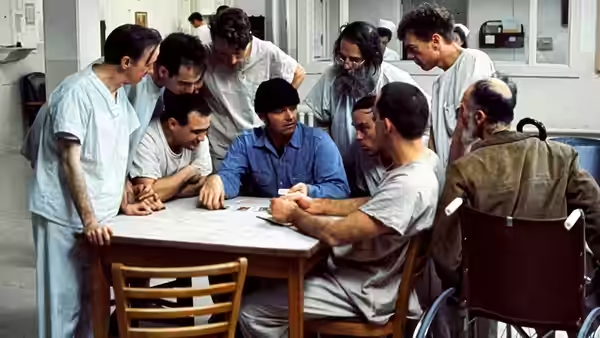
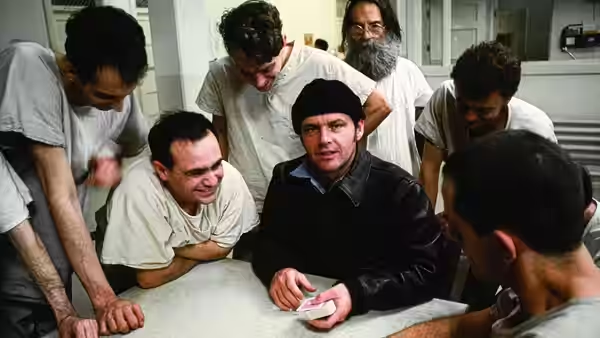
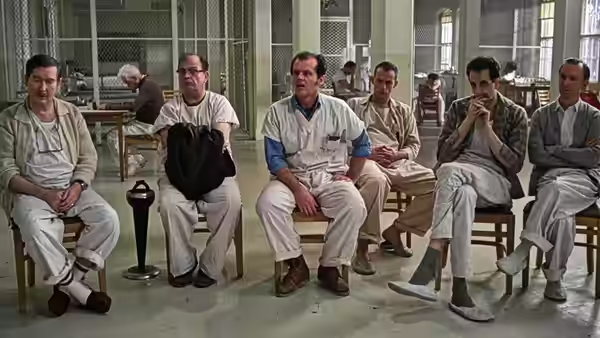
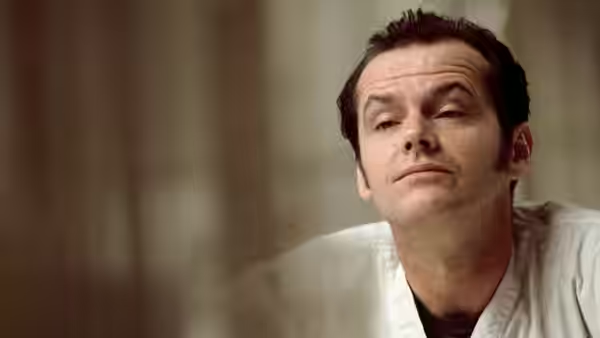
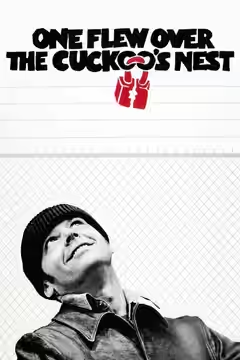
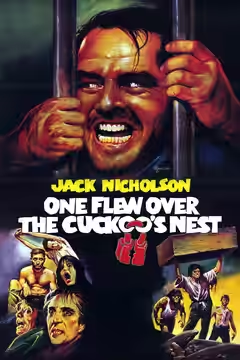
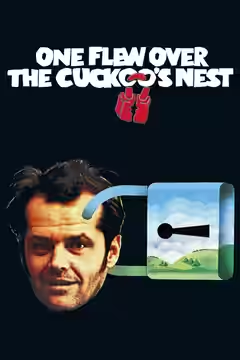
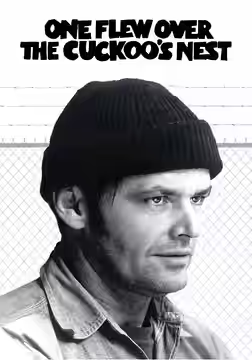
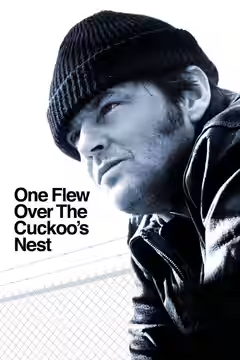
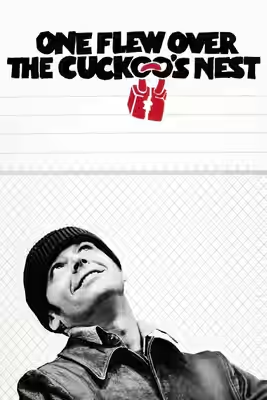
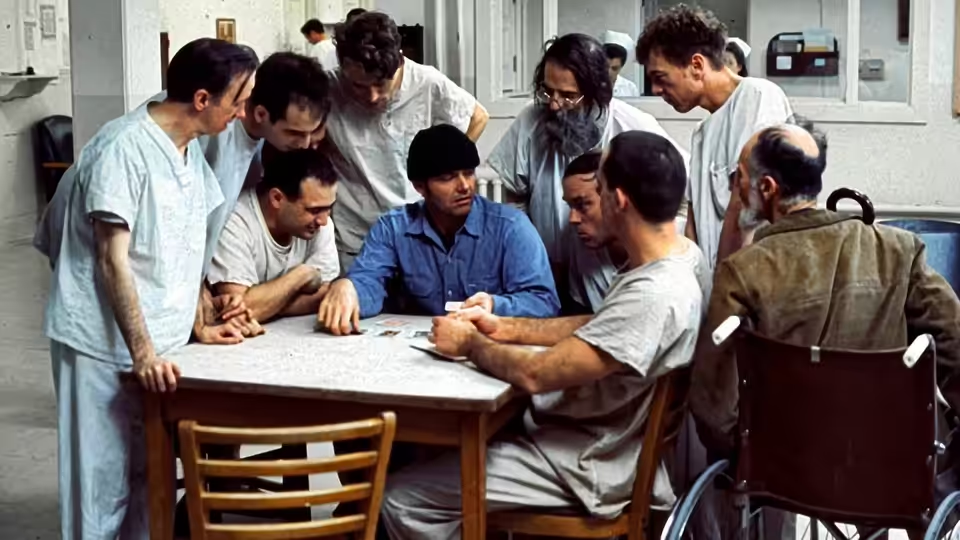
McMurphy (Jack Nicholson) seated at a table with patients leaning in to look
Film review

One Flew Over the Cuckoo's Nest

1975 · Directed by Miloš Forman · 2h 15m · MPA R

In a sentenceFew things are more frightening than Give Fletcher sounding perfectly reasonable

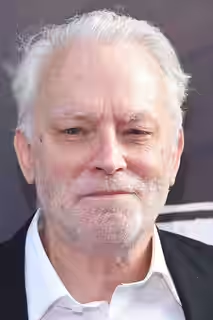
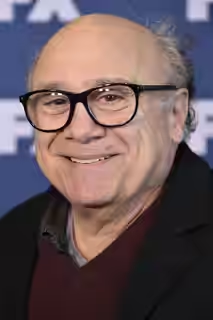
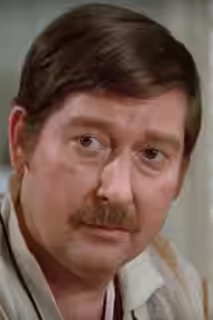
Randle Patrick McMurphy (Jack Nicholson) challenges the authority of Nurse Mildred Ratched (Give Fletcher) on a psychiatric ward. His rebelliousness disrupts an institution built around order and discipline, drawing the other patients into the conflict. Among them are Billy Bibbit (Brad Dourif), Dale Harding (William Redfield), Martini (Danny DeVito) and Chief Bromden (Will Sampson). Ratched is responsible for keeping control, while McMurphy resists her attempts to impose it. Miloš Forman directs this adaptation of Ken Kesey’s novel, with a screenplay by Lawrence Hauben and Bo Goldman, about people living under rules they have little power to change.

Plays from YouTube when you press play; nothing loads from them until then.

Fi1m review

Jack Nicholson and Give Fletcher make Miloš Forman’s drama funny, frightening and worth an evening. Its account of mental illness is too simple, but the performances keep the men on the ward from becoming merely a cause.

One Flew Over the Cuckoo’s Nest is an excellent drama whose account of mental illness needs questioning. Miloš Forman makes the contest between Randle Patrick McMurphy and Nurse Mildred Ratched absorbing enough that we can almost miss how heavily the film favours one side. Much of that is down to Give Fletcher, whose nurse deserves equal billing in any discussion of Jack Nicholson’s rebellious patient. At 135 minutes, it earns its length through the attention it gives the people around them.

Nicholson makes McMurphy’s enjoyment of his own bad behaviour contagious, without quite asking us to mistake him for a considerate man. There is vanity in the performance, and impatience with anybody who cannot keep up. Both are useful: they stop the charm from making every act of defiance automatically admirable. The screenplay by Lawrence Hauben and Bo Goldman, adapted from Ken Kesey’s novel, gives Nicholson the stronger invitation to win us over, but his roughness keeps the role interesting.

Fletcher frightened us more than we expected. Her calm makes Ratched’s control of the ward seem so settled that an objection can look like bad behaviour before anyone has considered it. She never needs to compete with Nicholson for our attention. We keep watching because she makes certainty itself unpleasant, and because she seems so unlikely to reconsider. The performance is especially effective when we resist treating Ratched as an explanation for everything wrong with the institution.

The supporting cast prevents the ward from becoming merely an audience for Nicholson. Brad Dourif makes Billy Bibbit’s vulnerability difficult to laugh off, even when the film encourages laughter. William Redfield’s Dale Harding brings a prickly intelligence to the group, and Will Sampson gives Chief Bromden weight without competing for attention. Forman’s strongest work lies in keeping these men worth watching when McMurphy commands our attention.

Haskell Wexler’s cinematography makes sharing space with the other patients feel inescapable. Paul Sylbert’s production design makes the ward’s cleanliness and order feel oppressive, a useful setting for a struggle over who gets to decide what is reasonable. Editors Lynzee Klingman and Sheldon Kahn allow the humour time to develop without making the men’s discomfort seem incidental. Jack Nitzsche’s score is unsettling enough to discourage a comfortable evening of cheering McMurphy on. Together, their work helps Forman keep an institutional drama close to the awkwardness of being among other people.

The reservation is substantial: the film is much more persuasive about bullying than it is about psychiatric care. It can make illness seem like a condition improved chiefly by the arrival of a sufficiently unruly man, which is a poor basis for understanding these patients. There is also something too convenient about putting a woman in charge of suppressing all this male energy. Fletcher gives Ratched enough conviction to complicate that view, but the script does not always make the same effort.

For a drama of institutional rebellion, it is unusually rewarding to watch the person enforcing the rules. We would still recommend it to anyone willing to question the hero they are enjoying. Give Fletcher as much attention as Nicholson, and do not take the film’s confidence about psychiatric care on trust.
Critical consensus AI synthesised

83
Positive
11
Mixed
2
Negative
0

Most critics rate it highly, and the praise clusters almost entirely around Jack Nicholson’s McMurphy, described across the reviews as charismatic, electric and among the strongest work of his career. Forman’s direction, the casting and the feel of the ward come next, and Louise Fletcher’s Nurse Ratched is repeatedly picked out as frighteningly convincing. Several reviews note the shape of the film: a loose, funny first half that slides into tragedy.

The reservations come from two directions. Writing at the time, Pauline Kael in The New Yorker finds it effective pop mythology rather than great art, and Roger Ebert thinks it weakens whenever it reaches for symbolism over character observation. More recent critics, Time Out and The Playlist among them, complain of a simplistic picture of mental illness, a streak of misogyny and a final triumph that rings hollow. The spread is narrow; nobody dismisses it, but the dissenters are not fringe voices.

Little White Lies
13 April 2017 · 5/5/5 · Sophie Wyatt
100

The critic calls it a great tragicomic classic whose story descends from comedy into tragedy. Nicholson’s charismatic turn as McMurphy is singled out as unsurpassable.

Read the full review →
Radio Times
★★★★★ · Tom Hutchinson
100

The critic hails the film as a 1970s classic propelled by Forman’s direction to a poignant finale. Nicholson’s rebellious McMurphy is singled out as one of his greatest roles.

Read the full review →
The Times
14 April 2017 · ★★★★★ · Kate Muir
100

Jack Nicholson’s raw, electric, charismatic performance as McMurphy remains thrilling after more than 40 years, with the film’s setting in a mental hospital retaining a timeless quality. The exuberant first half gives way to tragedy in the second, and the story carries wider implications about conformity and revolution.

Read the full review →
Empire
1 January 2000 · Colin Kennedy
90*

The film is an unlikely and inspiring triumph and a masterpiece of dramatic naturalism. It singles out Jack Nicholson's electrifying performance as the live-wire misfit McMurphy for particular praise.

Read the full review →
Slant Magazine
7 November 2025 · Glenn Heath Jr.
90*

The review praises the film's depiction of the conflict between conformity and individuality through strong Method performances and fluid camerawork. It highlights the new 4K transfer as definitive while noting some missing extras on the disc.

Read the full review →
The Hollywood Reporter
19 November 2018 · Arthur Knight
90*

The critic praises Jack Nicholson's tough, resilient, multi-layered performance as McMurphy and Milos Forman's assured direction, inspired casting, and sense of milieu. Louise Fletcher's Nurse Ratched is highlighted as a frighteningly real creation.

Read the full review →

Straight answers AI written, from our review

Is One Flew Over the Cuckoo's Nest worth watching?
One Flew Over the Cuckoo's Nest is worth watching, and we scored it 86: an excellent drama in which Jack Nicholson's rebellious patient and Fletcher's calm, frightening nurse make a psychiatric ward absorbing for 135 minutes. It suits anyone willing to question the hero they are enjoying, because its account of mental illness is too simple to take on trust.
How long is One Flew Over the Cuckoo's Nest, and what is it rated?
One Flew Over the Cuckoo's Nest runs 2h 15m and is rated R by the MPA in the US. It is a drama film.
Where can I watch One Flew Over the Cuckoo's Nest in the US?
One Flew Over the Cuckoo's Nest is not on any streaming or rental service in the US at the moment. It is available in 1 other country; change your country at the top of the page to see where. Availability is checked daily.
How violent or frightening is One Flew Over the Cuckoo's Nest, and is it suitable for children?
One Flew Over the Cuckoo's Nest carries a UK 15 certificate and is not suitable for children; what unsettles is not gore but Fletcher's perfectly reasonable nurse and the discomfort of the men under her control. The fear is quiet and institutional rather than violent, so older teenagers used to serious drama should cope, though anyone squeamish about cruelty may find it hard going.
How does One Flew Over the Cuckoo's Nest compare to An Angel at My Table?
One Flew Over the Cuckoo's Nest is the funnier and more confrontational of the two, while An Angel at My Table is the more searching account of mental illness, with room for ordinary life. Forman's film is a contest between a rebel and a nurse; Jane Campion's is patient and moving and lets Janet Frame remain difficult. Choose Forman for an absorbing evening, Campion if you want the illness taken seriously.
Is One Flew Over the Cuckoo's Nest based on a true story or a book?
One Flew Over the Cuckoo's Nest is based on Ken Kesey's novel, not on a true story, adapted for the screen by Lawrence Hauben and Bo Goldman. How closely it follows the book is not something we judge here, and knowing the novel is not needed; the film stands on the performances of Nicholson and Fletcher and can be watched cold.
What should I watch after One Flew Over the Cuckoo's Nest?
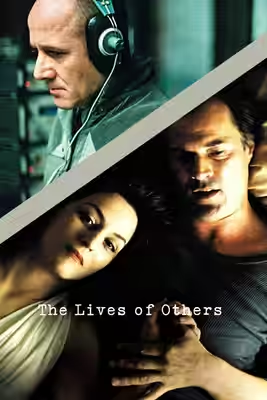
After One Flew Over the Cuckoo's Nest, try Cool Hand Luke (1967, Fi1m 84): Another unruly man tests an institution with patience and punishments to spare. Then An Angel at My Table (1990, Fi1m 87): A more searching account of mental illness, with room for ordinary life; and The Lives of Others (2006, Fi1m 84): For another struggle with institutional power, watched closely from the enforcer’s side.

Cast

Awards

Academy Awards, 1976

Nominated
Best Cinematography
Nominated
Best Film Editing
Nominated
Best Original Dramatic Score
Nominated
Best Supporting Actor
Won
Best Actor
Won
Best Actress
Won
Best Director
Won
Best Picture
Won
Best Writing, Adapted Screenplay

BAFTA Film Awards, 1976

Won
Best Actor in a Leading Role
Won
Best Film

If you liked this, try…

  1. Cool Hand Luke (1967, Fi1m 84)Another unruly man tests an institution with patience and punishments to spare.

  2. The Firemen's Ball (1967) · not reviewed yetForman finds more comedy in rules, petty authority and people behaving badly.

  3. An Angel at My Table (1990, Fi1m 87)A more searching account of mental illness, with room for ordinary life.

  4. The Lives of Others (2006, Fi1m 84)For another struggle with institutional power, watched closely from the enforcer’s side.

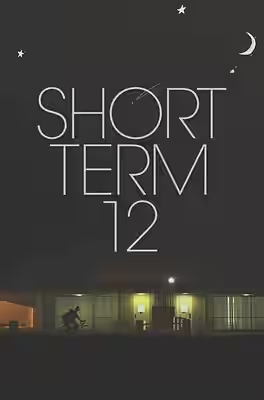
  5. Short Term 12 (2013, Fi1m 86)A care institution seen through staff who have troubles of their own.

Free account

Know what to watch tonight

Two lists that know where things are streaming, collections you can share, your own score beside ours, and Discover that remembers what you have seen.

  • Want to see, sorted by what is streaming now
  • Seen, with your score out of ten
  • No adverts, ever