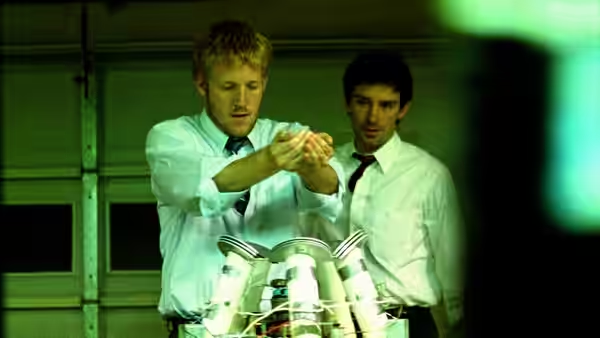
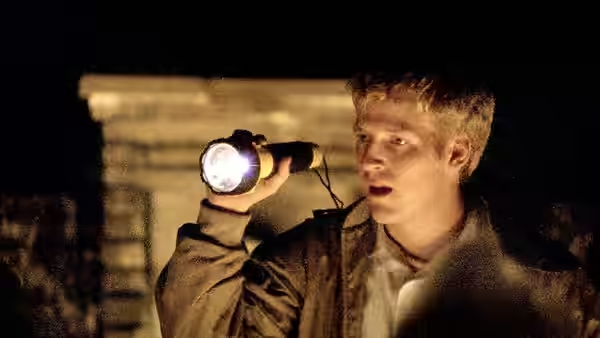
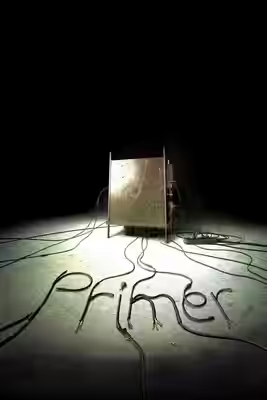
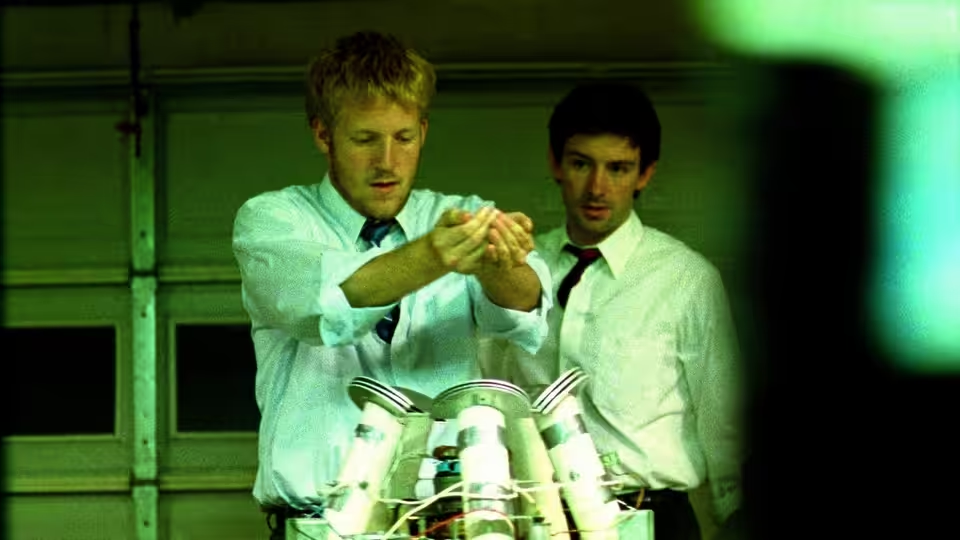
Aaron (Shane Carruth) and Abe (David Sullivan) inspecting machinery in a workshop
Film review

Primer

2004 · Directed by Shane Carruth · 1h 17m · MPA PG-13

In a sentenceWe would ask these engineers to explain their time machine, but we suspect they already have

Shane Carruth writes, directs and stars as Aaron, alongside David Sullivan as Abe, in a science-fiction thriller about engineers who invent a time machine. The discovery presents them with a problem that goes beyond the workings of the device: what should they do with it? As the men try to understand what they have made, technical questions become questions about consequences and responsibility. The story follows the inventors’ attempts to work through those questions, using the language of their profession. Casey Gooden plays Robert, with Anand Upadhyaya as Philip.

Fi1m review

Shane Carruth’s time-travel thriller makes technical talk gripping and its engineers convincing. Its tangled storytelling can be frustrating, but we recommend it to anyone who enjoys a film that needs working out.

Shane Carruth’s Primer is a good science-fiction thriller with a substantial condition attached: following it takes work, and work does not always bring clarity. Its engineers invent a time machine, then have to consider what such an invention permits them to do. Carruth writes and directs with unusual confidence in our willingness to listen to technical conversation. He is interested in the trouble clever people can cause, including the trouble they can cause while sounding entirely reasonable.

Carruth plays Aaron, with David Sullivan as Abe, and both make the scientific language sound like something they use every day. The dialogue offers few explanations for anyone outside their profession; the actors resist the temptation to announce which words matter. We felt uneasy listening to them, because their calm competence makes the possibility of time travel seem horribly practical. There is no need to play the discovery with grand astonishment when the men discussing it are this convincing.

Troy Dick’s cinematography is rough-looking and unceremonious, which suits the engineers’ matter-of-fact discussions. Carruth’s production design works in the same spirit, making the invention feel like an engineering problem that somebody has managed to solve. The plain presentation keeps our attention on the people trying to understand the machine, and encourages us to take their work seriously. Some of that roughness can be wearing, but polishing it away would make these engineers less plausible.

Carruth also edits and composes the music, and the cutting supplies most of the anxiety. The scrambled storytelling makes us keep checking how one conversation relates to another, with little time to settle on an answer. His score supports the tension without being especially memorable; the difficult conversations are quite enough to be listening for. At 77 minutes, this is a short film that demands sustained concentration, and its speed helps keep the uncertainty from becoming exhausting.

The weakness is that Carruth’s screenplay sometimes makes it hard to tell what we have missed and what we are not yet supposed to know. Having to reconstruct events can be pleasurable, but it can also stop us caring about the people while we try to get the order straight. We wanted a little more help at those points, not an explanation of every scientific term. The danger is specific to this kind of puzzle: a viewer can spend so much effort following the mechanism that the people operating it become a secondary concern.

For a time-travel thriller, Primer is unusually willing to make us struggle with its central problem. Carruth persuades us to listen carefully to engineers, and to worry about what their cleverness might allow them to justify. We recommend it, though we would not promise that a second viewing will settle every question. Choose it when untangling a difficult story sounds like a decent way to spend the evening.

Critical consensus AI synthesised

69
Positive
9
Mixed
3
Negative
2

Most critics like it, and the praise gathers around the same thing: a time-travel puzzle made on almost no money that refuses to explain itself and trusts the audience to keep up. The technical, half-overheard dialogue between two engineers is singled out again and again as the film’s spine, and several reviews argue that the tiny budget helps rather than hurts, pushing Carruth towards ideas and paranoia instead of spectacle. Comparisons to Memento come up more than once.

The reservations attach to the very same qualities. The film is confusing; for the majority that is the point, for a smaller group it tips into being pleased with its own obliqueness. Variety and Empire find the characters and story thin beneath the puzzle, and The Times says the pile of moral quandaries collapses in the second half. Slant goes furthest, calling it derivative and pretentious. The spread is wide, from admiring the ambition outright to finding the thing simply incomprehensible, with little middle ground.

The Guardian
19 August 2005
90*

The film grips the viewer despite its baffling elements and assumes an intelligent audience with its indirect, technical dialogue and unconventional narrative. It stands out as an ambitious, exhilarating rebuke to mainstream dumbed-down sci-fi.

Read the full review →
The New Yorker
1 April 2013 · Richard Brody
90*

Shane Carruth’s first feature is a tour de force of low-budget science-fiction filmmaking, anchored by its script, relativity twist, and self-experimentation that gives the story dramatic urgency. Eerie visuals and rhythms suggest a world wrenched out of joint while exploring the endurance of personal identity.

Read the full review →
RogerEbert.com
28 October 2004 · Roger Ebert
85*

The critic finds it a maddening, fascinating and completely successful puzzle film that delights with its confidence that the audience can keep up, praising its technical achievement on a tiny budget.

Read the full review →
The AV Club
12 October 2004 · Scott Tobias
85*

The critic praises Primer as a smart, idea-driven sci-fi achievement made on a tiny budget, noting how it turns financial constraints into an asset by focusing on imagination, paranoia, and logical puzzles rather than spectacle. They highlight its brainteaser qualities and comparison to films like Memento.

Read the full review →
The New York Times
8 October 2004 · A. O. Scott
80*

Praises it as an ingenious movie about the perils of ingenuity, with rigorous science fiction and invigorating storytelling, though oblique at times.

Read the full review →
Time Out
· JWin
80*

The critic finds the low-budget debut an audacious time-travel mindfucker that provokes strong reactions and rewards patience and repeat viewings. The rough-hewn execution by a former engineer is singled out as thrilling and ethically engaged.

Read the full review →

Straight answers AI written, from our review

Is Primer worth watching?
Primer is worth watching for anyone who enjoys a science-fiction thriller that needs working out, and we scored it 79. Shane Carruth makes technical talk between engineers gripping and their calm competence unsettling. The scrambled storytelling can be frustrating, and a second viewing will not settle every question, so it suits the patient rather than the tired.
How long is Primer, and what is it rated?
Primer runs 1h 17m and is rated PG-13 by the MPA in the US. It is a science fiction and drama film.
Where can I watch Primer in the US?
Primer is available to rent from Amazon Prime Video and Apple TV from $2.99. Availability is checked daily; the links above go straight to each service.
How violent or frightening is Primer, and is it suitable for children?
Primer carries a UK 12 certificate and is a talky, low-key thriller rather than a violent or frightening one. Its unease comes from listening to reasonable men discuss a time machine, not from gore or shocks. It is suitable for teenagers, though younger children are more likely to be baffled than scared by 77 minutes of dense engineering conversation.
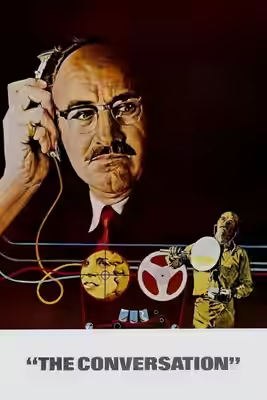
How does Primer compare to The Conversation?
Primer and The Conversation both make technical obsession suspenseful, but Coppola's film is the more assured and the one we would recommend without hesitation. The Conversation builds its tension through repeated listening and Gene Hackman's loneliness; Primer builds it through a deliberately scrambled structure that asks the viewer to reconstruct events. Choose Coppola for character, Carruth for a puzzle.

Cast

Awards

Alfred P. Sloan Prize, 2004

Won
Alfred P. Sloan Prize

Sundance Film Festival U.S. Dramatic Grand Jury Prize Award, 2004

Won
Sundance Film Festival U.S. Dramatic Grand Jury Prize Award

If you liked this, try…

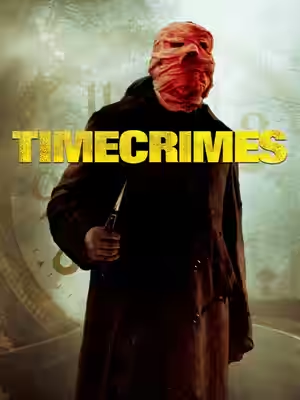
  1. Timecrimes (2007) · not reviewed yetA tightly staged time-travel thriller that makes its escalating trouble easier to follow.

  2. La Jetée (1962) · not reviewed yetA brief, unsettling time-travel story that gives memory and longing their due.

  3. The Conversation (1974, Fi1m 92)For the technical obsession, mounting suspicion and discomfort of knowing too much.

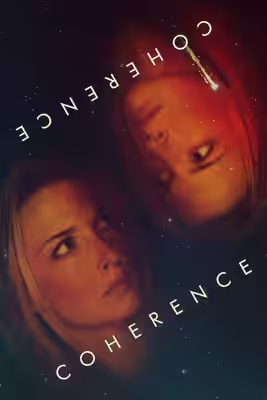
  4. Coherence (2013) · not reviewed yetDomestic conversation turns threatening, with the same pleasure in thinking through impossible events.

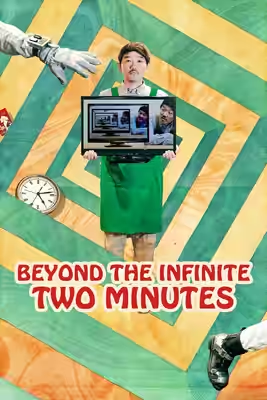
  5. Beyond the Infinite Two Minutes (2020) · not reviewed yetA smaller time loop, with more laughter and unusually clear geography.

Free account

Know what to watch tonight

Two lists that know where things are streaming, collections you can share, your own score beside ours, and Discover that remembers what you have seen.

  • Want to see, sorted by what is streaming now
  • Seen, with your score out of ten
  • No adverts, ever