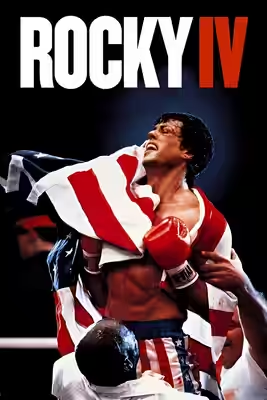
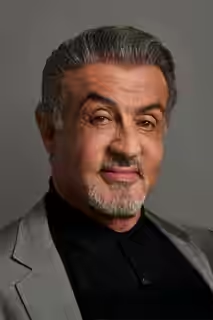
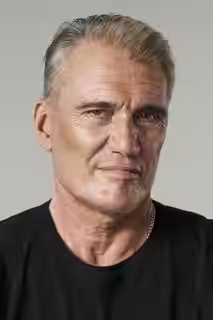
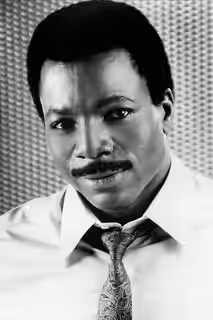
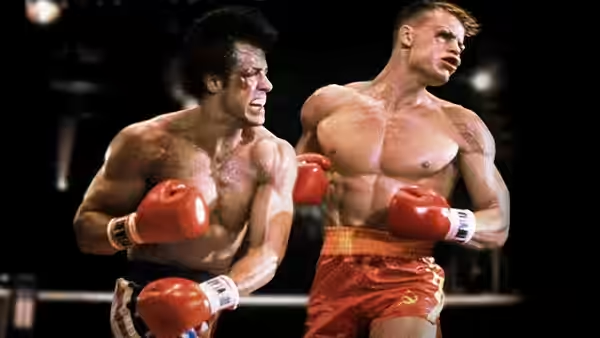
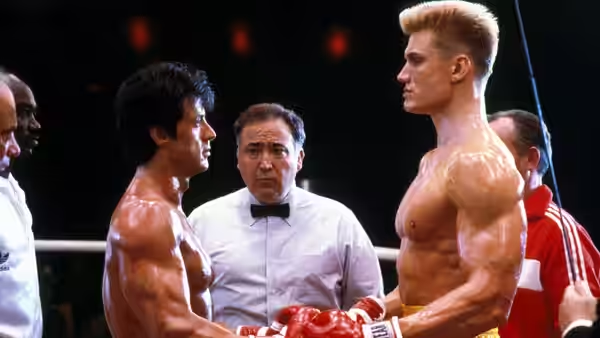
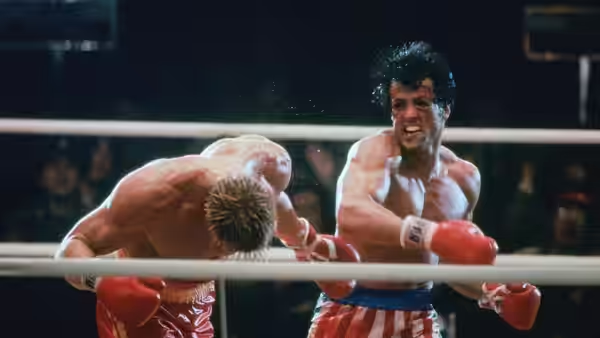
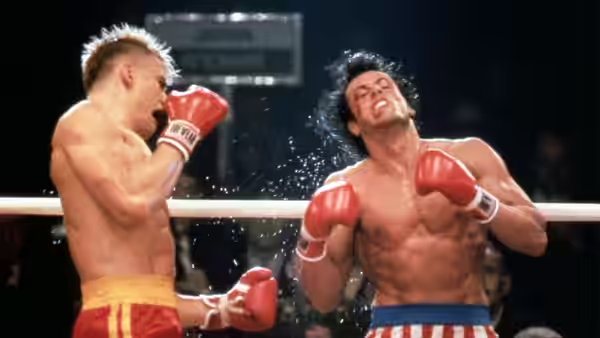
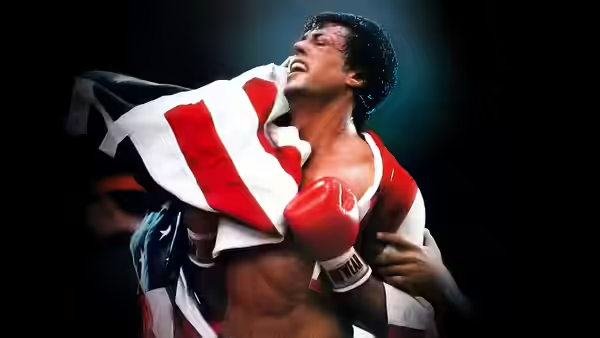
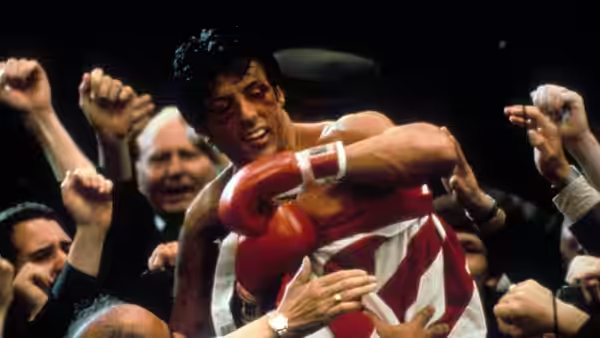
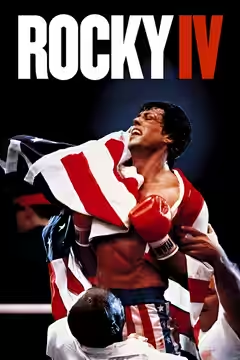
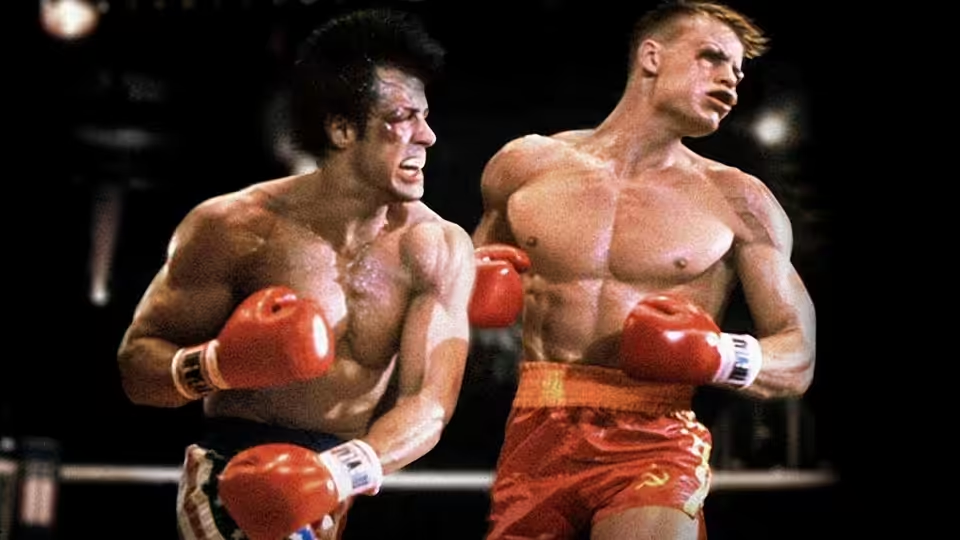
Rocky Balboa (Sylvester Stallone) and Ivan Drago (Dolph Lundgren) facing off in the ring
Film review

Rocky IV

1985 · Directed by Sylvester Stallone · 1h 31m · MPA PG

In a sentenceA ninety-minute film, of which a good third is montage and one stretch is a montage of the film so far

Rocky Balboa (Sylvester Stallone) is heavyweight champion of the world, rich, settled in a large house in Philadelphia with Adrian (Talia Shire), and short of anything to do. His brother-in-law Paulie (Burt Young) is given a talking robot for his birthday and takes to it. Then Ivan Drago (Dolph Lundgren), a Soviet amateur the size of a doorway, arrives in America with his wife Ludmilla (Brigitte Nielsen) and a handler, Nicoli Koloff (Michael Pataki), and announces at a press conference that he will fight professionals. Apollo Creed (Carl Weathers), retired and restless, decides the proper answer is an exhibition bout in Las Vegas, with Rocky and Duke (Tony Burton) in his corner. Adrian thinks it a bad idea. Apollo comes out to dancing girls and a stage full of stars and stripes, and the bell goes.

Plays from YouTube when you press play; nothing loads from them until then.

Fi1m review

Stallone strips the Rocky story to a poster and a soundtrack: one Soviet giant, one American in the snow, and Vince DiCola’s synthesiser doing the talking. The training footage still gets the pulse up; everything around it has been cut away.

Sylvester Stallone writes, directs and stars in the fourth Rocky film, which runs 91 minutes and opens with the last few minutes of the third. Rocky Balboa is champion, comfortable and a little lost, and the film has no interest in any of that. It wants a villain, and it gets one: Ivan Drago (Dolph Lundgren), a Soviet amateur who arrives in America with his wife Ludmilla (Brigitte Nielsen) and a handler, Nicoli Koloff (Michael Pataki), and is presented at a press conference as something built in a laboratory. Apollo Creed (Carl Weathers) takes it personally and arranges an exhibition in Las Vegas. What happens in that ring we will not describe; the rest of the film is Rocky’s answer to it.

The plot is an outline and Stallone knows it. His script has perhaps four scenes in which two people sit and talk, and in each of them one person says what they feel while the other nods. Talia Shire’s Adrian gets one real objection and then a change of heart. Burt Young’s Paulie is given a talking robot for his birthday, and the film treats this as normal. Weathers is the one actor allowed some life: his Apollo is a man who cannot bear to have stopped, and the scenes in which he talks Rocky into letting him fight are the only ones with two ideas in them.

Lundgren is used as a wall. He is enormous and blond, shot from below by Bill Butler so that he fills the frame and the ceiling lights sit behind his head like a halo, and he is given almost nothing to say. He says it slowly. Nielsen does the talking for him, and she is cold and amused and better than her lines. Bill Kenney’s production design gives the Soviets a training hall of steel, monitors and men in white coats, with Drago wired up like a car on a test bench, and Tom Bronson dresses them in grey and red so that nobody could mistake them for the home side.

Then the montages, which are what people remember and what the film really is. John W. Wheeler and Don Zimmerman cut Rocky in the snow against Drago in the machine: a log across a shoulder, a bar on a rack; a sledge dragged uphill, a treadmill; a beard coming in, a needle going in. Vince DiCola scores it with a synthesiser that is one part march and one part heartbeat, and the cuts land on the downbeat every time. We felt our pulse go up, and we were slightly embarrassed about it, because we knew exactly what was being done to us and it made no difference. The editors earn that. The writing does not, since the montage is doing the work of the second act and there is no second act underneath it.

There is also, at about the hour mark, a montage of the film so far, with Rocky driving at night and remembering scenes we watched forty minutes earlier. In a film this short that is a confession. We were bored by it, then irritated, because the picture had run out of things to show and had decided to show them again.

The fight is staged as Stallone stages all of them: close, sweating, in slow motion, with a great deal of fluid leaving faces. Butler lights the arena hard and white over a grey crowd, and Stu Nahan’s commentary explains everything we can already see. We will not say how it goes, though the tagline has a fair idea. The politics come down to a speech and a crowd, and the crowd is not believable for a second.

Against the series’ own standards this is the thinnest of the four. The first Rocky, in 1976, was a small film about a man who wanted to last fifteen rounds. This one is about a country, and a country turns out to be a duller character than a man. What the film says, when it says anything, is that a good heart beats a good laboratory.

See it with a room full of people who know the songs and it will be a decent hour and a half. On a sofa with one other person it is 91 minutes of a man being shouted at by a synthesiser, plus a robot.
Critical consensus AI synthesised

44
Positive
1
Mixed
4
Negative
5

Most critics do not think much of Rocky IV, and they agree on why. The reviews call it a Cold War fairy tale in which Rocky fights the Soviet Union rather than a man, with the supporting characters shrunk to shadows and the dialogue witless. What praise there is goes to the fights themselves: even the sharper notices concede that it is hard not to root for the underdog against the bully, and Dolph Lundgren’s Drago is singled out as a vivid new villain.

The reservations cluster on the montages, which several critics say replace the human feeling of the earlier films with something closer to a pop video, and on the jingoism. The spread is wide. The one clearly positive review, from The Times, is for Stallone’s 2021 director’s cut, which /Film also finds an improvement; The Guardian, reviewing the same cut, calls it pointless. The original theatrical release has almost no defenders.

The Times
19 November 2021 · ★★★★☆ · Kevin Maher
90*

This 35th-anniversary re-release of the political Rocky instalment is ridiculously entertaining and impeccably well constructed, even if preposterous. The critic highlights the extra footage from the Apollo Creed funeral and additional fight scenes in the cleaned-up director’s cut.

Read the full review →
Variety
1 January 1985
60*

Stallone sloughs it off shamelessly in Rocky IV but it remains impossible not to root for the underdog to whup the bully one more time. Beyond its visceral appeal the film is truly the worst of the lot with a contrived opponent in Dolph Lundgren, though the fight scenes still pull in fans despite being predictable and preposterous.

Read the full review →
The New York Times
27 November 1985 · Janet Maslin
50*

Rocky IV turns the boxer into an international diplomat battling a Soviet villain in a contest framed as us against them, but the two fights share the same carnival sameness that has become the series' most debilitating feature. The visual style emphasizes slow-motion bodily fluids while Drago stands out as a vivid new villain.

Read the full review →
Time Out
10 September 2012 · CPea
40*

The film is reduced to its barest three-act structure of revenge against a Russian opponent, with other characters diminished to shadows and dialogue that is witless. It delivers raw emotion as battleground cinema despite the political messaging and focus on Rocky.

Read the full review →
RogerEbert.com
27 November 1985 · Roger Ebert
30*

The Rocky series has lost its legs with this predictable last gasp that drains out human emotions in favor of technology and MTV-style montages. The fight scenes and contrived plot points like a chanting Russian crowd feel unbelievable and formulaic.

Read the full review →
The Guardian
12 November 2021 · Peter Bradshaw
30*

Stallone’s re-edit of his Cold War sequel is a ridiculous and largely pointless undertaking that fails to salvage the film. The critic singles out the persistent goofy Reagan-era fantasy and political saber-rattling, along with the unsettling death of Apollo Creed, as elements that render the redemption arc hollow.

Read the full review →

Straight answers AI written, from our review

Is Rocky IV worth watching?
Rocky IV is worth watching only for the training montages, and we scored it 52. Sylvester Stallone cuts the story to a poster and a synthesiser: Ivan Drago as a wall, a talking robot treated as normal, and a montage of the film so far at the hour mark. It works with a room of people who know the songs; on a sofa with one other person it is thin.
How long is Rocky IV, and what is it rated?
Rocky IV runs 1h 31m and is rated PG by the MPA in the US. It is a drama and action film.
Where can I watch Rocky IV in the US?
Rocky IV is streaming on AMC+, Pluto TV, The Roku Channel, Amazon Prime Video and Apple TV in the US, and it is also available to rent from Apple TV and Amazon Prime Video from $3.99. Availability is checked daily; the links above go straight to each service.
How does Rocky IV compare to Rocky III?
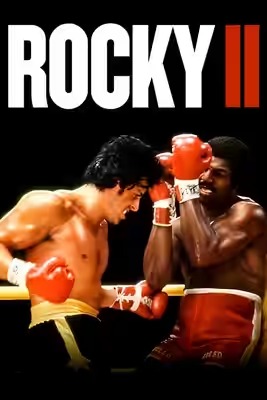
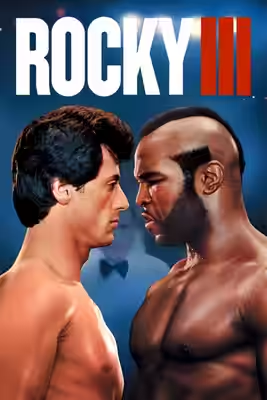
Rocky IV is the thinner of the two, and Rocky III is the better film. The third film trades the grit of the original for gloss and speed but keeps a proper threat in Mr. T and fights that hurt; the fourth keeps the gloss and drops most of the drama, leaving a villain who barely speaks and a plot that is an outline. Anyone who wants a boxing film should choose the third.
Do you need to have seen the other Rocky films before Rocky IV?
Rocky IV can be watched without the earlier films, since the plot is simple enough to follow cold, but it opens with the last few minutes of Rocky III and assumes you care about Apollo Creed already. Newcomers should start with the first Rocky, a small film about a man wanting to last fifteen rounds. This one is a poor place to begin.
What should I watch after Rocky IV?
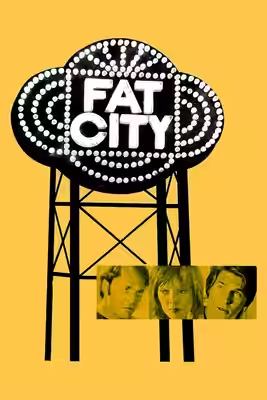
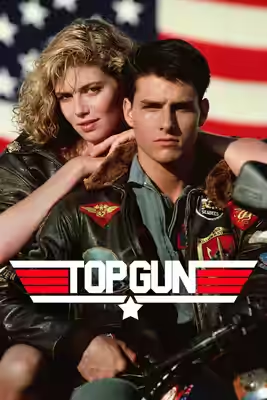
After Rocky IV, try Rocky (1976, Fi1m 85): The small, sweaty original, about a man who only wants to last fifteen rounds. Then Fat City (1972, Fi1m 73): John Huston’s fighters in Stockton, California, losing slowly; the honest version of this story; and Top Gun (1986, Fi1m 71): The other great Reagan-era poster film: same flags, same synthesisers, jets instead of gloves.
What order should I watch the Rocky films in?
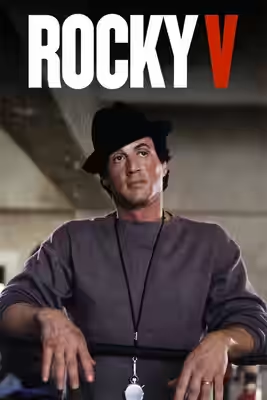
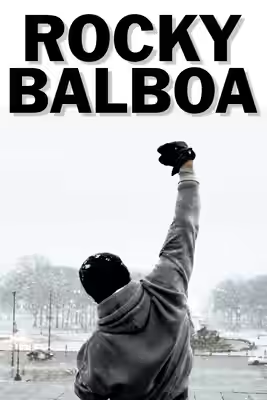
Release order is the safe choice for Rocky, and it is the order our collection page lists them in. Rocky IV is number 4 of the 9 Rocky titles on Fi1m; before it comes Rocky III and after it Rocky V. The full order.

Part of · 4 of 9

Rocky

9 films on Fi1m · 1976–2023 · average 68 · best Rocky 85

All 9 in order

Cast

If you liked this, try…

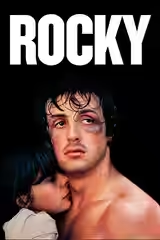
  1. Rocky (1976, Fi1m 85)The small, sweaty original, about a man who only wants to last fifteen rounds.

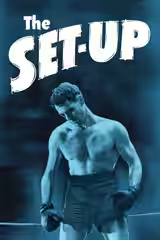
  2. The Set-Up (1949) · not reviewed yetRobert Wise’s 72-minute boxing noir, one bout in near real time, no montage required.

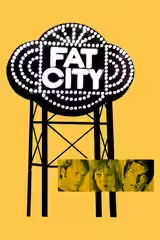
  3. Fat City (1972, Fi1m 73)John Huston’s fighters in Stockton, California, losing slowly; the honest version of this story.

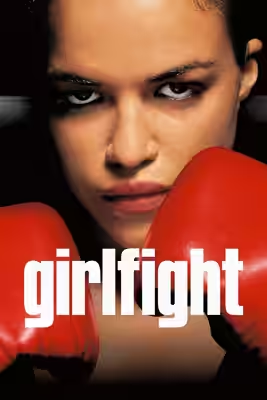
  4. Girlfight (2000) · not reviewed yetMichelle Rodriguez trains in a Brooklyn gym; the boxing picture with a person in it.

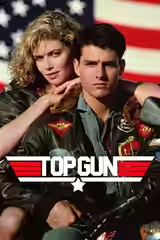
  5. Top Gun (1986, Fi1m 71)The other great Reagan-era poster film: same flags, same synthesisers, jets instead of gloves.

Free account

Know what to watch tonight

Two lists that know where things are streaming, collections you can share, your own score beside ours, and Discover that remembers what you have seen.

  • Want to see, sorted by what is streaming now
  • Seen, with your score out of ten
  • No adverts, ever