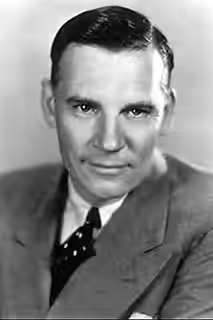
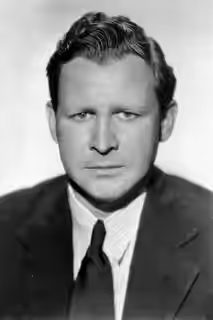
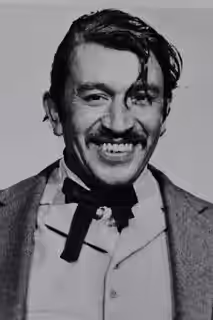
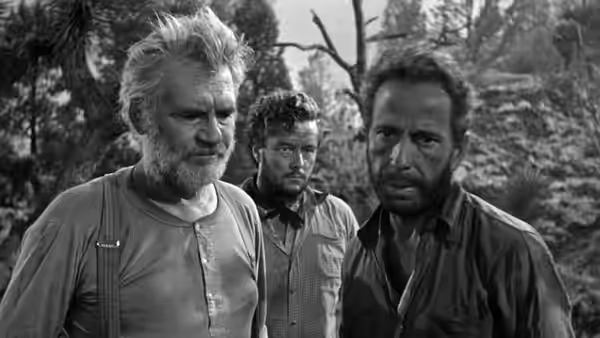
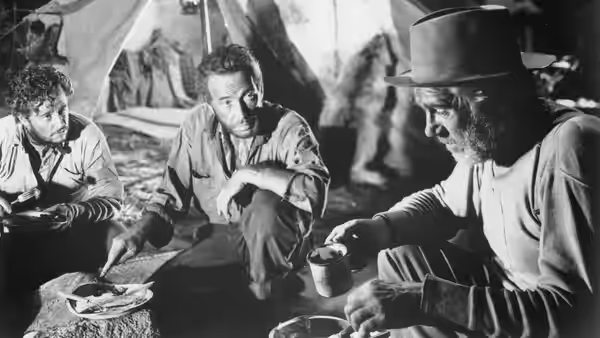
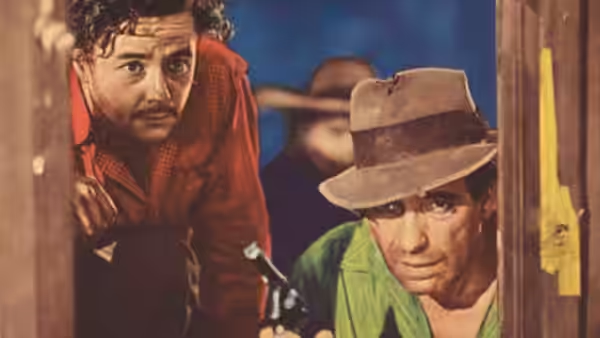
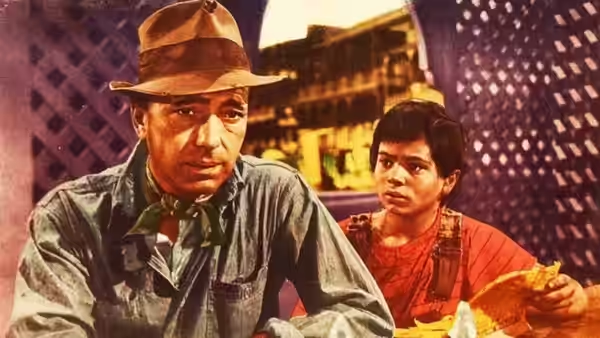
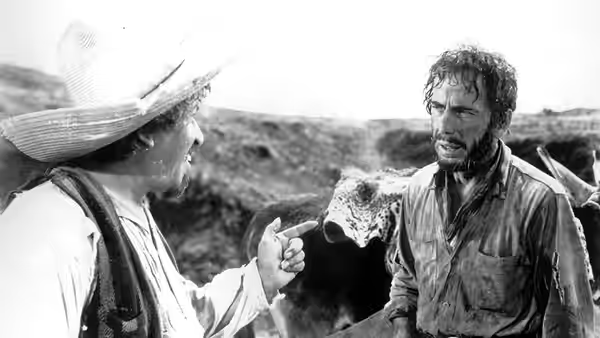
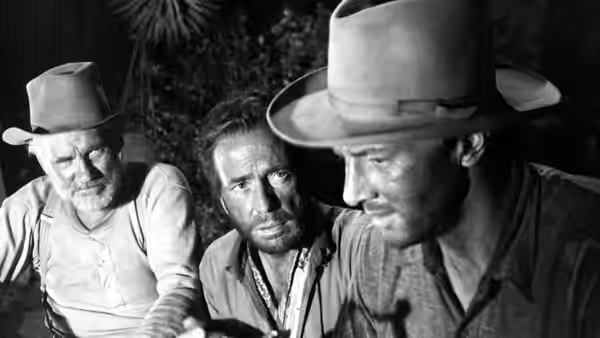
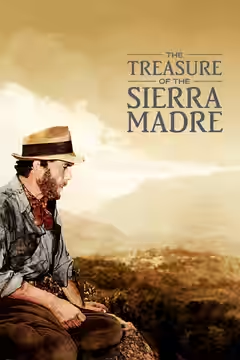
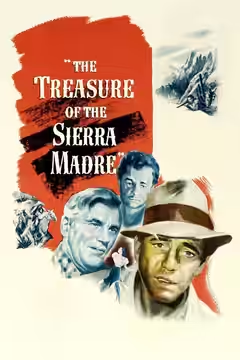
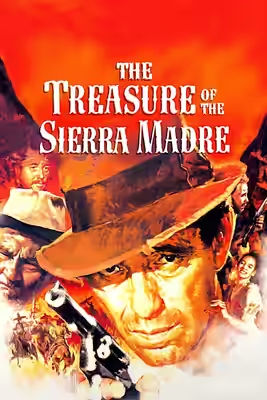
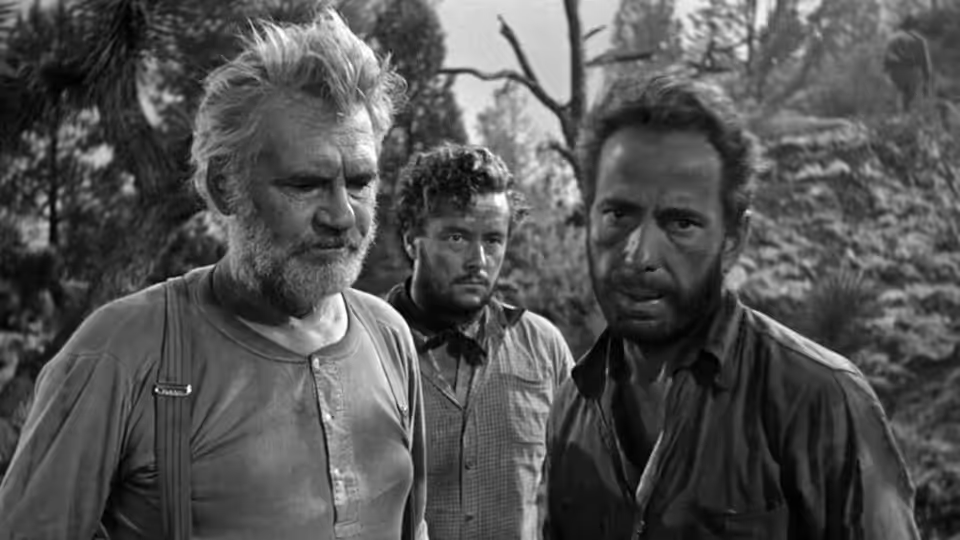
Howard (Walter Huston), Bob Curtin (Tim Holt) and Fred C. Dobbs (Humphrey Bogart) standing together outdoors
Film review

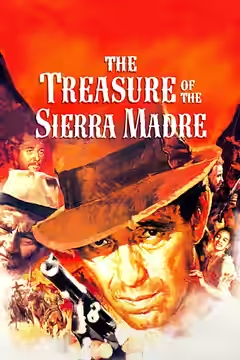
The Treasure of the Sierra Madre

1948 · Directed by John Huston · 2h 06m · MPA NR

In a sentenceGold prospecting looks hard enough without having to trust Humphrey Bogart with the proceeds

Fred C. Dobbs (Humphrey Bogart) joins Bob Curtin (Tim Holt) and the experienced Howard (Walter Huston) in a search for gold. Their venture brings together three men with different temperaments and a shared hope of making their fortune. Howard knows prospecting and has his own views about what money does to people; Dobbs and Curtin must decide how much to trust him and each other. John Huston writes and directs this adventure drama, adapted from B. Traven’s novel, in which the prospect of wealth gives the men as much to worry about as to look forward to.

Plays from YouTube when you press play; nothing loads from them until then.

Fi1m review

John Huston’s gold-prospecting adventure is tense, funny and unusually frank about how people excuse their own greed. Humphrey Bogart and Walter Huston make its occasional lecturing worth forgiving; we recommend it warmly.

John Huston’s The Treasure of the Sierra Madre is a tense, funny adventure that makes the search for gold seem tempting and a thoroughly bad idea. Three prospectors want to make their fortune, a plan simple enough to leave room for the difficult business of getting along. Huston writes as well as directs, adapting B. Traven’s novel, and his great strength is his interest in these particular men. We recommend it warmly, with a reservation about how often it explains what they have already shown us.

Bogart’s Fred C. Dobbs is the chief reason their company becomes so uncomfortable. His performance allows us to follow a selfish man’s reasoning without asking us to approve of it, and he makes suspicion seem horribly easy to acquire. We were unsettled by Bogart’s self-righteousness: Dobbs sounds most dangerous when he seems convinced he is being sensible. Bogart does not soften that unpleasantness to keep us fond of him, and the performance is gripping because he allows the character to be such poor company.

Walter Huston’s Howard gives the film much of its humour, with the energy of someone who knows more than his companions and sees no reason to conceal it. His experience as a prospector makes the advice worth hearing, though there is also pleasure in how freely he offers it. Tim Holt, as Bob Curtin, has the less showy part, and his steadiness is important. He keeps the exchanges between these men from becoming a contest between two conspicuous performances. Their differing temperaments make the partnership believable even when agreement seems a considerable effort.

Ted D. McCord’s cinematography makes good use of the location shooting without turning the expedition into sightseeing. The rough surroundings make getting rich look like work. That matters in a story which could otherwise become three actors discussing a moral problem: the physical difficulty makes their hopes of a fortune easier to understand. Owen Marks’s editing gives the action its snap while allowing the disagreements room to develop. The conversations remain worth following because we are watching men assess one another, with money giving them reason to pay attention.

The reservation is with John Huston’s screenplay when it insists on spelling out what greed does. We grasp the danger early, and another explanation cannot always deepen it. Howard’s philosophical manner is convincing because Walter Huston makes it part of the man’s personality, but even good company can talk too much. Steiner’s music can be more insistent than these performances need, pressing feelings that the actors have already made clear. These are occasional irritations rather than reasons to lose interest, though a little less emphasis would have made the film more disturbing.

There is enough danger and humour here to satisfy anyone who comes for a western adventure rather than a lesson. Huston is refreshingly doubtful that wanting to get rich makes a man admirable, and he does not require us to admire his prospectors before taking an interest in them. Their determination is understandable even when their judgement is difficult to defend. Choose it for Bogart and Walter Huston, with a little patience for the speeches.

Critical consensus AI synthesised

82
Positive
5
Mixed
1
Negative
0

Most critics regard The Treasure of the Sierra Madre as a forceful study of greed, with praise centred on John Huston’s writing and direction and the performances of Humphrey Bogart and Walter Huston. Bogart’s portrayal of suspicion and moral deterioration draws particular attention, while Walter Huston’s philosophical prospector earns approval even from a sceptical review. The location shooting and convincing atmosphere also feature repeatedly, giving the adventure the realism that admirers find essential to its treatment of human weakness.

The disagreement concerns how much the film has to say about greed, and how persuasively it says it. The New Yorker finds the message simplistic and the direction sluggish, though it praises Walter Huston; Time Out sees pretension getting in the way of an enjoyable yarn. The spread is therefore broad: most find the drama searching and honest, while dissenters question its seriousness and pacing.

Empire
1 January 2000 · David Parkinson
90*

The critic hails the film as a brilliant and sobering study of avarice, crediting John Huston with coaxing outstanding performances from the cast in a gritty location-shot production. Bogart's turn as the corrupted prospector is singled out as one of his most effective.

Read the full review →
RogerEbert.com
12 October 2003 · Roger Ebert
90*

Ebert praises the film's exploration of greed and character through adventure, highlighting Walter Huston's masterful performance as the wise prospector and Bogart's fearless portrayal of a man descending into madness. He singles out the stark realism and honesty in the closing scenes as bringing the story to truth.

Read the full review →
Variety
6 January 1948 · Herm Schoenfeld
90*

Schoenfeld hails the film as a distinguished and radically different achievement with compelling honesty and powerful authenticity from location shooting and realistic focus. He singles out the grim ironic twist at the end and the superbly balanced cast, especially Walter Huston's energetic performance.

Read the full review →
The New York Times
24 January 1948 · Bosley Crowther
85*

Crowther lauds the film's originality, maturity, and ruthless realism in depicting greed with ironic contempt, crediting Huston's direction and script for a searching drama. He singles out Bogart's performance as his best and most substantial, noting the vivid and exciting action display.

Read the full review →
The New Yorker
17 January 1948 · John McCarten
45*

McCarten finds the film's simple message on greed unconvincing and its direction disappointing and moping compared to Huston's earlier work, despite authentic atmosphere. He singles out Walter Huston's convincing performance as the philosophical prospector for praise amid otherwise uneven execution.

Read the full review →
Slant Magazine
10 October 2010 · Rob Humanick

The critic calls the film one of the most insightful ever made about greed and the effects of temptation on human nature, praising its universal indictment of the profit motive and strong performances, especially Bogart's portrayal of a man destroyed by paranoia.

Read the full review →

Straight answers AI written, from our review

Is The Treasure of the Sierra Madre worth watching?
The Treasure of the Sierra Madre is worth watching for anyone who likes a tense, funny adventure with a hard eye on greed, and we scored it 88. Humphrey Bogart and Walter Huston carry it; the reservation is that John Huston's screenplay sometimes explains what the actors have already shown. Come for the performances and forgive the speeches.
How long is The Treasure of the Sierra Madre, and what is it rated?
The Treasure of the Sierra Madre runs 2h 06m and is rated NR by the MPA in the US. It is an adventure and drama film.
Where can I watch The Treasure of the Sierra Madre in the US?
The Treasure of the Sierra Madre is not on any streaming or rental service in the US at the moment. It is available in 1 other country; change your country at the top of the page to see where. Availability is checked daily.
How does The Treasure of the Sierra Madre compare to The Wages of Fear?
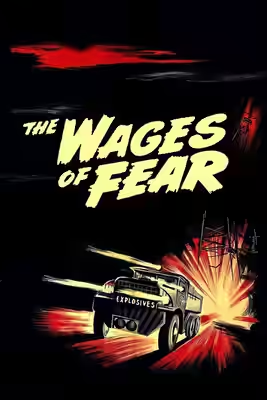
The Treasure of the Sierra Madre and The Wages of Fear are both about a dangerous job in which the promise of money makes companions harder to trust. Huston's film is the warmer and funnier of the two, more interested in its men's characters than their peril. Clouzot's is the tighter, more frightening thriller, though its long wait in town asks for patience of a different kind.
Is The Treasure of the Sierra Madre based on a true story or a book?
The Treasure of the Sierra Madre is adapted from B. Traven's novel, not from a true story. John Huston wrote the screenplay himself, and his interest in these particular prospectors is the film's great strength. You do not need to know the book; the film explains its view of greed fully, and if anything a little too often.
What should I watch after The Treasure of the Sierra Madre?
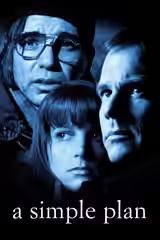
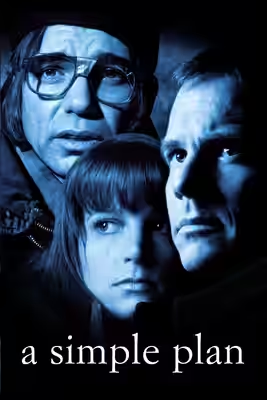
After The Treasure of the Sierra Madre, try The Wages of Fear (1953, Fi1m 90): Another dangerous job where the prospect of money makes companionship increasingly difficult. Then Le Trou (1960, Fi1m 88): Patient attention to practical work makes the question of trust painfully important; and A Simple Plan (1998, Fi1m 86): Ordinary people discover how much explaining apparently easy money can require.

Cast

Awards

Academy Awards, 1949

Nominated
Best Picture
Won
Best Director
Won
Best Supporting Actor
Won
Best Writing, Adapted Screenplay

If you liked this, try…

  1. The Wages of Fear (1953, Fi1m 90)Another dangerous job where the prospect of money makes companionship increasingly difficult.

  2. Le Trou (1960, Fi1m 88)Patient attention to practical work makes the question of trust painfully important.

  3. A Simple Plan (1998, Fi1m 86)Ordinary people discover how much explaining apparently easy money can require.

  4. Theeb (2014, Fi1m 80)Desert adventure with watchful performances and good reasons to mistrust a stranger.

  5. The Pearl (1947) · not reviewed yetA hoped-for fortune brings trouble in another unsentimental story about wealth.

Free account

Know what to watch tonight

Two lists that know where things are streaming, collections you can share, your own score beside ours, and Discover that remembers what you have seen.

  • Want to see, sorted by what is streaming now
  • Seen, with your score out of ten
  • No adverts, ever