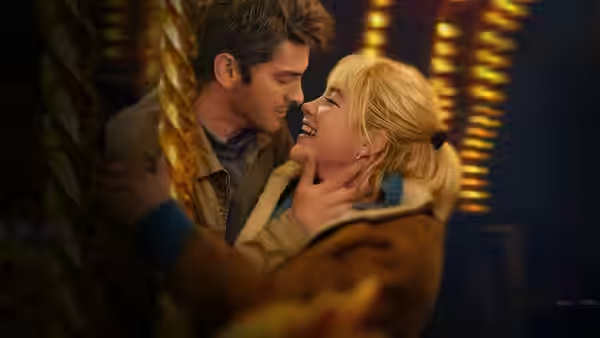
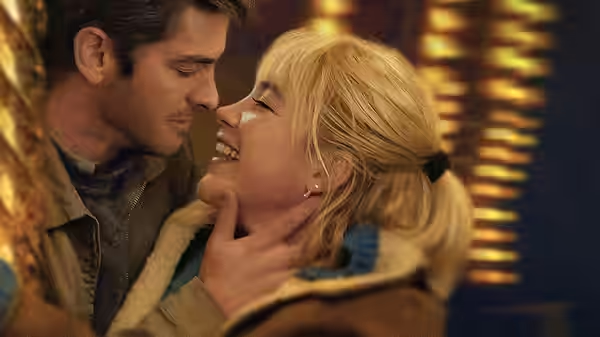
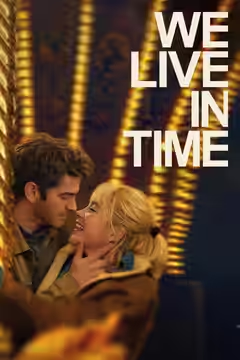
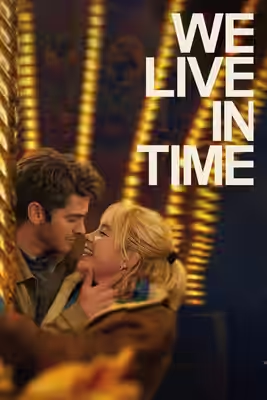
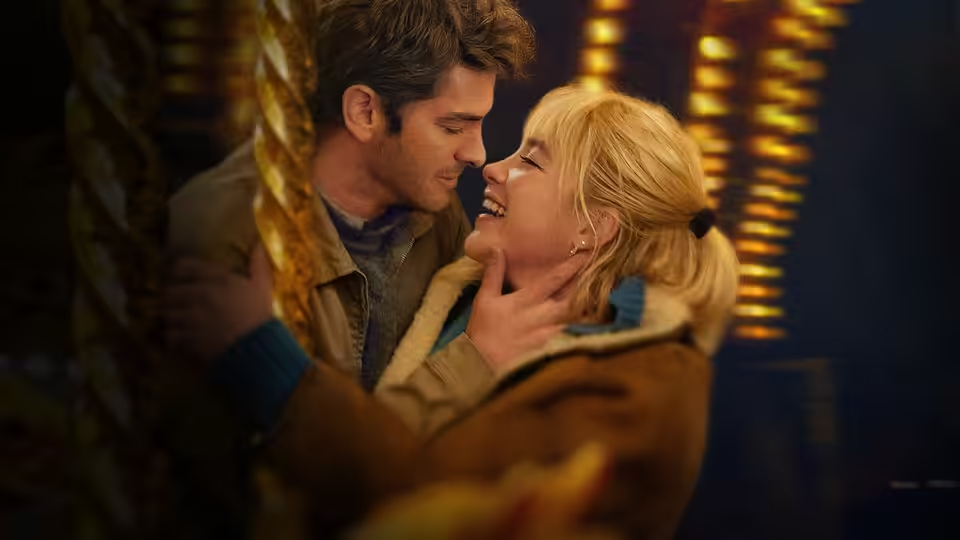
Tobias (Andrew Garfield) and Almut (Florence Pugh) touch foreheads during an intimate embrace
Film review

We Live in Time

2024 · Directed by John Crowley · 1h 48m · MPA R

In a sentenceTwo fine actors, one petrol station toilet, and a script that keeps changing the subject

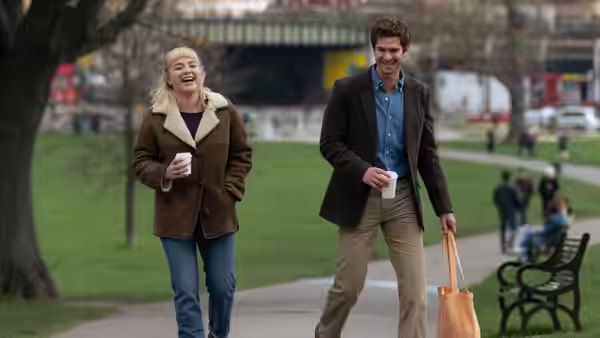
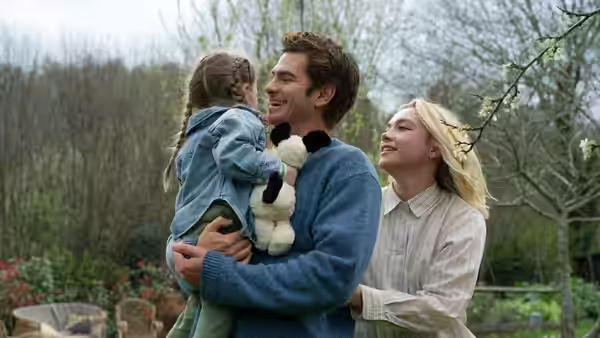
Tobias Durand (Andrew Garfield) is a man in London in the middle of a divorce who is knocked down one night by a car. The driver is Almut Brühl (Florence Pugh), a chef with a restaurant to run and little patience for apology. John Crowley’s film, written by Nick Payne, follows the two of them across about a decade, but not in order: it cuts between their first weeks together, the arrival of their daughter Ella (Grace Delaney), and a hospital appointment at which Almut is given a diagnosis and asked how she wants to spend the time she has. Douglas Hodge, Niamh Cusack and Adam James fill in family and work; Lee Braithwaite and Aoife Hinds are the friends and colleagues around the couple.

Plays from YouTube when you press play; nothing loads from them until then.

Fi1m review

Pugh and Garfield are the film, and they are good enough to make you forget, for minutes at a time, how ordinary the story around them is. Crowley’s shuffled timeline hides that ordinariness rather than deepening it, and we came out feeling handled.

John Crowley made Brooklyn (2015), which told a plain story in order and trusted it. We Live in Time, written by the playwright Nick Payne, is a plainer story still. Almut (Florence Pugh), a chef, knocks Tobias (Andrew Garfield) down with her car one night. They fall in love, argue about children, have a daughter, and somewhere in there Almut is told she has cancer. Payne deals these years out shuffled, so that a hospital consultation sits beside a first kiss and a child’s birthday beside a chemotherapy chair. The idea is that a love looked at from every end at once will show us something a straight telling would not. The film has the idea and does not do much with it.

What it does have is the two of them. Pugh plays Almut as somebody who works with knives for a living and talks the same way: quick, unsentimental, quite unwilling to be admired for being ill. She does not soften as the news gets worse, and the film is at its most honest when it lets her be difficult about it. Garfield’s Tobias is the sort of man who reads the leaflet before he takes the tablet, and Garfield gets a great deal out of a face that hears bad news and rearranges itself while we watch. Their early argument about whether they want children is the best-written scene in the film: two people who had each assumed the other agreed with them, finding out otherwise.

Then there is the birth. It happens in a petrol station toilet, with Garfield taking instructions shouted through the door and Pugh on the floor telling everyone to shut up, and for about five minutes the film stops arranging itself and simply happens. We laughed, and then we were crying, and we had not seen either one coming. It is the one stretch of the 108 minutes that does not feel arranged. Justine Wright then cuts to a different year, as the structure requires, and the feeling drains out.

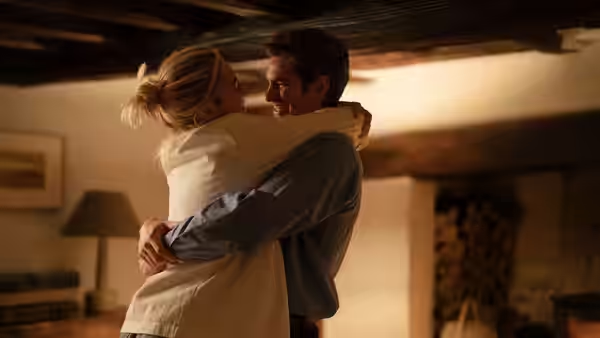
Stuart Bentley shoots London in low warm light, table lamps and kitchen extractors and late sun through blinds, and keeps the focus shallow so the backgrounds go to soft colour and the faces sit in front of them like portraits. It is handsome and it is never once surprising; every room looks like the same expensive candle. Alice Normington’s flats and restaurant kitchens are lived in without being untidy. Liza Bracey keeps Almut in whites and outsized coats and Tobias in cardigans, which tells you who is who before either speaks. Bryce Dessner’s score is piano and strings, and it arrives, on cue, at the point in each scene where the actors might have been left to finish it themselves.

The trouble is the shuffle. Payne’s play Constellations put the same two people through dozens of versions of the same conversation, and the repetition was the meaning. Here there are no versions, only one story dealt out of sequence, and nothing we learn in a later year changes what we saw in an earlier one. After a while we could feel the cuts coming: a scene would start to hurt and the film would leave it for somewhere safer. The structure does not sharpen the story; it numbs it. There is also a breakfast cereal that turns up often enough that we started counting the boxes, which is not the state of mind a film about dying should leave you in.

The back half hands Almut a decision about her work that the film plainly wants us to find brave. We will not describe it. We will say that we did not believe it, that it is the kind of choice a screenplay makes so its last act has somewhere to go, and that Pugh has to carry it almost alone against the writing. She nearly does. Adam James, Douglas Hodge and Niamh Cusack fill in a family and a workplace with the few lines each is given, and Grace Delaney, as Ella, is allowed to be a child rather than a symbol.

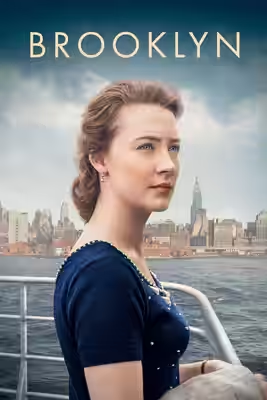
Brooklyn trusted us to feel a story told straight. This one trusts the edit instead, and the edit keeps intervening. See it for Pugh and Garfield, who are worth the evening, and for one toilet floor in a petrol station. By the end we felt handled, and we could name the cuts that did it. It runs 108 minutes and carries a 15 certificate.

Critical consensus AI synthesised

63
Positive
10
Mixed
3
Negative
5

The reviews split, and widely. Most critics agree on one thing: Florence Pugh and Andrew Garfield are the reason to watch, and their chemistry carries scenes that might otherwise tip into cliché. Pugh draws particular praise, with several critics noting how she plays a woman who stays ambitious while facing her own mortality. Beyond the leads, the consensus frays. The non-linear structure is the main dividing line: admirers say it lets the relationship be seen whole and keeps the story unpredictable; detractors call it contrived, gimmicky and a way of disguising a conventional terminal-illness weepie. Complaints about sentimentality recur across the mixed and negative notices. The Telegraph goes furthest, finding the leads lack chemistry, which almost no one else says. The Guardian objects to product placement and a bland score, and The i Paper finds the film’s conclusions regressive. The early festival notices are markedly warmer than the later British ones.

The Hollywood Reporter
7 September 2024 · festival review · Michael Rechtshaffen
85*

The critic praises the achingly resonant performances of Pugh and Garfield and the thoughtful, non-linear structure that creates poignant moments in this romantic drama about a couple facing cancer.

Read the full review →
Empire
1 January 2025 · Amon Warmann
80*

The non-chronological structure adds unpredictability to the weepy romcom, and the straightforward story packs a punch thanks to powerhouse performances. Pugh and Garfield are a force with abundant chemistry in this likably earnest, satisfyingly complicated love story.

Read the full review →
Little White Lies
6 January 2025 · 3/4/3 · Mark Asch
80

The critic sees it as every generation getting the cancer romance it deserves, a brutally efficient but aggressively middlebrow and forgettable tearjerker. Pugh's driven performance gives the melodramatic scope some substantial appeal amid the structural manipulation.

Read the full review →
Time Out
13 December 2024 · ★★★★ · Helen O’Hara
80

The critic praises the honest London romance in which Garfield and Pugh break your heart, with the time-hopping structure adding value by letting viewers consider the relationship in its totality. Strong performances keep scenes free from cliché and make the film feel real and honest.

Read the full review →
Evening Standard
18 October 2024 · festival review · Tom Davidson
75*

It would take a heart of stone to be unmoved by this saccharine time-hopping tearjerker, with Pugh and Garfield on knockout form and their intimacy captured frankly. The structure keeps viewers on their toes, and certain sequences may leave audiences sobbing.

Read the full review →
Variety
6 September 2024 · festival review · Peter Debruge
60*

The critic praises the genuine chemistry between leads Florence Pugh and Andrew Garfield but finds the nonlinear structure contrived and the cancer drama manipulative, reducing it to a run-of-the-mill story despite strong performances.

Read the full review →

Straight answers AI written, from our review

Is We Live in Time worth watching?
We Live in Time is worth watching for Florence Pugh and Andrew Garfield, who are better than the film around them, and we scored it 58. Nick Payne's shuffled timeline keeps cutting away from scenes just as they start to hurt, and the last act asks Pugh to carry a decision we did not believe. Go for the two leads and a birth in a petrol station toilet, not for the story.
How long is We Live in Time, and what is it rated?
We Live in Time runs 1h 48m and is rated R by the MPA in the US. It is a romance and drama film.
Where can I watch We Live in Time in the US?
We Live in Time is streaming on Apple TV in the US, and it is also available to rent from Amazon Prime Video and Apple TV from $4.99. Availability is checked daily; the links above go straight to each service.
How violent or frightening is We Live in Time, and is it suitable for children?
We Live in Time is not a violent or frightening film, but it carries a 15 certificate in the UK and is not for children. Its subject is a woman's cancer, and it spends time in consulting rooms and beside a chemotherapy chair, with a rough, funny birth on a toilet floor along the way. Teenagers who can sit with a story about dying will be fine; the squeamish have nothing to fear.
What should I watch after We Live in Time?
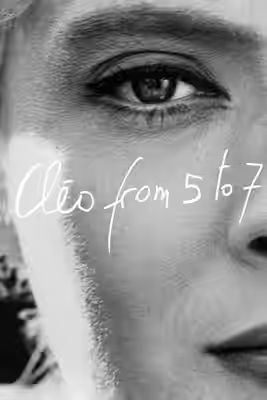
After We Live in Time, try Blue Valentine (2010, Fi1m 82): Two timelines of one marriage, and not a single lamp is flattering. Then Cléo from 5 to 7 (1962, Fi1m 88): Ninety minutes of a woman in Paris waiting for a result; nothing is shuffled; and Brooklyn (2015, Fi1m 83): Crowley telling one story straight, and trusting Saoirse Ronan’s face to carry it.

Cast

If you liked this, try…

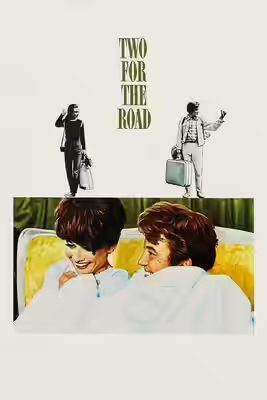
  1. Two for the Road (1967) · not reviewed yetA marriage told out of order, on French roads, with jokes that still land.

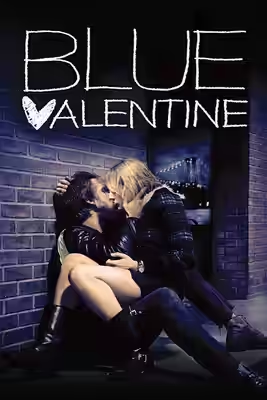
  2. Blue Valentine (2010, Fi1m 82)Two timelines of one marriage, and not a single lamp is flattering.

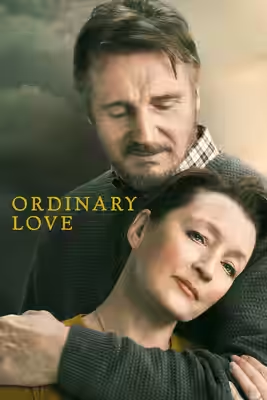
  3. Ordinary Love (2019) · not reviewed yetManville and Neeson face a diagnosis in Belfast, in order, without music telling you when.

  4. Cléo from 5 to 7 (1962, Fi1m 88)Ninety minutes of a woman in Paris waiting for a result; nothing is shuffled.

  5. Brooklyn (2015, Fi1m 83)Crowley telling one story straight, and trusting Saoirse Ronan’s face to carry it.

Free account

Know what to watch tonight

Two lists that know where things are streaming, collections you can share, your own score beside ours, and Discover that remembers what you have seen.

  • Want to see, sorted by what is streaming now
  • Seen, with your score out of ten
  • No adverts, ever