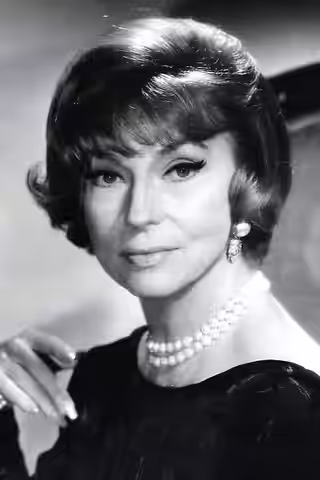
Agnes Moorehead's best work is women who want something they cannot ask for, and she plays it through the hands and the voice rather than the face. She had one great part, Fanny in The Magnificent Ambersons, and thirty years of narrower versions of it.
Fi1m perspective
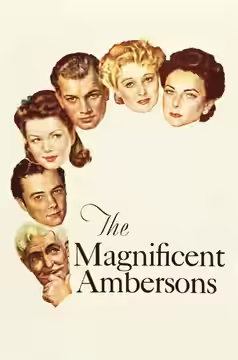
Late at night in the Amberson kitchen, Fanny Minafer feeds her nephew strawberry shortcake and asks who Eugene danced with. Every question is about something else. Stanley Cortez holds the pair of them in a single shot, George eating and Fanny hovering, and Moorehead does almost none of it with her face; it is in what her hands find to do and in where her voice settles, a shade too bright. It put a lump in our throat we had not planned on, because nothing happens except that a woman gives herself away to a boy who is not listening. That scene is the whole of what Moorehead did best: a woman who wants something, refusing to ask for it.
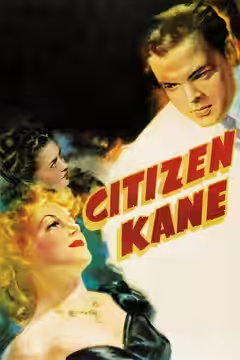
She came to pictures from the radio and the stage, joining Orson Welles's Mercury Players in 1937 and going west with them. Her first film part was Mary Kane in Citizen Kane (1941), a few minutes as Kane's mother on which the film's account of the man depends. Our review does not single her out, and that is not a slight; she was one of Welles's instruments, and he handed her the awkward ones. "He thought I could play anything," she said of him. "If it was a strange part, he said, 'Give it to Agnes. She can play it.'" She made four films with Welles and three with Joseph Cotten, and Fanny in The Magnificent Ambersons (1942) is the one that used everything she had.
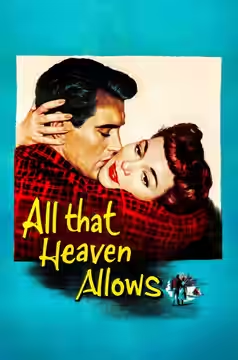
What followed was thirty years of supporting parts, and the parts narrowed. Madge Rapf in Dark Passage (1947), Sara Warren in All That Heaven Allows (1955), the housekeeper Velma Cruther in Hush... Hush, Sweet Charlotte (1964): strong women, haughty women, neurotic women, meddling spinsters, the sort of role a producer reaches for when the script needs somebody unsettling in the second half. She was good at them, and the radio training showed in the diction; she could pitch a voice for almost any age. But Fanny was never an eccentric. She was an ordinary woman in agony, and the later parts kept Moorehead's sharpness and mislaid the ache.
Then came Endora in Bewitched (1964–1972), the television role that reached far more people than any of her films did. There are worse fates. If you know her only from there, go back to the Amberson kitchen and watch what she does with a plate of shortcake and a question she cannot ask. It is the finest thing in a film we rate among the best America has made, and it is over before you have worked out what she was doing.
Biography
Agnes Moorehead was an American actress. She joined Orson Welles’s Mercury Theatre in 1937 and made her film debut as Mary Kane in Citizen Kane (1941). Over a career spanning five decades she worked in radio, stage, film and television, appearing in more than seventy films.
Moorehead is best known for playing Endora in the television series Bewitched (1964–1972). She received one Primetime Emmy Award and two Golden Globe Awards, and was nominated four times for the Academy Award for Best Supporting Actress.