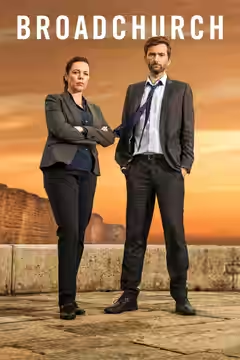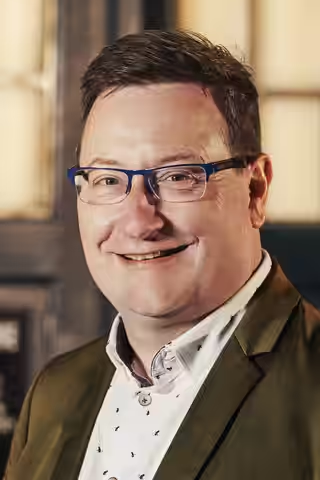
Chris Chibnall writes crime as a town watching itself. At his best, in the first series of Broadchurch, the grief matters more than the puzzle; away from small communities, on Doctor Who and the weaker Torchwood hours, the structure shows and the people thin.
Fi1m perspective
Chris Chibnall's best hour of television begins with a plumber saying good morning. Mark Latimer crosses a small Dorset town at the start of Broadchurch (2013), greeting the shops, the hotel and the church, and by the end of the episode a boy is dead at the foot of the cliffs and every face he greeted is a suspect. That is the Chibnall move: a community shown whole, then a crime, then eight hours of watching the community look at itself. He is not much interested in who did it. He is interested in the local paper deciding what to print and neighbours crossing the street to avoid each other.
He came to that late. He started as a playwright on the Edinburgh Fringe, entered television with Born and Bred (2002), then spent the middle of the decade writing for other people's programmes: episodes of Life on Mars (2006), the first two series of Russell T Davies's Torchwood (2006), then Law & Order: UK (2009) and Camelot (2011). Much of the Torchwood he oversaw is a teenager's idea of grown-up, and it embarrassed us slightly. His own episode Countrycide, which sends the team into the Brecon Beacons, is the exception, nasty enough to earn the certificate by itself, and it is the first sign of the writer who would make Broadchurch: a small place, something terrible in it, ordinary people at the door.
What he does well is build. He works in four acts with a cliffhanger every twelve minutes, and he can hold an ensemble together across years. Olivia Colman is the reason the first series of Broadchurch holds, with David Tennant opposite her, and Chibnall gives them both something to do in every scene rather than a speech every third episode. When the third series (2017) turned to an assault on a grown woman, he researched it with survivors and wrote it plainly, and Julie Hesmondhalgh played it the same way. It moved us more than we expected, because the programme declined to decorate anything she did.
What he does less well is let go of the machinery. The second series of Broadchurch (2015) moved to the trial and lost the town, and the structure that had carried grief now carried only twists. The same complaint followed him to Doctor Who (2018–22), where he ran the programme for three series with Jodie Whittaker: most critics found the characters thin and the reveals abrupt, and the complaint has a familiar shape. Cliffhangers are a means. When the community goes, they are all that is left.
He has since gone back to crime, with a novel, Death at the White Hart (2025), and an adaptation of Agatha Christie's The Seven Dials Mystery (2026). On the evidence of everything he has written, that is the right place for him.
Biography
Chris Chibnall is an English television writer and producer. He studied drama at St Mary's University, Twickenham, and later gained an MA in Theatre and Film from the University of Sheffield. His early career included work as a football archivist and floor manager for Sky Sports, followed by administrative roles with theatre companies including Complicité.
Chibnall's television work includes writing episodes of Life on Mars (2006–07). He created and wrote the ITV crime drama Broadchurch (2013–17) and served as showrunner of Doctor Who (2018–22), having previously written five episodes of the series and acted as head writer on the first two series of Torchwood (2006–08). Other credits include Born and Bred (2002–05), Law & Order: UK (2009) and The Great Train Robbery (2013).