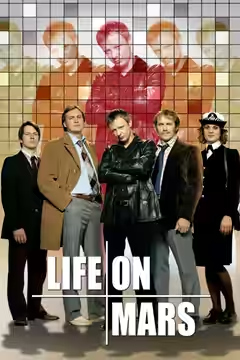
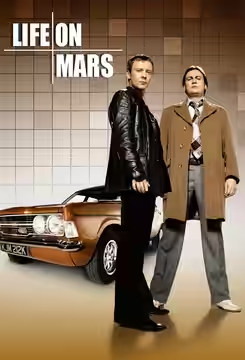
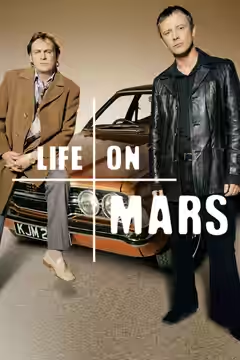
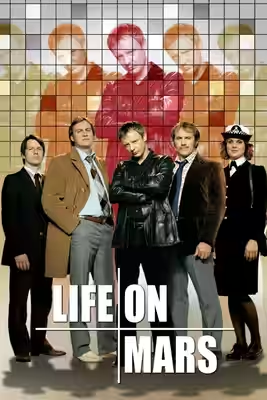
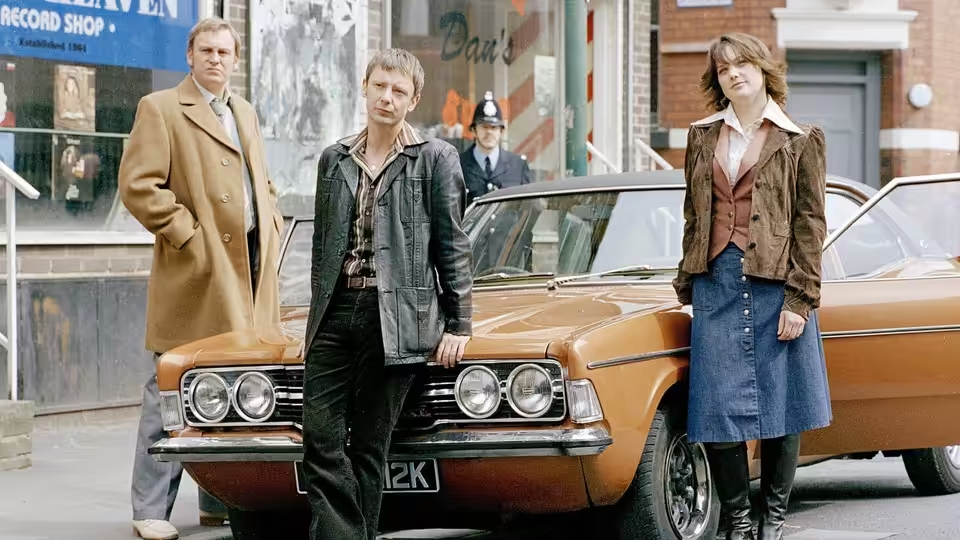
Gene Hunt (Philip Glenister), Sam Tyler (John Simm) and Annie Cartwright (Liz White) beside an orange car
Series review

Life on Mars

2006 · Created by Matthew Graham, Ashley Pharoah, Tony Jordan · Series · 1h 00m · MPA TV-14

In a sentenceBeing trapped in the past would be easier if Gene Hunt occasionally doubted himself

Detective Sam Tyler (John Simm) appears to have travelled back in time. He has other explanations to consider: he may be in a coma, or his mind may be deceiving him. Unable to settle which is true, he faces a mystery that concerns his own existence as well as his work as a detective. Philip Glenister plays Gene Hunt, with Liz White as Annie Cartwright, Dean Andrews as Ray Carling and Marshall Lancaster as Chris Skelton. The crime drama follows Sam as he tries to understand what has happened to him.

Fi1m review

A gripping crime series whose time-travel mystery has consequences we can feel. John Simm and Philip Glenister make a compelling pair, even when the police stories and the arguments between them begin to repeat.

Life on Mars is a gripping crime series with a clever enough premise to survive some ordinary police stories. Detective Sam Tyler appears to have travelled back in time, although a coma or a crisis in his own mind might explain what is happening. Writers including Matthew Graham, Ashley Pharoah and Tony Jordan give him a problem that his professional training cannot resolve. The uncertainty makes even the familiar business of detection feel unsafe.

John Simm gives Sam enough strain and irritation to keep this from becoming a cheerful excursion into the past. We found his uncertainty unsettling, because a man trained to establish facts cannot establish the most basic fact about his own life. Simm makes that predicament feel tiring, and his seriousness gives the stranger material weight. He can also be a rather dutiful centre to the programme, especially when the writing leaves him reacting to stronger personalities. His performance is most persuasive when the need to understand feels urgent.

Philip Glenister’s Gene Hunt is the stronger personality, and the programme knows it. Glenister gives him such certainty that even an unreasonable position sounds, briefly, like the end of the discussion. The pleasure of watching him creates a problem: Hunt can become so entertaining that the objections to his attitudes struggle to hold our attention. We do not need the programme to interrupt every joke with a correction, but it sometimes lets his force of personality settle a disagreement that deserved more thought.

The cinematography team, including Balazs Bolygo and Tim Palmer, makes the period surroundings persuasive enough to account for some of that temptation. The images encourage us to enjoy looking backwards, even while Simm makes being there seem distressing. The editing team, which includes Sarah Brewerton and Barney Pilling, keeps the police investigations moving alongside the questions about Sam’s condition. The shifts between the two are usually brisk enough to sustain our interest, though the move from casework to personal mystery can sometimes feel awkward.

The weaker stretches belong to investigations and exchanges that return Sam and Hunt to familiar positions. Once we recognise how an argument is likely to go, another round brings little surprise. The writing team gets more mileage from the uncertain premise than from every individual case, and there are moments when we are plainly waiting for the larger mystery to resume. It is a real limitation for a crime drama, even one with this much else to keep us occupied.

The series nevertheless gives us more reason to worry about its detective than a procedural usually manages. Sam’s predicament makes his judgement, his temper and his ability to keep working matter when nothing around him feels dependable. The science-fiction element stays engaging because it affects his daily experience without requiring a separate lesson in how time travel works. Simm’s anxious presence makes the combination convincing, including those stretches when the case itself looks routine.

Across two series of eight episodes apiece, the central uncertainty has room to sustain more than an initial burst of curiosity. The ordinary police stories are a caveat, particularly for anyone chiefly interested in the procedural side, but they never cancelled our concern for Sam. We recommend it for the uneasy company of Simm and Glenister, whose performances make even the repeated disagreements worth hearing. Leave room for a second episode before starting the first.

Critical consensus AI synthesised

75
Positive
7
Mixed
1
Negative
0

Most critics like it, and the praise falls in the same places. The premise, a detective knocked back to 1973, is judged clever not for its mechanics but for what it lets the series say about memory, nostalgia and how much Britain has changed. The recreation of the period is admired for its detail. Philip Glenister’s Gene Hunt is the performance nearly every review names, and the relationship between Hunt and Sam Tyler is picked out as the thing holding the show together.

The reservations are few. Sam divides the reviews: Variety finds the lead somewhat bland and The AV Club, the one mixed notice, thinks his character moments are weaker and the time-travel threads sometimes clumsily handled, while Collider finds John Simm’s performance captivating. Radio Times admits to some queasiness at Hunt’s attitudes. The spread is narrow, and the retrospective reviews written years later are warmer than the ones from 2006.

The Guardian
10 January 2006 · Sam Wollaston
90*

The critic finds the time-travel police drama a rich combination of nostalgic romp, gripping procedural and mind-bending premise that hooks the viewer. The detailed 1973 production design and strong central performances are singled out for praise.

Read the full review →
Empire
26 May 2006 · Dorian Lynskey
70*

The critic finds the time-travel premise a clever ploy to explore memory, history and nostalgia without getting bogged down in mechanics, praising the deft recreation of a very different 1970s Britain and Philip Glenister's authentic performance as Gene Hunt.

Read the full review →
Radio Times
· David Brown
70*

The critic calls it a crime drama with the highest of high concepts, noting how Gene Hunt epitomises the blinkered thinking of the past while acknowledging the ingenious premise remains undiminished despite some queasiness looking back.

Read the full review →
Variety
23 July 2006 · Brian Lowry
70*

The critic describes the series as the TV equivalent of a page-turner whose audacious concept keeps it lively and elevates cop drama to a surreal level, singling out the compelling mystery and atmosphere as key strengths despite a somewhat bland lead.

Read the full review →
The AV Club
12 December 2007 · B/B+ · Noel Murray
50*

The episodes mix routine police procedural elements with time-travel plot threads that feel clumsily handled at times. The critic highlights Gene Hunt's compelling presence and memorable lines as a standout strength amid some weaker character moments for Sam.

Read the full review →
Collider
25 March 2026 · Kelcie Mattson
90*

The critic calls the BBC series a quietly brilliant cult classic and one of Stephen King's all-time favorites, praising its inventive genre-blending fusion of mystery, psychological thriller, period drama, and sci-fi elements along with John Simm's captivating performance.

Read the full review →

Straight answers AI written, from our review

Is Life on Mars worth watching?
Life on Mars is worth watching for anyone who wants a crime series with a real mystery at its centre, and we scored it 84. John Simm and Philip Glenister make an uneasy, compelling pair, and the uncertainty over what has happened to Sam Tyler keeps ordinary casework feeling unsafe. The individual police stories and the arguments between the two men do repeat, which is a caveat for viewers chiefly after procedure.
How long is Life on Mars, and what is it rated?
Life on Mars has episodes of about 1h 00m and is rated TV-14 by the MPA in the US. It is a crime and drama series.
Where can I watch Life on Mars in the US?
Life on Mars is streaming on BritBox and The Roku Channel in the US. Availability is checked daily; the links above go straight to each service.
How violent or frightening is Life on Mars, and is it suitable for children?
Life on Mars carries a UK 15 certificate, so it is not for children and sits at the older end for teenagers. The series is a police drama about rough 1970s-style policing, with Gene Hunt's attitudes and methods often going unchallenged, and Sam Tyler's predicament is unsettling rather than frightening. Expect adult tone and language rather than horror.
How does Life on Mars compare to The French Connection?
Life on Mars and The French Connection both put a forceful, unrepentant policeman at the centre and let his methods pass with too little objection. The film is the leaner and more relentless of the two, a street thriller without the comfort of nostalgia; the series is warmer and more playful, and adds a mystery about its detective's own existence. Choose Friedkin for tension, the series for company.
What should I watch after Life on Mars?
After Life on Mars, try The French Connection (1971, Fi1m 85): Rough policing and a forceful central presence, without the comfort of nostalgia. Then Dark (2017, Fi1m 74): A more demanding time puzzle, held together by damaged family relationships.

Cast

Awards

Writers Guild of America Award for Television: New Series, 2009

Nominated
Writers Guild of America Award for Television: New Series

BAFTA Television Awards, 2008

Nominated
Best Drama Series

BAFTA Television Awards, 2007

Nominated
Best Actor

International Emmy Award for best drama series, 2006

Won
International Emmy Award for best drama series

If you liked this, try…

  1. The Prisoner (1967) · not reviewed yetFor a protagonist whose questions only make his surroundings more threatening.

  2. The French Connection (1971, Fi1m 85)Rough policing and a forceful central presence, without the comfort of nostalgia.

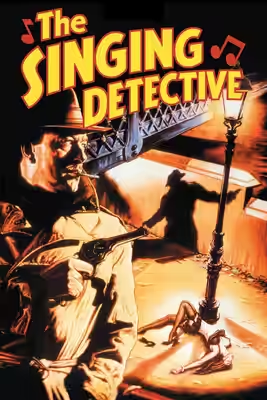
  3. The Singing Detective (1986) · not reviewed yetAnother troubled mind turns detective fiction into something painfully personal.

  4. Signal (2016) · not reviewed yetDetectives reach across time, with cases that make the connection matter.

  5. Dark (2017, Fi1m 74)A more demanding time puzzle, held together by damaged family relationships.

Free account

Know what to watch tonight

Two lists that know where things are streaming, collections you can share, your own score beside ours, and Discover that remembers what you have seen.

  • Want to see, sorted by what is streaming now
  • Seen, with your score out of ten
  • No adverts, ever