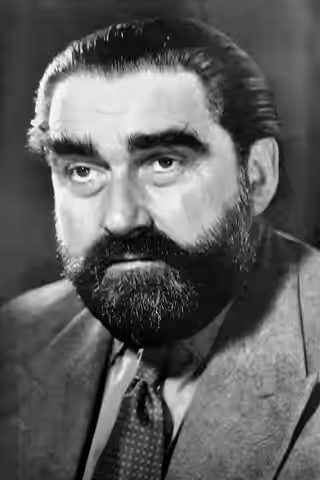
A big, bearded man with a deep, slow voice, Francis de Wolff spent thirty years being the Norman on the battlements, the gypsy chief and the Hammer heavy. He was seldom asked to do anything else, and what he was asked to do he did with weight.
Fi1m perspective
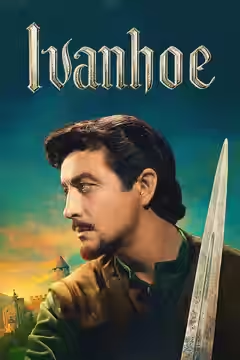
He is up on the wall. In Ivanhoe (1952) the ladders go up against Torquilstone, Robin of Locksley's archers loose from the trees, and Front De Boeuf roars down at them from the battlements, a large bearded man who looks as though he was there before the stones were. That is Francis de Wolff's method in a single shot: put the body in the frame, let the voice carry, do not wait for a close-up. Richard Thorpe's film leaves the acting to George Sanders and Elizabeth Taylor, and de Wolff is not competing with them. He is there to make the castle look defended.
He came to film from theatre and radio, and radio explains a good deal. The beetle brows and the beard got him cast; the voice got him kept. From the late 1940s he was a fixture in period adventures, Captain Gardiner in John Huston's Moby Dick (1956) among them, and once, in Scrooge (1951), he was allowed to be the Spirit of Christmas Present, a part that used his size for warmth rather than threat. Then Hammer found him, and The Hound of the Baskervilles (1959), with de Wolff as Dr Richard Mortimer, is the typical assignment: a supporting part in something atmospheric, standing in the fog and being ominous.
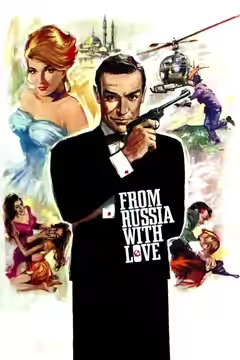
By From Russia with Love (1963) he was Vavra, the gypsy leader, in a film we admire for its leanness and for Robert Shaw. Our review did not single him out, and that is the honest measure of the part. In a Bond film he is one more foreigner with a beard and a grievance, and Terence Young has more urgent things to look at. The complaint that follows him through the filmography is that he was offered villains and foreigners and little else, and the complaint is fair. After Scrooge the films mostly stopped asking what else he could do.
Still, watch that siege. We sat forward for it and stayed forward, surprised at how much we cared whether one ladder would hold, and part of what held us was the man shouting from the top of it, because a castle under attack needs somebody worth taking it from. That is the character actor's contribution and it is not a small one. He finished in features with The Three Musketeers (1973) and carried on in television, Doctor Who and Jesus of Nazareth among it, still large, still bearded, still the man you would not want to meet on the stairs. Nobody built a film around him. He was what the films were built out of.
Biography
Francis de Wolff was an English character actor. Born Francis-Marie Arist de Wolff on 7 January 1913 in Essex, he was the son of a Russian-born nobleman and studied acting at the Royal Academy of Dramatic Art. He made his film debut in Flame in the Heather (1935) and appeared in numerous films over four decades.
De Wolff was frequently cast as villains or foreigners. His credits include Treasure Island (1950), Scrooge (1951) as the Spirit of Christmas Present, Ivanhoe (1952), Moby Dick (1956), The Hound of the Baskervilles (1959), From Russia with Love (1963) as Vavra, and The Three Musketeers (1973). He also featured in several Hammer horror films and television productions such as Doctor Who and the miniseries Jesus of Nazareth (1977). He died on 18 April 1984 in Sussex.