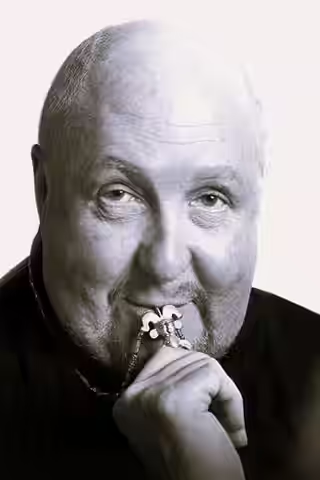
Frank Thring played tyrants with a drawl, a lisp and pauses long enough to make a whole court wait, and he did not disappear into any of them. In the Hollywood epics of 1958 to 1961 that was exactly what was wanted.
Fi1m perspective
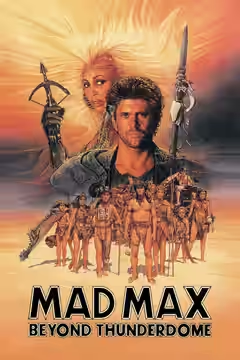
In Mad Max Beyond Thunderdome (1985) he stands among the gantries of Bartertown in fur and face paint as the Collector, one more figure in a town dressed as if it had raided a museum in the dark. He fits. Norma Moriceau's costume does some of the work, but most of it is the man underneath: the bulk, the heavy face, the voice that arrives after a pause and then takes its time. Thring had been doing this for thirty years, and the wasteland only had to stand still and let him.
The career began in radio at his family's Melbourne station, 3XY, in 1941, and moved to the stage after his discharge from the RAAF in 1945. He founded the Arrow Theatre in Melbourne in 1951 and took its Salome to London in 1954, where he played Herod, and he was in Titus Andronicus with Olivier. Hollywood found him in 1958 and used him as a costume-drama villain for three years: Aella, the usurping king, in The Vikings (1958); Pontius Pilate in Ben-Hur (1959); Herod Antipas in King of Kings (1961); Al Kadir in El Cid (1961). He is the only actor to have played both Pilate and Herod on film, which tells you what the studios saw when he walked in.
In 1961 he went home, and the rest of the working life was Melbourne stage, a good deal of it with the Melbourne Theatre Company, with Australian film and television around it. Age of Consent (1969) put him opposite James Mason. Later there were cameos, of which the Collector is the one people remember, until a final film in 1993.
What he did was narrow and he did it well. The parts were imposing, sybaritic or glowering, usually all three, and the drawl and the long pauses made a small role feel like a large one. The cost was that Frank Thring was always visible inside the character; the style was thought old-fashioned even when he was a young man, and it never became less so. Our own review of Ben-Hur found the evening earned by the chariot race and by Heston and Boyd, and did not stop for Pilate, which seems fair to a performance built to be looked at rather than followed.
We will admit we were pleased when he turned up in Bartertown. The town is the best thing in the film, and having a man who had once governed Judea presiding over a market in a crater made the joke of the place land a little harder. Off screen he was flamboyant and waspish and always in black, and by the end the roles and the man were much the same performance. See the epics for the parts made to his measure. See Beyond Thunderdome for the last time the measure was taken.
Biography
Frank Thring (Francis William Thring IV) was an Australian character actor and theatre director. Born in Melbourne in 1926, he began his career in radio at station 3XY before moving to stage work. He established the Arrow Theatre in Melbourne in 1951, directing and starring in numerous productions, and later performed in London, including with the Shakespeare Memorial Theatre Company.
Thring appeared in several Hollywood epics of the late 1950s and early 1960s. He played Pontius Pilate in Ben-Hur (1959), Aella in The Vikings (1958), Al Kadir in El Cid (1961) and Herod Antipas in King of Kings (1961). Later roles included appearances in Age of Consent (1969), Mad Dog Morgan (1976) and Mad Max Beyond Thunderdome (1985). He was the son of Australian film entrepreneur F. W. Thring.