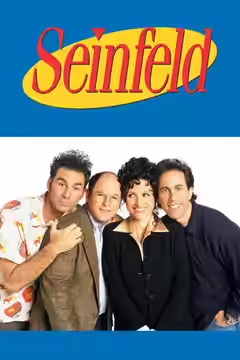
Larry David writes comedy about people who cannot let a small thing go. Seinfeld is the exact version and Curb Your Enthusiasm the untidy one, and both are worth your evening, though the second is best taken an episode at a time.
Fi1m perspective
The Larry David character has one move, and it is the explanation nobody asked for. Someone takes offence at something small, Larry sets out to clear it up, and each attempt makes it worse, because he cannot see that the other person stopped listening a while ago. That is Curb Your Enthusiasm (2000), in which David plays a version of himself, and it was the engine of Seinfeld (1989) before it, where one person's certainty that a problem is somebody else's fault can carry a whole scene. David's method is to take the irritation most people swallow and give it far more attention than it deserves.
He came to it through stand-up in New York clubs in the mid-1970s, then writing and performing on Fridays (1979–82) and writing on Saturday Night Live (1984–85). He met Jerry Seinfeld in 1976, and the series they made together was David's for its first seven seasons as head writer; he left in 1996 and returned to write the finale with Seinfeld in 1998. In between he wrote and directed a feature, Sour Grapes (1998). A 1999 special became Curb, which ran from 2000 to 2024, with the film Clear History (2013) along the way.
Seinfeld is the more exact of the two. It is written and plotted, and David, Seinfeld and Peter Mehlman among others follow every excuse and objection until a small grievance seems to justify almost anything. His rule for his programmes is "no hugging, no learning", and Seinfeld keeps to it: nobody grows, nobody is forgiven, and the comedy is better for it. Curb throws the script away for outlines and improvisation, and Robert B. Weide and Jeff Schaffer direct it so that people appear to be working out what they mean while saying it. Patrick Alexander Stewart's watchful camera puts us too close to the quarrel to escape it. We laughed at David's persistence and then wanted him to stop talking, and the wanting is the joke.
He is also generous with the people who have to put up with him. Susie Essman's Susie Greene is the one force Larry cannot talk around, JB Smoove's Leon brings a different rhythm to conversations that might otherwise sound alike, and Cheryl Hines's steadiness lets us measure how unreasonable he is being. Jeff Garlin has been beside him for all twelve seasons. The cost of the method is repetition. Over a run of Curb the quarrels start to wear, which is why we suggest an episode at a time, and viewers who need someone to like will not find them here. Both series ended in ways that divided their audiences; we will not say how. In 2026 he began a new historical sketch series, Life, Larry and the Pursuit of Unhappiness, and it is a fair bet that nobody in it learns anything either.
Biography
Larry David is an American writer, producer and actor, also credited as Lawrence Gene David. Born on 2 July 1947 in Brooklyn, New York, he attended the University of Maryland and began performing stand-up comedy in New York nightclubs in 1974. He wrote for and performed on the sketch show Fridays from 1979 to 1982 and later worked as a writer on Saturday Night Live.
In 1989, David co-created the sitcom Seinfeld with Jerry Seinfeld. He served as writer and producer on the series until 1996 and returned to write the 1998 finale. David created the HBO series Curb Your Enthusiasm in 2000, starring as a fictionalised version of himself. He wrote and directed the feature film Sour Grapes (1998).