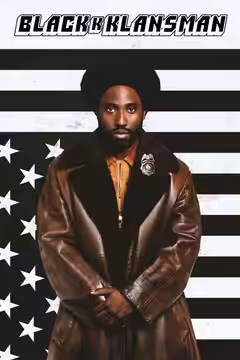
Laura Harrier gives BlacKkKlansman a woman with her own reasons to disagree, rather than another admirer for its leading man. We rate that firmness, and want to see it given more room by the writing.
Fi1m perspective
In BlacKkKlansman (2018), Laura Harrier makes Patrice Dumas difficult for Ron to take for granted. There is a firmness to the performance that gives their disagreements weight, even when the writing does not allow them enough time. We warmed to Patrice because Harrier made her objections matter, while the film kept encouraging us to enjoy Ron's appeal. Spike Lee gets something valuable from her here: a supporting character whose approval cannot simply be assumed. We recommend the performance with the same reservation we have about the film, which too often lets Ron's charm settle questions it has barely addressed.
That was a useful step beyond Liz Allan, Peter Parker's love interest in Spider-Man: Homecoming (2017), the part that brought her international attention. The danger for an actor in either role is being given little to do beyond making the leading man seem desirable. Harrier's work with Lee shows what happens when she has a position of her own to defend. Her preparation for Patrice included documentary viewing and writing a character autobiography, giving her more to draw on than the dialogue alone. The research is worth mentioning because the result is a character who seems to have thought about things before Ron arrived.
In Hollywood (2020), she takes a lead role as Camille Washington, a Black actress in the 1940s. The performance is underdeveloped, with less of the force she finds as Patrice, and we would not choose it as an introduction to her work. Her work for Lee leaves us wanting a substantial part that allows her to sustain a difficult conversation, without the script moving on too quickly.
Our reservations about Michael (2026), in which she plays Suzanne de Passe for Antoine Fuqua, concern an authorised biography that avoids the difficult parts of its story. Those objections concern the storytelling; we have no separate case to make against her acting in it. Start with BlacKkKlansman, and pay attention when Patrice disagrees; we wish the film did so more often.
Biography
Laura Ruth Harrier is an American actress and model. Born on 28 March 1990 in Chicago, Illinois, she began modelling at the age of 17 after being discovered by a location scout. She moved to New York City, where she was represented by IMG Models and Wilhelmina Models, and later studied acting at the William Esper Studio.
Harrier first gained recognition for her role as Destiny Evans in the 2013 revival of the soap opera One Life to Live. Her performance as Liz Allan in Spider-Man: Homecoming (2017) brought her wider attention. She subsequently appeared as Patrice Dumas in BlacKkKlansman (2018), Camille Washington in the miniseries Hollywood (2020), and Tatiana in White Men Can't Jump (2023). In 2026 she portrayed music executive Suzanne de Passe in the biopic Michael.