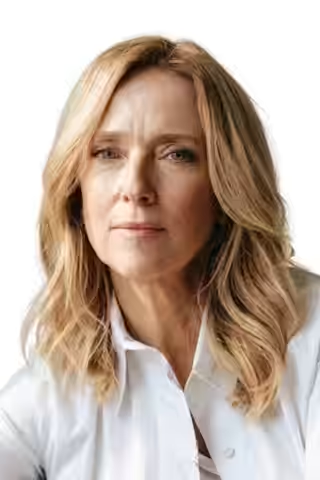
Léa Drucker's trade is stillness. Cast again and again as women under pressure at home or in an office, she plays them by watching rather than showing, and in a good film the watching is the drama.
Fi1m perspective
In The Bureau (2015) she is Docteur Balmes, the service psychologist, and her job is to read faces. Mathieu Kassovitz's Malotru has to sit opposite her and lie. Éric Rochant shoots these scenes the way he shoots everything in that series, grey partitions and strip lighting and nothing to look at but two people, and we found that we were watching her, not him. She listens and she waits, and the not-doing is what makes the liar work harder. It is the whole Drucker method in a few minutes of screen time.
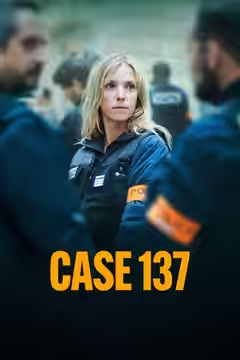
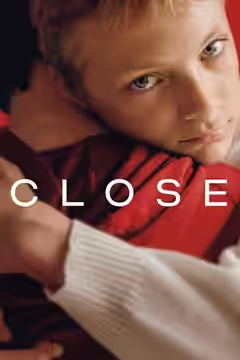
She came to it slowly. Theatre first, through the 1980s and 1990s, then a film debut in 1991 and the better part of two decades in supporting parts. The turn came with Xavier Legrand's Custody (2017), a drama about domestic abuse in which she plays Miriam Besson, and it made her a lead in her mid-forties. Since then she has moved between French auteur cinema and television: War of the Worlds (2019–2022), her first major English-language series role, then Close (2022), then Dominik Moll's Case 137 (2025), in which she is Stéphanie Bertrand, an internal affairs investigator. Legrand and Moll have each now made two films with her, which tells you the sort of director she suits: the patient kind, more interested in law and family than in spectacle.
She works by taking things away. Critics have noticed the same thing since Custody: an actor who barely moves, whose face does the work, and who lets the tension in a scene come from what she notices rather than what she does. She has said as much herself. "Surjouer le moins possible, jouer la scène avec du recul, sans occuper l'espace de trop de gestes, ça m'a pris du temps dans ma carrière," she said in 2025: to overplay as little as possible, to stand back from the scene and not fill it with gestures, took her a long time to learn. You can see the lesson taken.
Films do not always know what to do with this. In Close, as Léo's mother Nathalie, she is given less than Émilie Dequenne, whose Sophie is the best thing in the second half, and Drucker is good with what she has; good with what she has is a phrase we suspect she has read about herself too often. Case 137 has drawn the opposite complaint: a performance that holds while the procedure around it turns generic and the film says its themes out loud. That is the hazard for an actor who works by subtraction. A careless film can borrow her stillness and pass it off as its own seriousness.
Put her in a room with someone who has something to hide, and wait. She will not do much. She has never needed to.
Biography
Léa Drucker is a French actress. She was born on 23 January 1972 in Caen and trained at the École de la rue Blanche and the École Nationale Supérieure des Arts et Techniques du Théâtre (ENSATT) in Paris. Her early career included stage work in classical and contemporary plays, with Molière Award nominations for Best Female Revelation in 2001 and 2004.
She is known for her film roles as Miriam Besson in Custody (2017), Nathalie in Close (2022), and Stéphanie Bertrand in Case 137 (2025). Drucker has also appeared in the television series War of the Worlds (2019–2022) as Catherine Durand and provided the voice of Aline Ruby in Mars Express (2023). She won the César Award for Best Actress for Custody and Case 137.