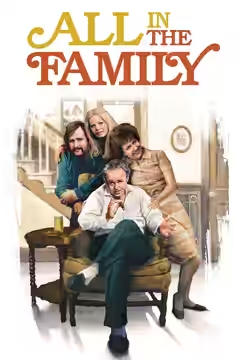
Norman Lear put an American family in a living room and let them argue about the country until the laughter hurt. All in the Family still works, though Archie Bunker's company is so enjoyable that his prejudices can start to pass for harmless eccentricity.
Fi1m perspective
The argument starts before the food is on the table. In All in the Family (1971) Archie Bunker, conservative, working-class and wrong about most things, sits down with his liberal son-in-law Mike Stivic, and neither can leave because they both live there. That is Lear's whole method in one room: no politician, no newsroom, just the people who have to share a roof and a fridge. Carroll O'Connor plays Archie and Rob Reiner plays Mike, and the programme works because O'Connor never plays the bigotry as a joke on Archie. He plays it as Archie's honest opinion, which is why it stings.
Lear had been at it a long time before that. He wrote sketches and for variety shows in the early 1950s, formed Tandem Productions with Bud Yorkin in 1958 and made feature films before adapting Johnny Speight's British sitcom Till Death Us Do Part into All in the Family, which began on CBS in January 1971. Then came the decade the American sitcom is still living in: Sanford and Son (1972), Maude (1972), with its two-part episode on abortion, Good Times (1974), the first of his programmes built around a Black working-class family in public housing, and The Jeffersons (1975).
What Lear did well was take a subject the news treated in three minutes, put it into a half-hour comedy and keep it there for a season. Race, class, gender, politics, all of it came through the front door in the shape of a relative. He called laughter "the intravenous of messaging through laughter", which is an ungainly sentence and a fair account of the trick. The risk, which our review of All in the Family names, is that the medicine goes down so easily that nobody notices it was medicine. We laughed at Archie's bluster more than we were comfortable with, and afterwards we could not say with any confidence that the laughter had been at him rather than with him. O'Connor is the reason: he gives Archie a wounded dignity, and Jean Stapleton, playing against him, gives the programme what warmth it has and a good part of its pain.
The failures are of the same kind. Good Times was criticised by Black writers and activists for reinforcing stereotypes of the struggling Black family and for keeping the people who knew that life at arm's length from how it was written. A method built on one man's ear for how families argue has an obvious limit, and that is where it lies. Repetition is the other fault: the arguments in All in the Family run on the same rails week after week, and the criticism of Archie wears thin with them.
Lear went on producing revivals and new work into the 2020s, and died in Los Angeles in December 2023. Start with All in the Family, an early season, and watch it with someone whose politics you do not share. He wanted people to think while they laughed. The evidence of the last fifty years is mostly that they laughed.
Biography
Norman Lear was an American television writer, producer and director. He created, wrote, directed and produced the sitcom All in the Family (1971), which ran until 1979 and addressed social and political issues through comedy.
Lear produced or created several other influential 1970s series, including Sanford and Son (1972), Maude (1972), Good Times (1974) and The Jeffersons (1975). He co-founded the advocacy organisation People for the American Way in 1981. He was born in New Haven, Connecticut, on 27 July 1922 and died in Los Angeles on 5 December 2023.