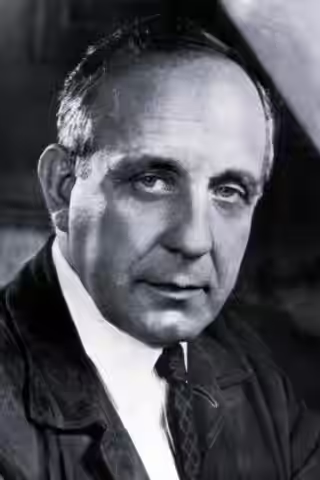
O.E. Hasse gives officers and officials a dark-voiced authority that can make their doubts more troubling. We value him most when that assurance begins to look suspect, as it does in Decision Before Dawn.
Fi1m perspective
Colonel von Ecker knows the war is lost and has decided to behave as though it is not. In Anatole Litvak's Decision Before Dawn (1951), O.E. Hasse makes that failure to face facts the important thing about the officer who takes Happy onto his staff. The rank tells us how the man expects to be treated; his denial tells us rather more. We found him unsettling because he understands enough to know better and still carries on. Hasse makes his authority convincing without asking us to respect it.
Litvak gives the film's heart to Oskar Werner, and Hasse does not displace him. Werner's corporal has to survive on a false name, a forged pass and a story about his unit. Von Ecker's established position makes a useful contrast to a man who has to think before every answer. The American dialogue is less persuasive, and our recommendation comes with that reservation: the film is worth watching principally for Werner and the people his corporal encounters.
Hasse's screen career moved from small parts in the 1930s and 1940s to post-war prominence, including Berliner Ballade (1948). The international work made use of more than his ability to wear a uniform: Alfred Hitchcock cast him as the caretaker Otto Keller in I Confess (1953). Then Canaris (1954) gave him the title role and helped establish him as a leading German actor. Officers and officials were a recurring part of his work, though those parts can encourage us to notice the rank before the distinctions he makes between the men.
His rough, dark voice helped, with modulation that gave him more to work with than sheer force. He also dubbed Humphrey Bogart, Spencer Tracy and Charles Laughton, a useful reminder of how much of his acting depended on speech. His development towards more restrained physical acting makes that vocal precision particularly worth attending to. Later work included stage and television collaborations with Peter Zadek and the role of Knut Hamsun in Eiszeit (1975). After Litvak, try I Confess for Hasse without the uniform.
Biography
O.E. Hasse (Otto Eduard Hasse) was a German actor. He was born on 11 July 1903 in Obersitzko, Province of Posen, German Empire (now Obrzycko, Poland) and died in 1978 in West Berlin.
He studied at Max Reinhardt's acting school in Berlin after briefly reading law. His stage career included work in Thale, Breslau and, from 1930 to 1939, the Kammerspiele in Munich, where he also directed. After the Second World War he appeared in numerous films, including international productions.
His credits include Decision Before Dawn (1951) as Col. Oberst von Ecker, I Confess (1953) as Otto Keller, Betrayed (1954) and The Adventures of Arsène Lupin (1957) as Kaiser Wilhelm II. He also worked extensively as a voice actor in German dubs.