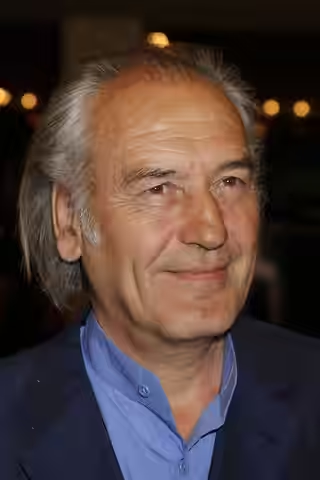
Patrick Bauchau plays the man at the edge of the picture who knows more than he says: doctors, officials, mentors, a blind seer. He is at his best when a director gives him a moral corner to occupy, and he has rarely been handed the whole film.
Fi1m perspective
Watch where Patrick Bauchau stands. He is seldom at the centre of the frame and he seldom needs to be; he is the doctor, the official, the mentor, the European in a good suit who has read the file and is not going to tell you what is in it. Casting directors on both sides of the Atlantic have seen him the same way, and for forty years he has been the steady, slightly withholding presence in other people's stories, from Sydney, watching over the escaped Jarod in The Pretender (1996–2000), to the blind seer Lodz in Carnivàle (2003–2005).
It did not begin that way. He started as a runner for Éric Rohmer and ended up playing the lead, Adrien, in La Collectionneuse (1967), a performance so unforced that some took it for Bauchau being Bauchau rather than acting at all. He then more or less disappeared for the 1970s. Wim Wenders brought him back as Friedrich Munro, the director of a stalled production, in The State of Things (1982); Choose Me (1984) was his first American film; and a year later he was Scarpine, the henchman, in A View to a Kill (1985).
We were not kind to that Bond, and we did not mention him. That is the henchman's lot: Christopher Walken and Grace Jones take the picture and the man behind them takes the pay. The Rapture (1991) is the film of his we would send a reader to. Michael Tolkin casts him as Vic, who goes to bars with Mimi Rogers's Sharon and brings couples back to motel rooms, and Bauchau plays the arrangement as ordinary, an evening like any other. Those early scenes unsettled us more than we expected, because nothing in his face suggests he thinks anything is wrong, and the film needs us to believe Sharon has tried this and found it empty. Tolkin used him again, and it is easy to see why: he does complicity without comment.
Then television, and a great deal of it. Eighty-six episodes of The Pretender made him a mainstay, and the fair criticism of the later career is that its reputation rests on that longevity and on supporting film parts, Panic Room (2002), 2012 (2009), rather than on leads. He does not seem to mind. "In the art films, it's more of a guerrilla style and less structured," he has said, and television, by his account, has more in common with those films than with the blockbuster, because you discover what is to be done and can be more creative. The blockbuster is a battleship, and he has spent most of his working life on the smaller boats. Look for him at the edge of the frame; he is usually the one person there who already knows how the story ends.
Biography
Patrick Bauchau is a Belgian actor. He was born on 6 December 1938 in Brussels and raised in Belgium, Switzerland and England. He attended Oxford University on an academic scholarship and speaks several languages including French, English, German, Spanish and Italian.
Bauchau began his career in French New Wave cinema, appearing in Éric Rohmer's La Carrière de Suzanne (1963) and La Collectionneuse (1967). He later featured in Wim Wenders' Der Stand der Dinge (1982). He is known for his role as Scarpine in the James Bond film A View to a Kill (1985), as well as appearances in Panic Room (2002), The Cell (2000), 2012 (2009) and the television series The Pretender and House.