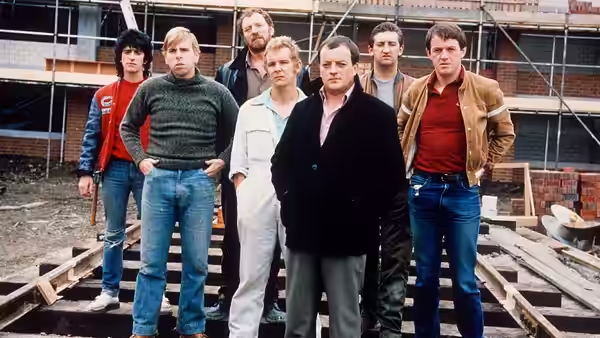
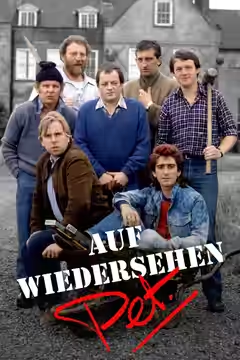
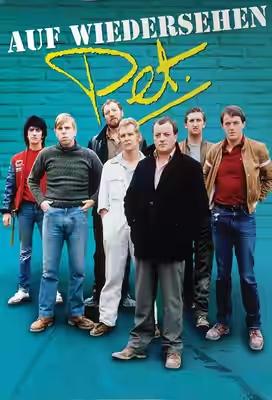
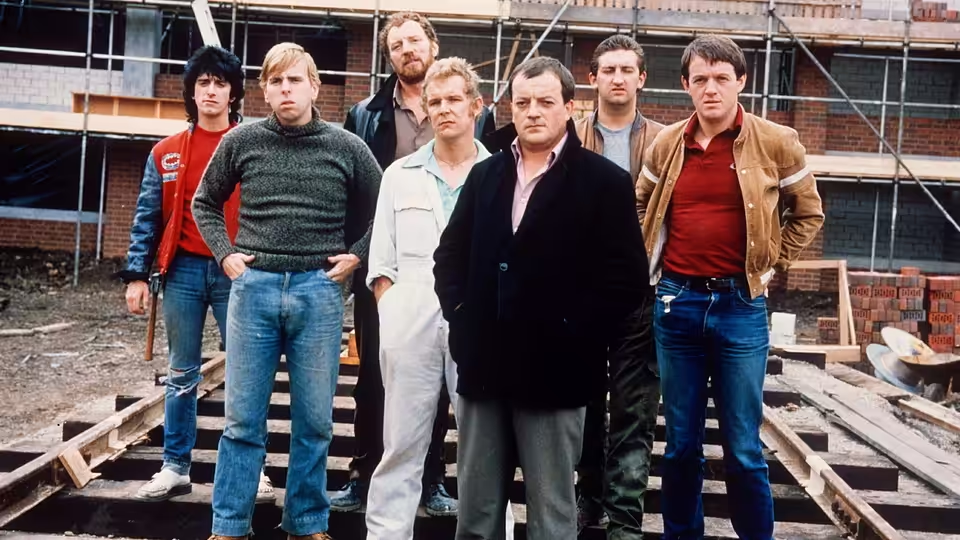
Group of men standing on wooden planks at a construction site
Series review

Auf Wiedersehen, Pet

1983 · Created by Franc Roddam · Series · 50m

In a sentenceWe would tolerate the building-site hut for the company, though we would ask the loudest resident to take his opinions outside

With jobs scarce at home, Dennis Patterson (Tim Healy), Neville Hope (Kevin Whately) and Leonard ‘Oz’ Osborne (Jimmy Nail) leave England for building work in Düsseldorf, West Germany. Dennis needs a wage, Neville misses his wife, Brenda Hope (Julia Tobin), and Oz makes settling in harder for everyone. Accommodation means a hut on the building site, shared with other British workers, while Herr Grunwald (Michael Sheard) supervises the job. In the early 1980s, earning money abroad means living at close quarters with men they have not chosen, far from their families and familiar routines.

Fi1m review

Auf Wiedersehen, Pet is a funny, warm comedy-drama about men who need wages more than adventure. Its ensemble makes the cramped company a pleasure, though some of the sexual and national stereotyping is hard work.

The original series of Auf Wiedersehen, Pet understands that going abroad for work is not much of an adventure when the alternative is having no work at all. Created by Franc Roddam and written by Dick Clement and Ian La Frenais, it finds its comedy in the daily business of getting along with people under those conditions. It is warm, funny and unusually patient with men who can be difficult company. The strongest reason to watch is the cast, though some of the jokes about women and foreigners have worn badly.

The building-site hut in Düsseldorf does a great deal of useful work. These men cannot finish an argument and retreat to a comfortable home; they have to keep sharing the same cramped accommodation. The writing gives them different ways of coping with that, so the quarrels come from more than a need to fill the next scene. The shortage of privacy makes the endless talking both understandable and occasionally exhausting, and the programme allows us to feel both.

Tim Healy gives Dennis Patterson the weary authority of someone who would prefer not to be in charge. Kevin Whately makes Neville Hope’s homesickness awkward and credible, without asking for sympathy each time he looks unhappy. We were more touched by Neville’s longing for home than we expected. Among the noisy exchanges in the hut, his difficulty settling becomes something the jokes cannot quite dismiss. Jimmy Nail, meanwhile, makes Leonard ‘Oz’ Osborne’s belligerence funny without making him easy to spend time with.

Timothy Spall’s Barry Taylor is funny because he talks as though a little more explanation might finally make everyone understand him. Gary Holton gives Wayne Norris a restless self-confidence, while Pat Roach makes Brian ‘Bomber’ Busbridge a reassuring presence without turning him into the group’s appointed saint. Christopher Fairbank’s Albert Moxey supplies another kind of awkwardness, distinct from Neville’s unhappiness or Barry’s earnestness. These are recognisable comic types, but the actors listen and react to one another closely enough to keep them from becoming merely predictable.

Directors Roger Bamford and Paul Seed generally know how much to leave to those performances. Conversations have enough room for an interruption or a stubborn pause to matter, rather than being hurried towards the next laugh. At 50 minutes an episode, the programme can let somebody be irritating for longer than a shorter comedy would risk. That patience helps the friendships feel credible, although it occasionally keeps an exchange going after we have understood everything it has to offer.

The difficulty is the material that expects recognition to do the work of a joke. Women can be reduced to a man’s complaint or boast, and the German setting sometimes encourages broad national caricatures where the writing elsewhere distinguishes individuals carefully. Occasionally a joke seems to expect us to share a man’s prejudice, which is where our goodwill runs out. Those moments are noticeable because so much care has gone into making the central group particular, contradictory people.

By the standards of ensemble comedy, the willingness to let these men be tiresome is an advantage. Their friendships are more convincing because we can understand why they might prefer to avoid one another. The quiet stretches give the cast opportunities that a constant demand for punchlines would take away. Start with the original series, and bring a little patience for the jokes the actors cannot rescue.

Critical consensus AI synthesised

1 of 6
Positive
1
Mixed
0
Negative
0
Den of Geek
14 March 2008 · Alex Westthorp
85*

The critic celebrates the original series as one of Britain's finest comedy-dramas, highlighting its well-drawn working-class characters and sharp response to 1980s unemployment themes. The piece singles out the ensemble cast and the writers' character work for particular praise.

Read the full review →

Straight answers AI written, from our review

Is Auf Wiedersehen, Pet worth watching?
Auf Wiedersehen, Pet is worth watching for anyone who enjoys ensemble comedy with room for its characters to be tiresome, and we scored it 84. The cast is the main reason to stay, with Tim Healy and Kevin Whately especially good, though some of the jokes about women and Germans have worn badly. Bring a little patience for those.
How long is Auf Wiedersehen, Pet, and what is it rated?
Auf Wiedersehen, Pet has episodes of about 50m. It is a comedy and drama series.
Where can I watch Auf Wiedersehen, Pet in the US?
Auf Wiedersehen, Pet is not on any streaming or rental service in the US at the moment. It is available in 1 other country; change your country at the top of the page to see where. Availability is checked daily.
How does Auf Wiedersehen, Pet compare to Riff-Raff?
Auf Wiedersehen, Pet and Riff-Raff both find comedy on a building site, but the television series is the warmer of the two and Ken Loach's film the angrier. The series gives its men cramped hut life and long, patient conversations; Riff-Raff has sharper politics and less comfortable company. Choose the series for friendship, the film for a harder edge.
What should I watch after Auf Wiedersehen, Pet?
After Auf Wiedersehen, Pet, try Riff-Raff (1991, Fi1m 77): Another building site, with sharper political anger and less comfortable company. Then The Station Agent (2003, Fi1m 82): Three reluctant companions find friendship through conversation, irritation and ordinary shared time; and Detectorists (2014, Fi1m 87): Gentler male companionship, patient jokes and people worth spending unhurried time with.

Cast

If you liked this, try…

  1. Riff-Raff (1991, Fi1m 77)Another building site, with sharper political anger and less comfortable company.

  2. Bread and Chocolate (1974) · not reviewed yetAn Italian worker abroad discovers how quickly earning a living becomes humiliating.

  3. The Station Agent (2003, Fi1m 82)Three reluctant companions find friendship through conversation, irritation and ordinary shared time.

  4. Detectorists (2014, Fi1m 87)Gentler male companionship, patient jokes and people worth spending unhurried time with.

  5. Going My Home (2012) · not reviewed yetA quieter ensemble comedy that lets awkward pauses and family habits matter.

Free account

Know what to watch tonight

Two lists that know where things are streaming, collections you can share, your own score beside ours, and Discover that remembers what you have seen.

  • Want to see, sorted by what is streaming now
  • Seen, with your score out of ten
  • No adverts, ever