Jonatan Etzler’s black comedy about a teacher who locks a disruptive pupil in her house is sharp for an hour and increasingly strained after it. Saoirse Ronan holds the whole thing together with a performance of unnerving reasonableness.
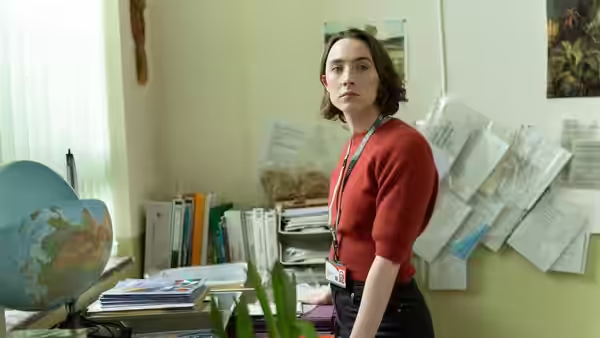
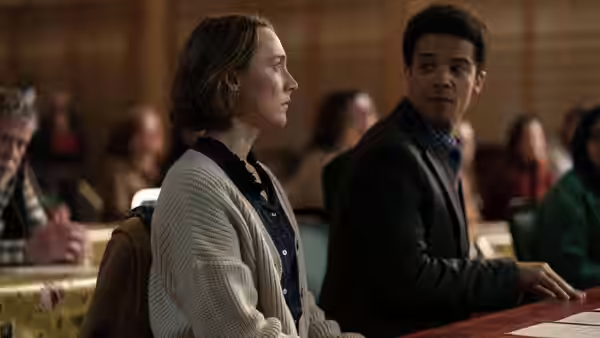
Maria (Saoirse Ronan) teaches a primary school class, and one boy in it has made teaching impossible. He is not evil; he is a child, and loud, and nothing anyone in the building has tried has worked. Then something happens that we will keep to ourselves, and Maria finds herself with the boy locked in a room in her house and a class that has gone quiet. Jonatan Etzler’s film, written by Jess O’Kane from Rasmus Lindgren’s novel, is a black comedy about what happens next, and for an hour it is as sharp a thing about schools as we have seen in some time. Then it has to finish, and finishing is where it comes apart.
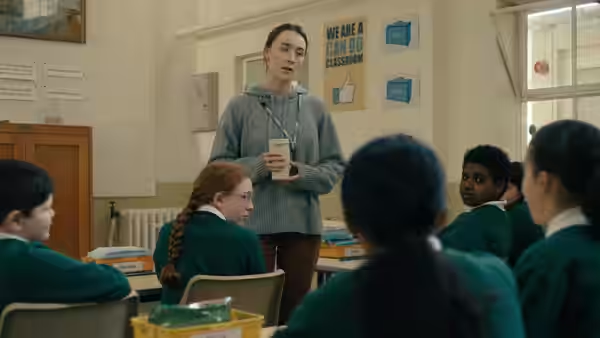
Ronan is the reason it works for as long as it does. She plays Maria as tidy, tired and entirely reasonable, a woman who has done the reading on behaviour management and found it does not survive contact with the boy. She never raises her voice and never asks us to like her, and the film’s best joke, repeated with variations, is that the calmer she is, the worse what she is doing looks. There is a scene early on where she takes the register the morning after and the classroom is so quiet that the children look up for permission to breathe. We laughed, hard, and then sat with the fact that we had laughed at a classroom that was peaceful because a child was missing from it. That is the film working exactly as intended.
Around her the town settles in. Sam (Jacob Anderson), the man she goes home to, notices she is sleeping better and does not ask why. The parents at the gate (Jaye Jacobs, Joanna van Kampen and Kirris Riviere among them) notice their children have stopped coming home in tears and are pleased about it. Kerry Howard’s PC Williams asks the questions the plot requires and no more. The satire here is precise and unkind: everyone benefits from what Maria has done, so nobody looks at it too closely. O’Kane’s script gives each of these people a small, human reason to keep quiet, and each one is convincing.
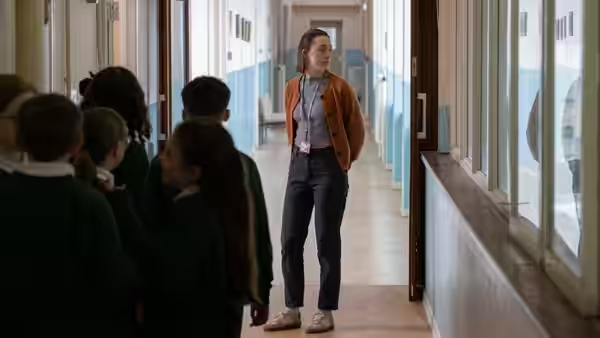
Nea Asphäll shoots the school in flat overhead light, laminated displays and coloured plastic chairs, and the house in something warmer and dimmer, so that the place where the crime is happening is the place you would rather be. Jacqueline Abrahams’s production design keeps both spaces ordinary; where the boy is kept has a door that locks and nothing else to mark it out. Sarah Blenkinsop puts Maria in the cardigans and flat shoes of someone who bends down a great deal, and the clothes never let us forget what her job is even when she has stopped doing it. Chris Roe’s score stays out of the way for the first half, then grows more insistent as the plot does, and we preferred it when it had less to say.
The trouble arrives with the second half. Having set up a situation in which one wrong is quietly rewarded, the film needs to escalate, and each escalation asks us to accept slightly more than the last. Robert Krantz’s editing, brisk and funny early, starts skipping the scenes in which someone would surely have said something, and the gaps show. The title metaphor, which the first hour trusts us to work out for ourselves, gets said out loud, more than once, by people who have no reason to be that articulate about it. By the last twenty minutes we were no longer laughing and not quite believing either, which is a poor place for a comedy thriller to leave you.
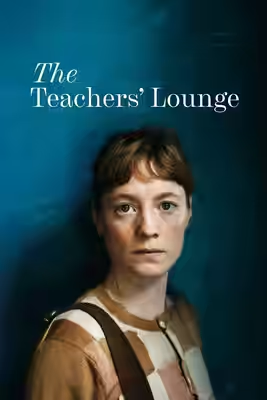
The obvious comparison is The Teachers’ Lounge (2023), which took a far smaller transgression in a similar staffroom and made it unbearable through plausibility alone. Bad Apples has the better jokes and the bigger idea, and it spends its last act unsure which of those it wants to be. Most critics have been a little warmer than we are, and we can see why: Ronan is that good, and the premise is that clever. We wish the film had known when to stop.
Worth an evening for the first hour and for Ronan, who plays a monstrous act with such ordinary good manners that we kept forgetting to be appalled. It runs 100 minutes, carries a 15, and is not recommended to anyone with a parents’ evening in the morning.