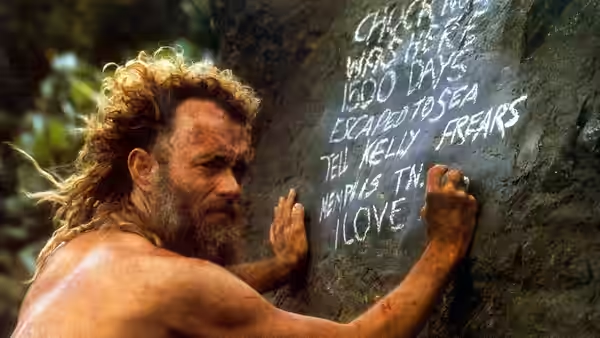
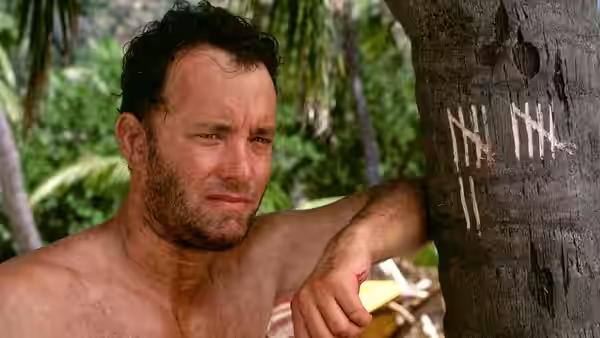
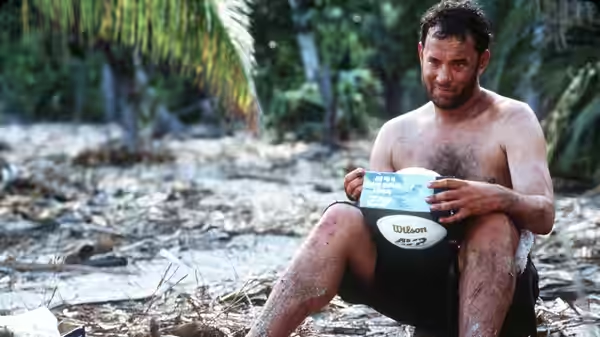
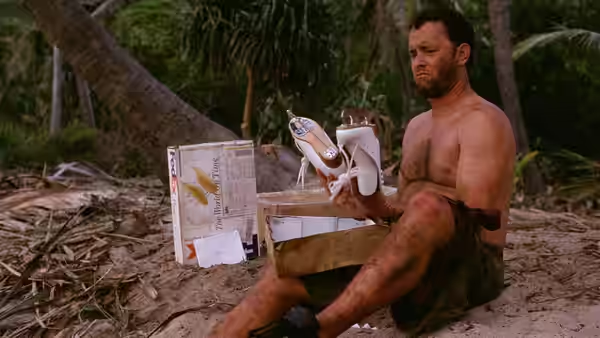
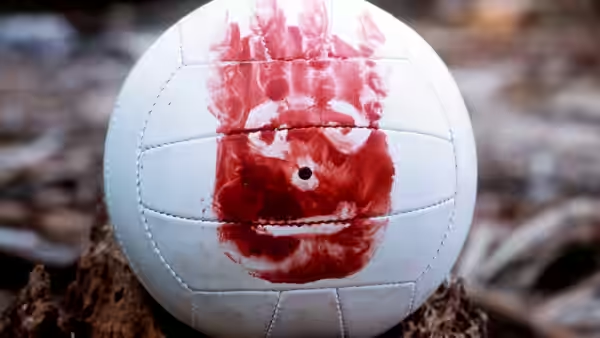
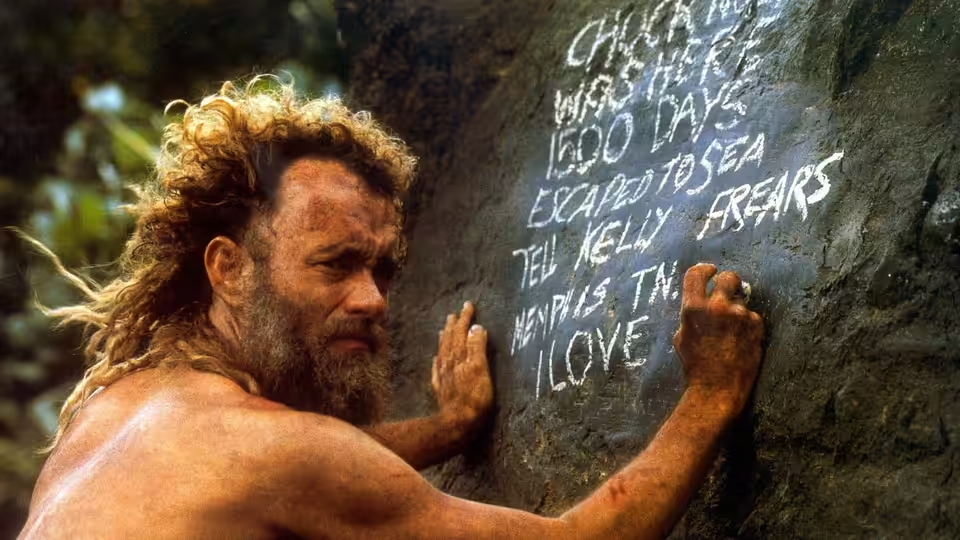
Chuck Noland (Tom Hanks) carving a message on a large rock
Film review

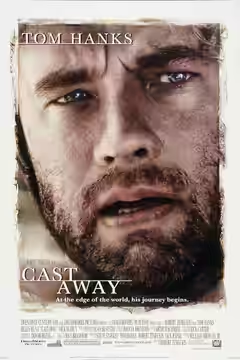
Cast Away

2000 · Directed by Robert Zemeckis · 2h 23m · MPA PG-13

In a sentenceTom Hanks makes surviving a day look harder than most films make saving the planet

Chuck Noland (Tom Hanks) is stranded on a desert island after an aircraft crash. Alone and cut off from civilisation, he has to learn how to survive, improvising solutions to problems that now take up his days. Physical hardship is only part of the task: without other people, he must also contend with loneliness and the passage of time. His immediate needs leave little room for anything beyond getting through the next day. Robert Zemeckis directs this adventure drama, with Helen Hunt playing Kelly Frears.

Plays from YouTube when you press play; nothing loads from them until then.

Fi1m review

Tom Hanks makes the physical work and loneliness of survival absorbingly clear. Robert Zemeckis is less convincing when he presses for life lessons, but Cast Away earns its long silences and most of its sentiment.

Cast Away is an absorbing survival drama, with a performance strong enough to carry it through some heavy-handed life lessons. Robert Zemeckis strands Tom Hanks on a desert island and trusts him to keep the business of getting through a day interesting. Chuck Noland’s predicament follows an aircraft crash, but the film does not need to keep finding comparable disasters to hold our attention. For much of its length, one man trying to manage without help is sufficient.

The crash is an early indication of how well Zemeckis can make physical danger register. We were frightened by it, because Hanks looks so helpless inside the disaster: we never get the comfortable sense that a capable leading man has things in hand. The staging keeps the danger clear without making it feel safely manageable. Hanks carries that vulnerability into the island scenes, where we remain conscious of how much is being asked of one body.

As Chuck, Hanks is particularly good at making concentration visible. His attention to a task lets us follow the work without needing somebody to explain what the scene is for. The sustained, largely wordless passages could easily become an actor asking to be admired, but he stays busy with the immediate difficulty. He allows frustration and awkwardness into the performance, too. The loneliness is affecting because we have spent time watching this man cope without the ordinary help and distraction of another person.

The island is well served by Don Burgess’s cinematography, which makes the space around Chuck feel exposing rather than inviting. We can follow the physical work without forgetting how alone he is. Rick Carter’s production design is equally important to the credibility of the improvisation: the surroundings present convincing difficulties, and the effort involved in dealing with them feels real. Neither contribution makes the island feel conveniently arranged for an adventure.

Arthur Schmidt’s editing is patient with that work, letting a task occupy a scene without hurrying towards the next crisis. This is the part of the film that feels most assured of what it has to offer. The patience occasionally becomes slackness, and the 143-minute running time leaves some stretches longer than their dramatic interest warrants. Survival adventures often hurry through this kind of labour; here it supplies much of the drama, and we would be reluctant to lose too much of it.

William Broyles Jr.’s screenplay is less persuasive when it presses the experience into a lesson about what matters in life. The symbolism feels too emphatic, as though Chuck’s isolation might otherwise strike us as a minor inconvenience. Alan Silvestri’s music supports the more openly sentimental writing, and its emotional weight is not always needed. Hanks has already made the suffering and loneliness clear. We do not need every feeling encouraged quite so firmly.

Viewers who want a brisk sequence of escapes may find the long concentration on one person trying. For us, that concentration is the reason to watch: Hanks makes frustration and persistence interesting without turning Chuck into a collection of admirable qualities. There is more sentiment than we would choose, but it does not undo that achievement. Give it an uninterrupted evening, when the small actions can receive as much attention as the crash.
Critical consensus AI synthesised

72
Positive
6
Mixed
0
Negative
1

Most critics respond warmly to Cast Away, with praise centred on Tom Hanks’ physical performance and the sustained attention to the practical work of survival. The island sequences are widely judged absorbing, making isolation, improvisation and loneliness compelling with little need for dialogue. Robert Zemeckis’ visual storytelling, the staging of the plane crash and the detailed production design also earn approval, even from reviews less persuaded by the film’s larger ideas.

The reservations concern heavy symbolism, uneven momentum and a tendency towards sentimentality outside the central survival story. The spread is wider than the broadly positive consensus suggests: Time Out finds the solemn tone wearing, while The Guardian objects to the commercial branding and lack of psychological curiosity. The Telegraph goes further, rejecting Hanks’ credibility as a survivor and finding little dramatic subtlety; most other reviews regard his performance as the film’s chief strength.

The New Yorker
11 December 2000 · David Denby
85*

The critic highlights the film's startling physicality and mesmerizing depiction of suffering, improvisation, and survival, focusing on the detailed airplane crash and Hanks' bodily performance. It is described as an old-fashioned adventure epic rather than a triumph of the human spirit.

Read the full review →
Screen Daily
12 December 2000
80*

Zemeckis delivers an intriguing survival and redemption saga that should be a huge box-office hit and earn Oscar nominations; it is more mature than his prior work but still features simplistic symbolism, with Hanks giving an awesome everyman performance.

Read the full review →
The AV Club
7 December 2000 · Keith Phipps
80*

Zemeckis' film is gripping and thoughtful, with Hanks delivering a strong performance that turns his everyman character into something more universal. The director's visual sense and the film's focus on time, isolation, and survival are highlighted as strengths.

Read the full review →
Variety
7 December 2000
80*

The critic commends the bold risks taken by Zemeckis and Hanks in this unique stranded-on-an-island story, praising Hanks' bravura performance and the meticulous production design. Some stretches lack dramatic momentum and veer into the overly metaphysical.

Read the full review →
Los Angeles Times
22 December 2000 · Kenneth Turan
70*

The critic notes the film's top-notch filmmaking and visuals but finds it more of a straightforward survivor tale than the philosophical work intended, with the high-minded ideas only sporadically realized. The production details and Hanks' commitment are singled out for praise.

Read the full review →
Time Out
30 May 2012 · GA
40*

The critic finds Hanks' performance solid enough to carry much of the film alone and praises the well-staged crash, but faults the overly serious tone and heavy symbolism that make the story drag on too long.

Read the full review →

Straight answers AI written, from our review

Is Cast Away worth watching?
Cast Away is worth watching for anyone content to spend two hours with one man working out how to survive, and we scored it 81. Tom Hanks makes the physical labour and loneliness of the island absorbing, though Robert Zemeckis presses too hard on the life lessons and the 143 minutes include some slack stretches.
How long is Cast Away, and what is it rated?
Cast Away runs 2h 23m and is rated PG-13 by the MPA in the US. It is an adventure and drama film.
Where can I watch Cast Away in the US?
Cast Away is available to rent from Amazon Prime Video and Apple TV from $3.99. Availability is checked daily; the links above go straight to each service.
How violent or frightening is Cast Away, and is it suitable for children?
Cast Away is a UK 12 with little violence, but its aircraft crash is frightening: Hanks looks helpless inside it, and the staging never lets the danger feel manageable. Beyond that, the film is a slow study of hardship and isolation rather than peril, so older children should cope, though younger ones may find the long silent passages trying.
How does Cast Away compare to The Red Turtle?
Cast Away and The Red Turtle are both patient, largely wordless stories of a man alone on an island, but Hanks's film grounds isolation in physical work and a star performance, while Michaël Dudok de Wit's animation makes it strange and tender. The Red Turtle is the sparer and more restrained of the two; Cast Away offers more incident and more sentiment.
What should I watch after Cast Away?
After Cast Away, try All Is Lost (2013, Fi1m 82): Another solitary survivor, with practical problems allowed to provide almost all the drama. Then The Red Turtle (2016, Fi1m 84): Animation makes island isolation strange and tender, with little need for spoken explanation; and Touching the Void (2003, Fi1m 87): A climbing documentary that makes each small decision feel frighteningly consequential.

Cast

Awards

Academy Awards, 2001

Nominated
Best Actor
Nominated
Best Sound

If you liked this, try…

  1. All Is Lost (2013, Fi1m 82)Another solitary survivor, with practical problems allowed to provide almost all the drama.

  2. The Red Turtle (2016, Fi1m 84)Animation makes island isolation strange and tender, with little need for spoken explanation.

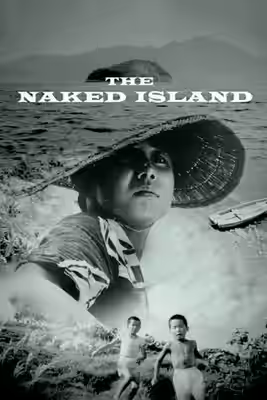
  3. The Naked Island (1960) · not reviewed yetDaily physical labour becomes absorbing drama, told with patience and almost no dialogue.

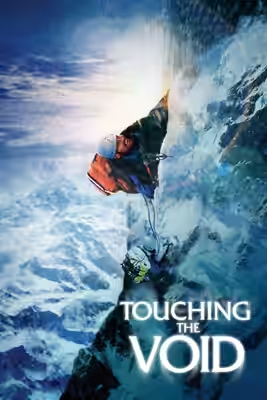
  4. Touching the Void (2003, Fi1m 87)A climbing documentary that makes each small decision feel frighteningly consequential.

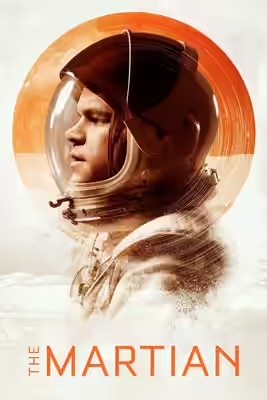
  5. The Martian (2015, Fi1m 82)For more resourceful problem-solving, with company on the radio and a lighter mood.

Free account

Know what to watch tonight

Two lists that know where things are streaming, collections you can share, your own score beside ours, and Discover that remembers what you have seen.

  • Want to see, sorted by what is streaming now
  • Seen, with your score out of ten
  • No adverts, ever