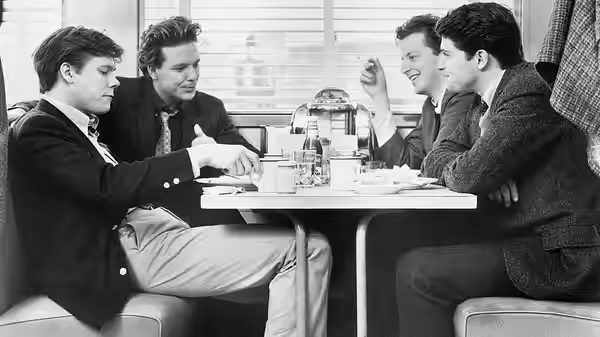
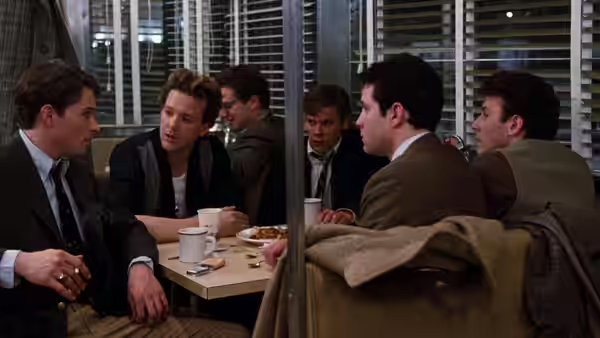
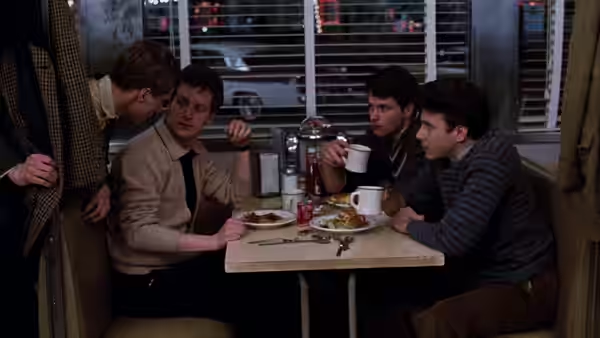
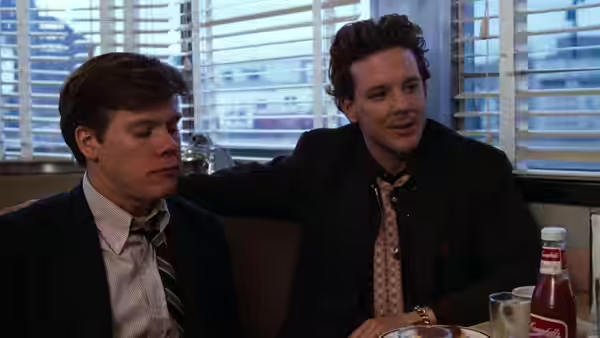
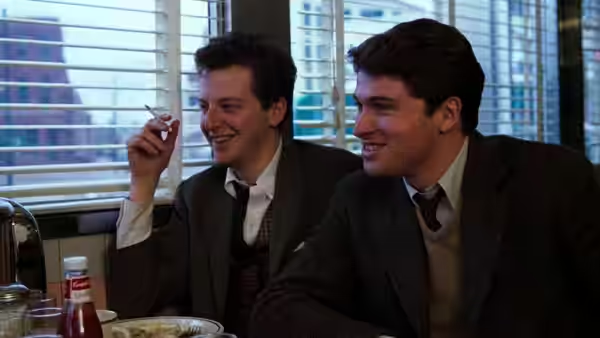
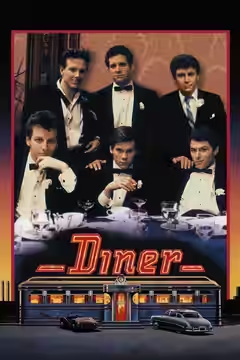
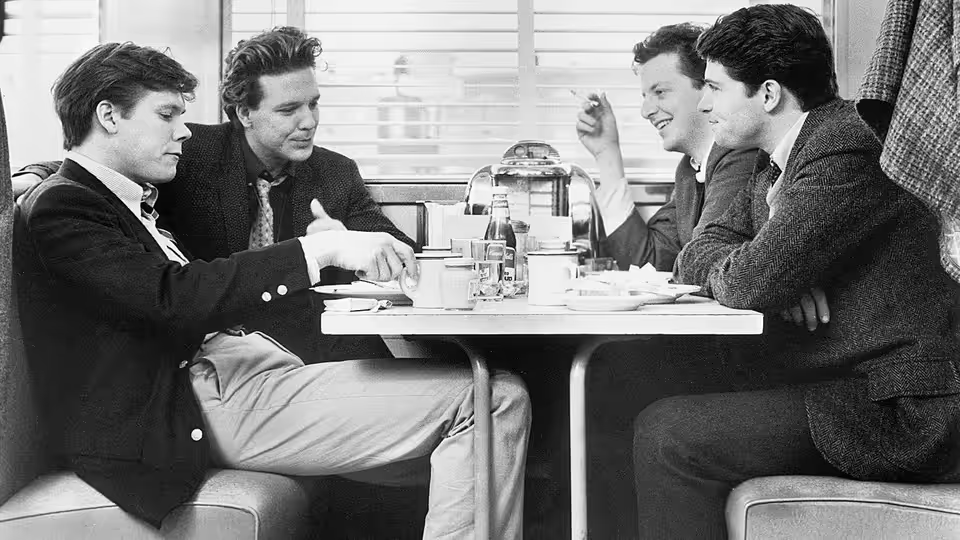
Four young men in suits seated at a diner booth table
Film review

Diner

1982 · Directed by Barry Levinson · 1h 50m · MPA R

In a sentenceAdulthood will have to wait; the men at this diner are still talking

At Christmas 1959 in Baltimore, a college student returns home and reconnects with his old friends. Their diner provides a place to gather as they put off the demands of adult life. Steve Guttenberg plays Eddie, Daniel Stern is Shrevie and Mickey Rourke is Boogie, with Kevin Bacon as Fenwick, Tim Daly as Billy and Paul Reiser as Modell. Ellen Barkin plays Beth Schreiber. Written and directed by Barry Levinson, Diner follows the group’s conversations and relationships as the friends try to hold on to their familiar ways of spending time together.

Plays from YouTube when you press play; nothing loads from them until then.

Fi1m review

Barry Levinson’s Diner is a funny, perceptive comedy about men in no hurry to grow up. Its cast earns our affection, though the drifting pace and scant room for the women call for some patience.

Barry Levinson’s Diner is funny, affectionate and worth an evening, provided we are content to spend much of it listening to men postpone becoming adults. The writer-director gathers old friends in Baltimore at Christmas 1959, with a returning college student providing the occasion to reconnect. He is interested in how they talk when they already know one another’s habits. There is little hurry to get them anywhere, and mostly that suits them.

The script gets the untidy business of friendship right: a conversation can matter enormously to the people having it and scarcely advance a story. Levinson lets these men be funny without making every remark a joke prepared for our benefit. Their shared history comes through in how readily they take up one another’s concerns, however trivial those concerns may seem. We felt unexpectedly sad during the diner conversations: the men are so comfortable together that growing up starts to look like losing something.

Steve Guttenberg’s Eddie and Daniel Stern’s Shrevie benefit from writing that lets them be difficult. Guttenberg makes immaturity engaging without entirely excusing it, while Stern gives the comedy enough irritation to keep the company from becoming too cosy. Mickey Rourke’s Boogie brings a persuasive charm; Kevin Bacon’s Fenwick makes the group’s restlessness harder to shrug off. These are distinct performances, and Levinson gives them room to rub against each other without turning every difference into a confrontation.

Paul Reiser’s Modell has an ease that keeps the dialogue from sounding rehearsed, and Tim Daly’s Billy belongs comfortably among these more insistent personalities. Nobody needs to announce what sort of friend he is before joining in. Ellen Barkin’s Beth is equally persuasive, though the film’s attention to the men leaves her with less space than she deserves. That imbalance matters: Levinson is alert to male selfishness, but he is sometimes too happy simply to enjoy the men being selfish.

Peter Sova’s cinematography keeps our attention on the faces, and the diner feels like somewhere these people could pass hours without noticing. The period setting is convincing without requiring us to keep congratulating the film on remembering 1959. Editors Andy Blumenthal and Stu Linder preserve the relaxed pace of the talk, although a few stretches would benefit from less indulgence. The music credited to Bruce Brody and Ivan Král gives the reminiscence warmth without pressing too hard for tenderness.

The film does drift, and a few conversations tell us little that we have not already learnt about the speakers. With the cast this good, it is tempting to forgive every extra minute, but 110 minutes is a generous allowance for such modest developments. There are easier laughs available to an adolescent comedy, and Levinson mostly leaves them alone. His patience helps us understand why these men resist change, even when we wish he would move them along.

For anyone who likes a comedy that lets people be irritating without making them unbearable, Diner is an easy recommendation. Its leisurely pace is better suited to an evening without much appetite for incident. Do not expect the men to become sensible.

Critical consensus AI synthesised

80
Positive
6
Mixed
0
Negative
1

The reviews lean strongly positive, and the praise gathers in the same two places: Levinson’s script and the ensemble that speaks it. Most critics single out the dialogue, the overlapping talk around the diner tables and the exactness of the period, late-1950s Baltimore on the eve of something the characters cannot see coming. The cast is described as first-rate almost across the board, with Mickey Rourke and Ellen Barkin named more than once, and several reviews note how much the film’s staying power owes to the chemistry of a group who were then unknown.

The spread is narrow with one clear outlier. Six of the seven reviews sit within ten points of each other; the seventh, from Variety, grants Levinson his realistic characters and dialogue but finds the story dark and depressing, without hope or uplift, and hard to watch. Nobody else raises that complaint. Later critics, if anything, read the same lack of incident as the point, calling it a hangout film whose low stakes are the appeal.

Empire
1 January 2000 · William Thomas
90*

The critic praises Levinson’s self-penned directorial debut as a disarming reminiscence on male friendship. It highlights the fine ensemble cast and witty screenplay.

Read the full review →
The Hollywood Reporter
3 March 1982 · Robert Osborne
90*

The film is a warmly written, engagingly acted and thoroughly captivating personal picture that could emerge as a sleeper hit. Levinson slowly unveils each character using the diner as their hub, with a strong script that is richly endowed despite some improvised scenes.

Read the full review →
The New Yorker
29 March 1982 · Pauline Kael
90*

The critic calls it a wonderful movie and a great period piece that captures the dynamics between young men and women in late-1950s Baltimore just before the sexual revolution. She singles out the authentic dialogue, overlapping conversations at the diner, and strong ensemble performances, especially by Mickey Rourke and Ellen Barkin.

Read the full review →
The New York Times
2 April 1982 · Janet Maslin
90*

The critic calls the film a fresh, well-acted and energetic American movie by a new director, small honest and entertaining. It stands out for its well-drawn characters played beautifully by a first-rate cast.

Read the full review →
Time Out
10 September 2012 · GA
90*

Levinson directs from his own script and revels in detailed observation of a college student returning home to Baltimore for Christmas 1959 and reconnecting with his old gang as they avoid adulthood. The period sense is acute, the witty script avoids crude pitfalls common to adolescent comedies, and the performances are spot-on.

Read the full review →
Variety
31 December 1981 · Variety Staff
30*

The review notes the director's skill with realistic characters and dialogue but finds the overall story dark and depressing with no real hope or uplift for audiences. It is seen as difficult to watch and sell.

Read the full review →

Straight answers AI written, from our review

Is Diner worth watching?
Diner is worth watching for anyone who enjoys a comedy built on talk rather than incident, and we scored it 84. Barry Levinson lets his men postpone adulthood at leisurely length, and the cast, particularly Steve Guttenberg and Daniel Stern, earns the time. It drifts, and Ellen Barkin's Beth deserves more room than the film gives her.
How long is Diner, and what is it rated?
Diner runs 1h 50m and is rated R by the MPA in the US. It is a comedy and drama film.
Where can I watch Diner in the US?
Diner is available to rent from Amazon Prime Video from $2.99. Availability is checked daily; the links above go straight to each service.
How violent or frightening is Diner, and is it suitable for children?
Diner is not violent or frightening; it is a UK 15 for adult talk and attitudes rather than anything on screen. The film is a comedy of conversation among grown men in 1959 Baltimore, and its subject is their reluctance to grow up. Younger children would find little to alarm them and less to hold their attention.
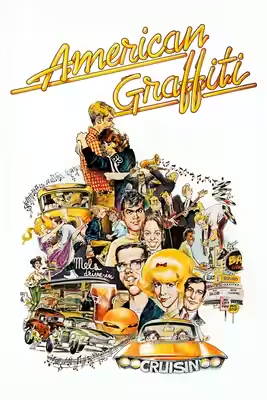
How does Diner compare to American Graffiti?
Diner and American Graffiti both watch young people delay adulthood through talk and music, but Levinson's film is the more grown-up and the drier of the two. Lucas uses cars and the radio to carry his story and reaches for a more openly moving finish; Levinson simply keeps his men at the table. Both let some conversations run long.
What should I watch after Diner?
After Diner, try American Graffiti (1973, Fi1m 84): Another group facing adulthood, with conversation and music delaying the moment. Then Withnail and I (1987, Fi1m 88): Two friends resist ordinary life with elaborate complaints and increasingly unhelpful companionship; and Metropolitan (1990, Fi1m 82): Young people talk around their anxieties, with class adding another reason to hesitate.

Cast

Awards

Academy Awards, 1983

Nominated
Best Writing, Original Screenplay

If you liked this, try…

  1. American Graffiti (1973, Fi1m 84)Another group facing adulthood, with conversation and music delaying the moment.

  2. I vitelloni (1953) · not reviewed yetFellini gives aimless male friendship a sharper sense of the years slipping away.

  3. Withnail and I (1987, Fi1m 88)Two friends resist ordinary life with elaborate complaints and increasingly unhelpful companionship.

  4. A Summer's Tale (1996) · not reviewed yetRohmer finds comedy in a young man’s talk, hesitation and romantic evasions.

  5. Metropolitan (1990, Fi1m 82)Young people talk around their anxieties, with class adding another reason to hesitate.

Free account

Know what to watch tonight

Two lists that know where things are streaming, collections you can share, your own score beside ours, and Discover that remembers what you have seen.

  • Want to see, sorted by what is streaming now
  • Seen, with your score out of ten
  • No adverts, ever