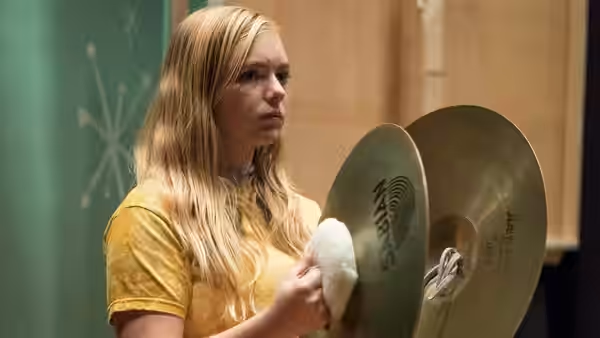
Kayla (Elsie Fisher) and Mark (Josh Hamilton) talking by a campfire at night
Film review

Eighth Grade

2018 · Directed by Bo Burnham · 1h 34m · MPA R

In a sentenceNinety-four minutes of teenage awkwardness, and we wanted to apologise for every adult who has ever suggested relaxing

As middle school draws to a close, Kayla Day (Elsie Fisher) wants to feel less out of place. Online, she can present a confident version of herself; face to face, words are harder to find. Her YouTube videos give her somewhere to talk about feelings she struggles to explain in company. Around her are Mark Day (Josh Hamilton), Kennedy (Catherine Oliviere) and the other people whose opinions she cannot stop worrying about. High school is approaching, and she wants to be ready for it. For now, finding the confidence to talk to someone is enough of a task.

Plays from YouTube when you press play; nothing loads from them until then.

Fi1m review

Bo Burnham makes teenage social anxiety funny and painful without dismissing it as a phase. Elsie Fisher makes it worth every uncomfortable pause, even when the writing and music insist too firmly on our sympathy.

Eighth Grade takes middle-school loneliness seriously, and still finds room to be funny. We recommend it warmly, with a small reservation about how firmly it sometimes tells us to care. Writer and director Bo Burnham treats Kayla Day as someone worth getting to know, without asking her to become unusually entertaining first. The task is to make ordinary embarrassment matter for 94 minutes, and Elsie Fisher does most of the work.

Kayla’s online confidence gives the film its clearest way into her predicament. She can speak about the person she would like to be, then struggle to manage the same ease around other people. We felt painfully exposed watching her try to sound assured in her videos. Elsie Fisher makes us hear how much effort goes into seeming casual, and Bo Burnham’s writing allows the words to be hesitant and untidy. The humour comes from recognising that effort, so we can laugh without needing her to fail.

Elsie Fisher is particularly good at making Kayla’s wish to belong seem reasonable. Her speech does not arrive polished into neat observations, and we are allowed to hear someone thinking about what might be acceptable to say. Josh Hamilton, as Mark Day, brings warmth to the father-daughter scenes without making parental concern seem sufficient to settle anything. The affection is persuasive because the film makes room for the difficulty of receiving it.

Andrew Wehde’s cinematography works best when it lets us study Kayla’s face: the effort of looking untroubled is visible. Sam Lisenco’s production design helps by keeping the school surroundings unremarkable. The rooms never look as though they have been dressed to explain Kayla to us. We can concentrate on how uncomfortable she feels in them.

Jennifer Lilly’s editing is willing to let an awkward exchange stay awkward, rather than rush to the next joke. The pauses give Elsie Fisher space to make the next words seem difficult, even when there is nothing remarkable about them. Anna Meredith’s music makes the anxiety harder to shrug off, treating small social pressures as something that can feel physically overwhelming. We like that respect for Kayla’s fear, but occasionally the music presses harder than the performance needs.

That occasional overemphasis also affects Bo Burnham’s writing. The affection can grow a little insistent, particularly when a scene seems determined to reassure us that Kayla deserves kindness. We have already reached that conclusion, and the reminders make the film less sharp. It is a modest reservation, but the quieter passages give us more room to feel something for ourselves.

Against the coming-of-age comedy’s habit of rewarding a shy child with sudden charm, this is refreshingly patient with someone who cannot simply switch awkwardness off. It understands that social media offers Kayla somewhere to speak, as well as more opportunities to feel inadequate. That makes it worth an evening even for those of us with no wish to revisit school. Watch it when there is room for a little discomfort alongside the laughter.


Critical consensus AI synthesised

81
Positive
16
Mixed
1
Negative
1

Most critics warmly recommend Eighth Grade, with praise centred on Elsie Fisher’s believable performance as the socially anxious Kayla. The reviews credit Bo Burnham with listening closely to teenage speech and treating embarrassment, loneliness and online self-presentation with humour and sympathy. Many find the adolescent experience recognisable beyond its social-media setting. Fisher’s natural delivery and the film’s willingness to take small social encounters seriously underpin much of that enthusiasm.

The spread is largely positive, but the dissent challenges the authenticity that most critics admire. The New Yorker finds Kayla thinly characterised and the film artificial and sentimental, while still praising Fisher for making her plausible. Collider also admires the lead performance but finds the filmmaking underdeveloped and short on telling detail. Elsewhere, reservations concern familiar coming-of-age conventions and how broadly the subject will appeal, rather than the central performance or Burnham’s sympathy for his characters.

Evening Standard
26 April 2019 · Charlotte O'Sullivan
95*

The critic calls the film a masterpiece for its realistic portrayal of social exclusion and refusal to follow typical teen rom-com tropes. It highlights the lead performance and the director's commitment to authenticity over star power.

Read the full review →
Total Film
26 March 2019 · Jane Crowther
95*

The review describes the film as powerful, emotional, funny, smart and empowering, with universal appeal. It singles out the empathetic, authentic direction and Elsie Fisher's standout performance.

Read the full review →
Empire
23 April 2019 · Ella Kemp
90*

The review praises Bo Burnham's debut as an innovative and honest new kind of teen movie that gives voice to those navigating life online. It singles out Elsie Fisher's authentic, raw performance as Kayla for particular praise.

Read the full review →
Film Comment
· Madeline Whittle
85*

The critic praises Burnham's feature debut for its graceful empathy toward early teenage life in a hyper-connected world, singling out the naturalistic performances and perceptive humor that capture adolescent discomfort.

Read the full review →
Variety
20 January 2018 · Critics Pick · Peter Debruge
85*

The critic hails it as a remarkable feature debut and spot-on portrait of Millennial angst, praising Burnham’s sociolinguist’s ear for 21st-century girl-speak and Fisher’s natural delivery of the dialogue. The film is noted for its aching honesty about middle-school self-doubt and social media without veering into simplistic territory.

Read the full review →
Little White Lies
13 July 2018 · 4/4/5 · Hannah Strong
80

The critic praises Burnham's sensitive, heartfelt debut for its non-judgmental portrait of a teenage girl's anxieties and social-media struggles. They single out Elsie Fisher's believable, endearing performance and the film's intimate, empathetic approach that laughs with rather than at the protagonist.

Read the full review →

Straight answers AI written, from our review

Is Eighth Grade worth watching?
Eighth Grade is worth watching for anyone who can sit with ninety-four minutes of teenage awkwardness, and we scored it 84. Elsie Fisher makes Kayla Day's wish to belong seem reasonable, and Bo Burnham finds the humour in her effort without needing her to fail. Our one reservation is that the writing and Anna Meredith's music occasionally insist on our sympathy when we have already given it.
How long is Eighth Grade, and what is it rated?
Eighth Grade runs 1h 34m and is rated R by the MPA in the US. It is a comedy and drama film.
Where can I watch Eighth Grade in the US?
Eighth Grade is streaming on Netflix and Tubi in the US, and it is also available to rent from Amazon Prime Video and Apple TV from $2.99. It leaves Tubi on 1 October. Availability is checked daily; the links above go straight to each service.
How does Eighth Grade compare to Welcome to the Dollhouse?
Eighth Grade is the kinder of the two films; Welcome to the Dollhouse is the harsher. Both watch a girl endure school humiliation, but Bo Burnham asks us to like Kayla, while Todd Solondz gives Dawn Wiener enough unpleasantness to stay believable and refuses sentiment. Choose Burnham's film if you want warmth with the laughter, Solondz's if you would rather have the indignities without comfort.
What should I watch after Eighth Grade?
After Eighth Grade, try Welcome to the Dollhouse (1995, Fi1m 82): A harsher school experience, with the same attention to social humiliation. Then Petite maman (2021, Fi1m 88): A quieter encounter with childhood feelings that adults struggle to put into words.

Cast

If you liked this, try…

  1. Welcome to the Dollhouse (1995, Fi1m 82)A harsher school experience, with the same attention to social humiliation.

  2. Rocks (2019) · not reviewed yetFriendship and adolescent worry, played with an equally persuasive lack of polish.

  3. Linda Linda Linda (2005) · not reviewed yetSchool friendships given time to develop, with music easing the awkward silences.

  4. Petite maman (2021, Fi1m 88)A quieter encounter with childhood feelings that adults struggle to put into words.

  5. The Edge of Seventeen (2016) · not reviewed yetA sharper comic voice for another teenager convinced everyone else received instructions.

Free account

Know what to watch tonight

Two lists that know where things are streaming, collections you can share, your own score beside ours, and Discover that remembers what you have seen.

  • Want to see, sorted by what is streaming now
  • Seen, with your score out of ten
  • No adverts, ever