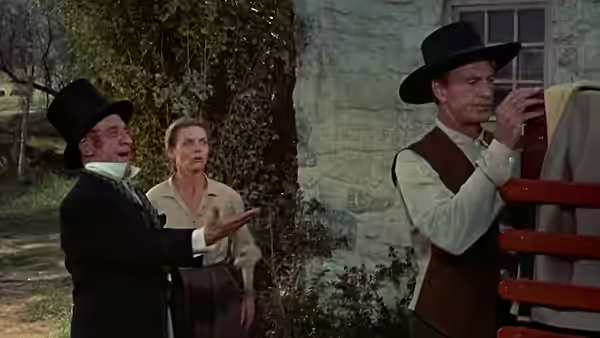
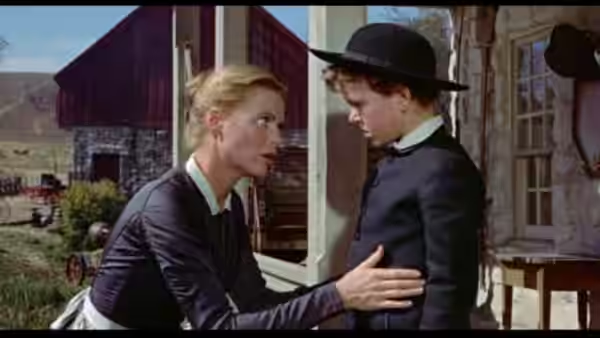
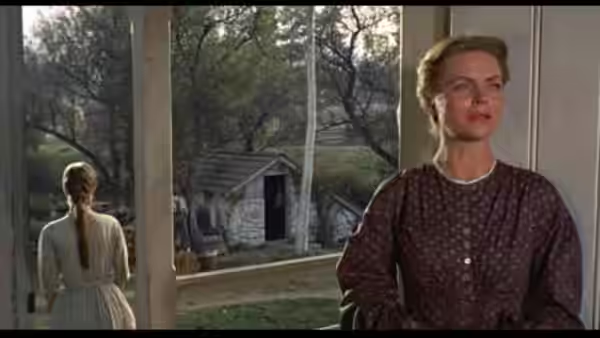
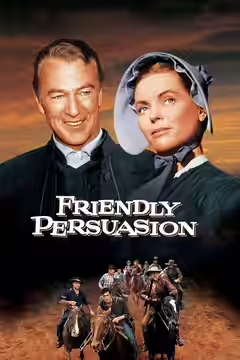
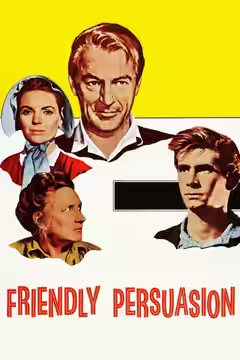
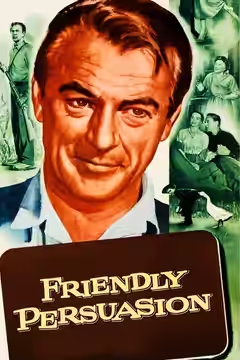
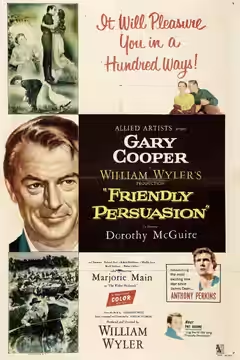
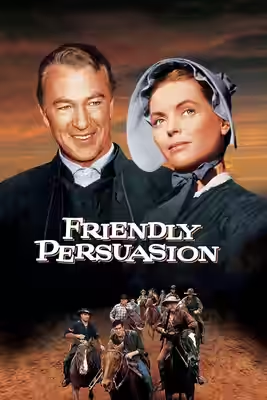
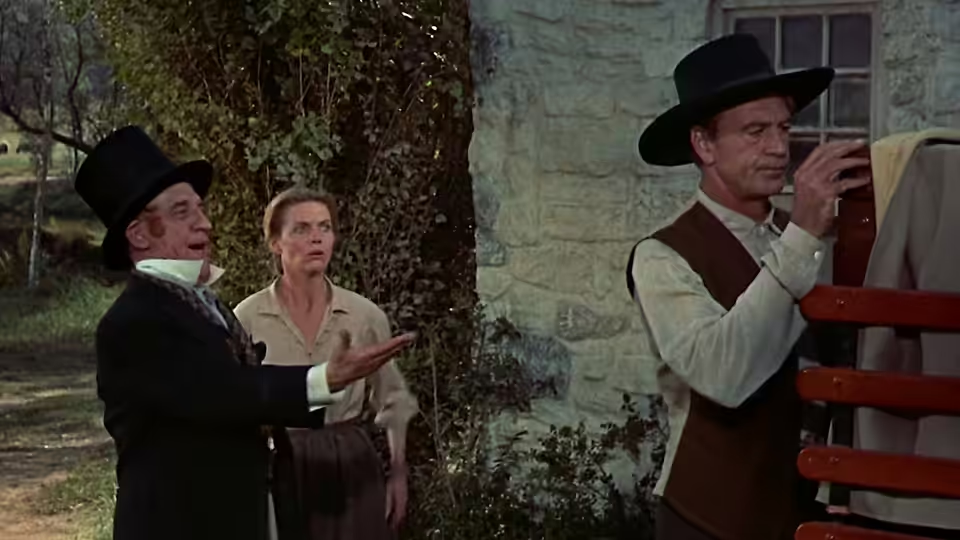
Professor Quigley (Walter Catlett) gestures while Jess Birdwell (Gary Cooper) adjusts a red ladder and Eliza Birdwell (Dorothy McGuire) watches
Film review

Friendly Persuasion

1956 · Directed by William Wyler · 2h 17m · MPA NR

In a sentenceGary Cooper spends the Civil War hiding an organ from his wife and losing arguments with a goose

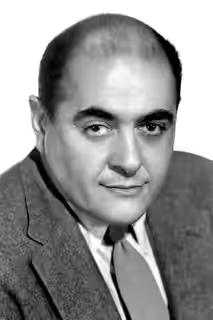
Indiana in the 1860s, with the Civil War being fought somewhere to the south. Jess Birdwell (Gary Cooper) is a Quaker nurseryman who loves a fast horse and loses the Sunday race to the meeting house every week to his Methodist neighbour Sam Jordan (Robert Middleton). His wife Eliza (Dorothy McGuire) is the meeting’s minister and would rather he did not race at all. Their eldest, Josh (Anthony Perkins), sits through the silence of worship wondering whether he could keep the peace if the war came up the road. A Union officer, Major Harvey (Theodore Newton), stands up in the meeting to ask which of the Friends will fight. Jess, meanwhile, has his eye on an organ, an instrument Eliza will not have in the house.

Plays from YouTube when you press play; nothing loads from them until then.

Fi1m review

William Wyler’s Quaker family drama is cosier and broader than its subject deserves, but when it turns to whether a peaceable man may fight it is honest, and Anthony Perkins, as the son who has to decide, is the best thing in it. Worth an evening.

William Wyler takes Jessamyn West’s stories of a Quaker family in Indiana during the Civil War and spreads them across 137 minutes, most of them sunlit, many of them played for laughs, with one hard question waiting at the end of the lane. What does a man who has promised never to raise his hand do when the fighting comes up his road? Friendly Persuasion is warm, broad and occasionally silly, and on that question it is honest. We recommend it, with the caveat that you will have to sit through a certain amount of goose.

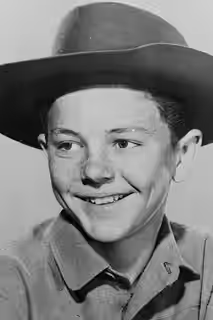
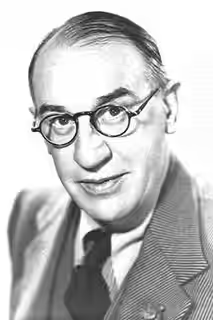
The comedy comes first. Jess Birdwell (Gary Cooper) races his Methodist neighbour Sam Jordan (Robert Middleton) to church every Sunday and loses, and the loss bothers him more than a Quaker should let it. A travelling salesman, Professor Quigley (Walter Catlett), sells him an organ, which he hides in the attic from his wife. His youngest, Little Jess (Richard Eyer), is in a running feud with the family goose, who bites. Cooper plays all of this at half speed, with a sly pleasure in his own weaknesses, and Michael Wilson’s screenplay gives him a way of saying thee that makes the plain speech sound like flirting.

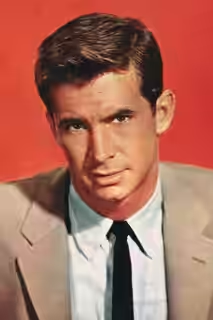
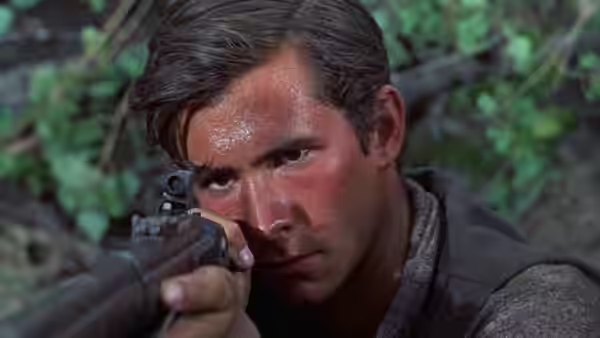
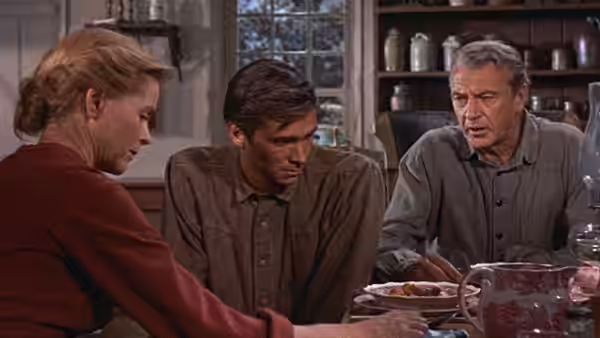
Dorothy McGuire’s Eliza is the meeting’s minister, and the film’s best idea is to give her the authority and give him the organ. When the instrument comes into the house she takes her bedding to the barn, and the scene in which Jess goes out to her, both of them stubborn and both of them fond, is as good a picture of a long marriage as Wyler ever shot. Anthony Perkins, as their son Josh, is something else again: long, awkward, the eyes always a little ahead of the mouth, a boy who cannot tell whether he is afraid to fight or afraid that he wants to. He is the only person in the film who seems to be thinking about the war before it thinks about him.

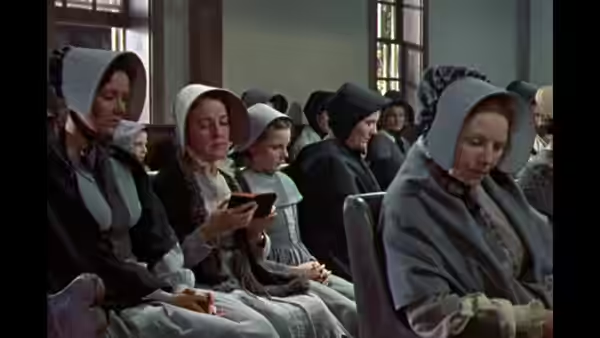
The scene we will not forget is in the meeting house, when Major Harvey (Theodore Newton), a Union officer, stands up in the silence and asks which of the Friends will come and fight. Nobody answers. Wyler holds on the benches, on the bonnets, on Perkins not looking at his mother, and lets the quiet do the arguing. It moved us more than we expected, because it is not staged as a debate. It is staged as a room full of people who have just worked out that a principle costs something.

Then the film goes back to being a farce. A selling trip in the middle, involving a widow and her three unmarried daughters, belongs to a different and worse picture, and Wyler plays it as broadly as a television comedy. We laughed, and then wished we had not, because the film had just been telling us it was serious. The three credited editors, Robert Belcher, Edward A. Biery and Robert Swink, cannot hide that this was stitched from a book of stories. Scenes end when the joke does, and the seams show.

Ellsworth Fredericks shoots the farm in colour so rich the fields look like a seed catalogue, yellow-green under a blue sky, and the interiors are plainly built on a stage, with the country outside the windows sitting a little too flat behind the glass. Dorothy Jeakins dresses the Birdwells in grey and brown and bonnets, so that Gard Jordan (Peter Mark Richman), courting Mattie (Phyllis Love) in his blue Union coat, looks like temptation walking through the door. Dimitri Tiomkin’s score is built on the title song, Thee I Love, sung over the credits by Pat Boone, and he brings the tune back on strings, on the organ and on a whistle until we could have sung it ourselves and rather wished he would stop.

Against Wyler’s own record this is a small film. The Best Years of Our Lives (1946) brought men home from a war; this one asks whether to go at all, and asks it of a boy rather than a nation. What the family does when the raiders reach the county we will not describe, except to say that the comfortable first hour is what makes it land. Most critics have liked it and so do we, though the reviews that call it charming are letting that middle stretch off lightly.

It carries a U certificate and runs a little long. Children will enjoy the goose. Adults will get more out of the meeting house, and out of watching Perkins fail to answer the major’s question.

Critical consensus AI synthesised

71
Positive
4
Mixed
1
Negative
0
The New York Times
2 November 1956
90*

The critic finds William Wyler's colorful film a warm, sweet surprise loaded with homely precept, cracker-barrel Americana, and a touching display of human nobility. Top honors go to the spirited, compassionate performances of Gary Cooper and Dorothy McGuire, with strong admiration also for Anthony Perkins.

Read the full review →
The New Yorker
3 November 1956 · John McCarten
70*

The film demonstrates that seeking peace requires more courage than seeking victory, delivering an affectionate portrait of a rural Quaker family with gently comic effects amid bucolic temptations. It is mostly charming with estimable acting, especially by Anthony Perkins, though sometimes overly sweet and marred by garish color and artificial scenery.

Read the full review →
Time Out
10 September 2012 · GA
70*

Wyler delivers an earnest Western-style tale of a Quaker family tested by the Civil War. Solid acting, especially from Perkins, and some humorous touches stand out, though the central conflict is handled simplistically and predictably.

Read the full review →
Variety
31 December 1955 · Variety Staff
70*

The simple story of a Quaker family in 1860s Indiana offers comedy, drama, suspense, and action, with warm vignettes of family life leading to a key dramatic point about pacifism. Gary Cooper and Dorothy McGuire are perfectly cast and immensely successful in the lead roles.

Read the full review →
The AV Club
13 March 2014 · festival review · A.A. Dowd
55*

The critic finds Friendly Persuasion a fine, amiable Golden Age entertainment with strong performances, intelligent ideas on pacifism and conscience, and Wyler's steady direction, but criticizes its cornball humor and lighter sitcom elements that dilute its moral seriousness. The piece questions its Palme d'Or win over bolder competition like Bresson and Wajda films.

Read the full review →

Straight answers AI written, from our review

Is Friendly Persuasion worth watching?
Friendly Persuasion is worth an evening, and we scored it 72. William Wyler's Quaker family drama is cosier and broader than its subject deserves, but when it asks whether a peaceable man may fight it is honest, and Anthony Perkins, as the son who has to decide, is the best thing in it. Expect a slack middle stretch and a good deal of goose.
How long is Friendly Persuasion, and what is it rated?
Friendly Persuasion runs 2h 17m and is rated NR by the MPA in the US. It is a drama and war film.
Where can I watch Friendly Persuasion in the US?
Friendly Persuasion is available to rent from Amazon Prime Video from $3.99. Availability is checked daily; the links above go straight to each service.
How violent or frightening is Friendly Persuasion, and is it suitable for children?
Friendly Persuasion carries a U certificate and is suitable for children, who will enjoy the family's feud with a biting goose. The Civil War stays mostly off screen, and the film's hardest moments are quiet ones, a Union officer asking a silent meeting house who will fight. Adults will get more from that question than the young ones will, but nothing here should trouble them.
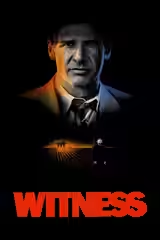
How does Friendly Persuasion compare to Witness?
Friendly Persuasion is a warmer, sillier and more honest film than Witness, though the later film is the more gripping. Wyler's picture is a family comedy with one serious question about pacifism at its heart; Peter Weir's is a romance with a crime thriller attached, and the thriller is its weaker half. Choose Wyler for the marriage and the meeting house, Weir for Harrison Ford and Kelly McGillis.
What should I watch after Friendly Persuasion?
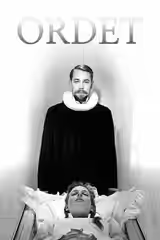
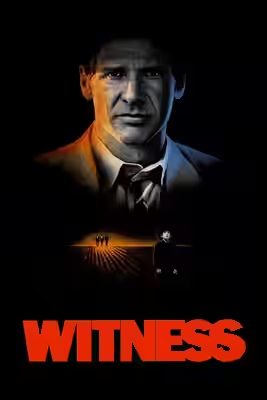
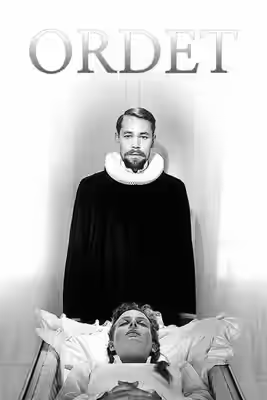
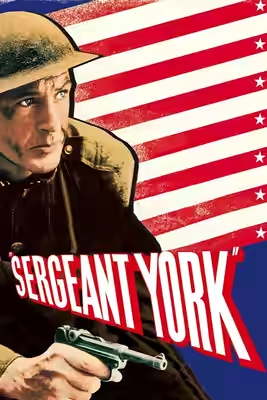
After Friendly Persuasion, try Witness (1985, Fi1m 84): Harrison Ford among the Amish; the barn, the bonnets and the gun in the flour tin. Then Ordet (1955, Fi1m 86): Dreyer’s Danish farming family, faith taken seriously and filmed without a single joke; and Sergeant York (1941, Fi1m 66): Cooper as another countryman who does not want to kill and is asked to.

Cast

Awards

Academy Awards, 1957

Nominated
Best Picture
Nominated
Best Sound
Nominated
Best Supporting Actor
Nominated
Best Writing, Adapted Screenplay

Cannes Film Festival, 1957

Won
Palme d'Or

Golden Globes, 1957

Nominated
Best Film Promoting International Understanding

If you liked this, try…

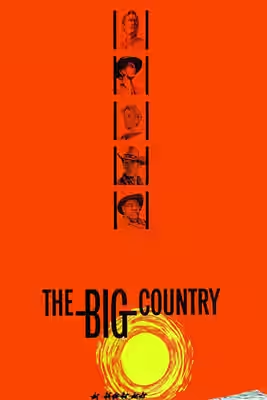
  1. The Big Country (1958) · not reviewed yetWyler again, two years on, with a hero who refuses to fight and means it.

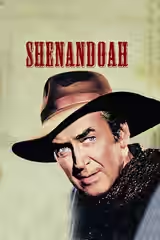
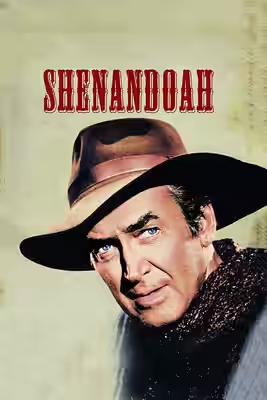
  2. Shenandoah (1965) · not reviewed yetJames Stewart tries to keep his sons out of the same war and fails.

  3. Witness (1985, Fi1m 84)Harrison Ford among the Amish; the barn, the bonnets and the gun in the flour tin.

  4. Ordet (1955, Fi1m 86)Dreyer’s Danish farming family, faith taken seriously and filmed without a single joke.

  5. Sergeant York (1941, Fi1m 66)Cooper as another countryman who does not want to kill and is asked to.

Free account

Know what to watch tonight

Two lists that know where things are streaming, collections you can share, your own score beside ours, and Discover that remembers what you have seen.

  • Want to see, sorted by what is streaming now
  • Seen, with your score out of ten
  • No adverts, ever