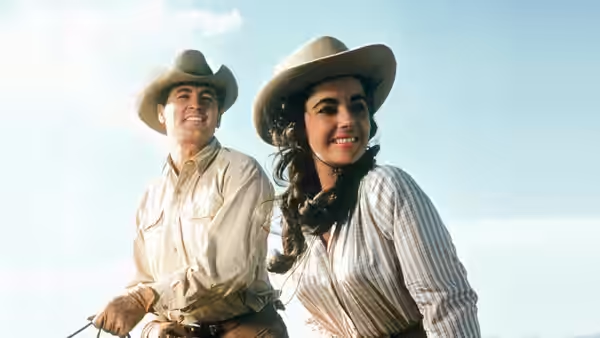
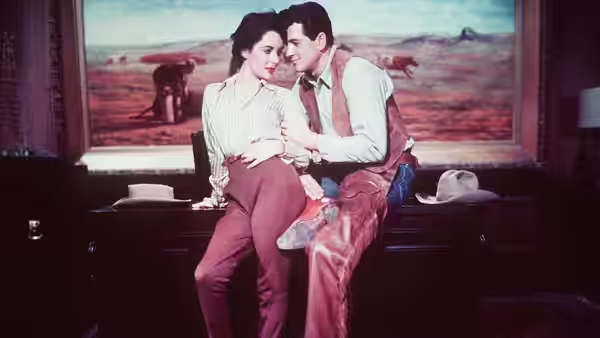
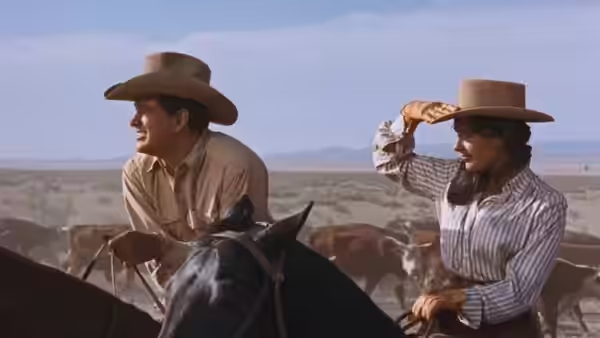
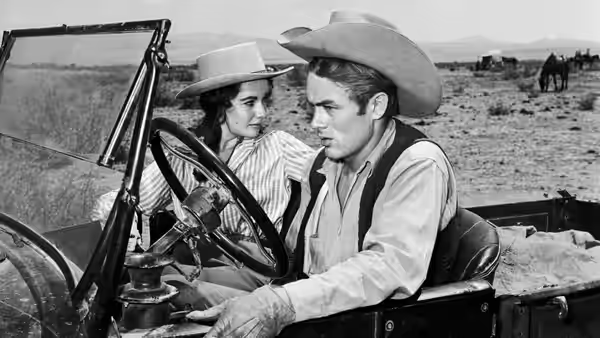
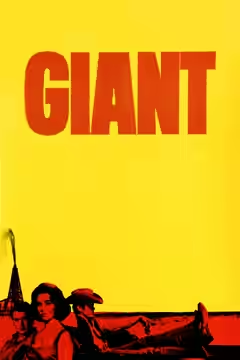
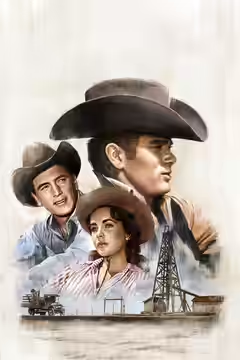
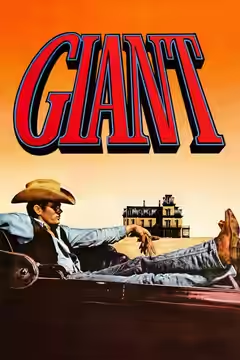
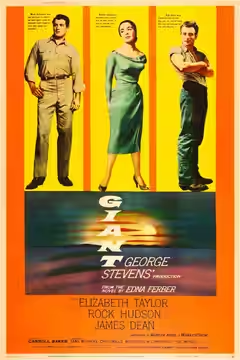
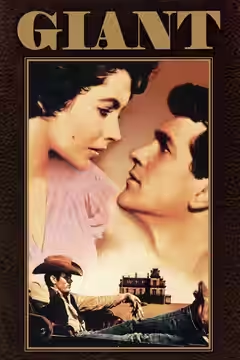
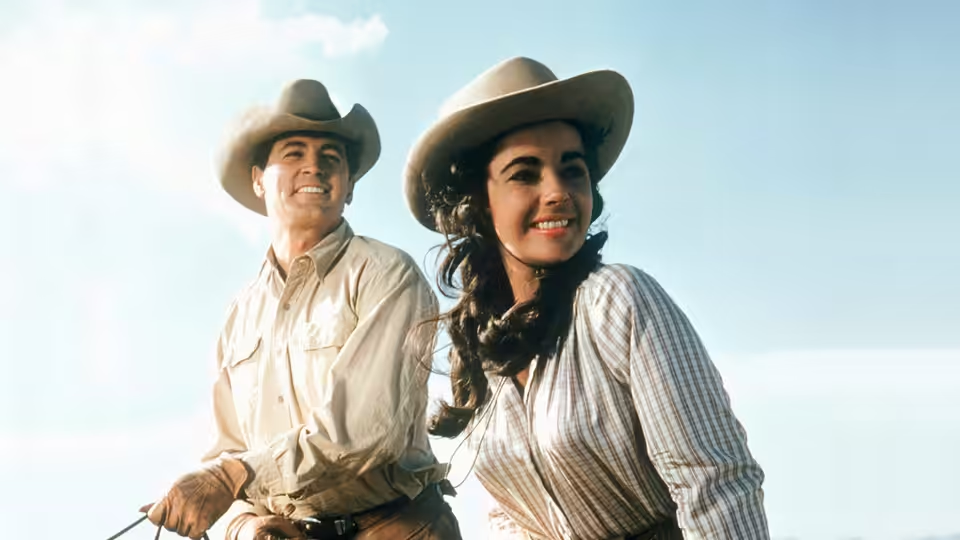
Bick Benedict (Rock Hudson) and Leslie Lynnton Benedict (Elizabeth Taylor) smiling in cowboy hats
Film review

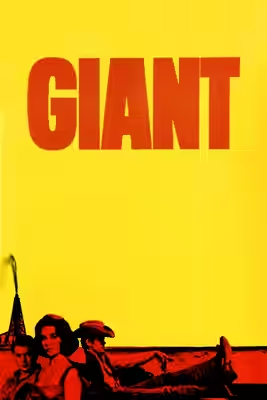
Giant

1956 · Directed by George Stevens · 3h 21m · MPA NR

In a sentenceRock Hudson owns most of Texas and Elizabeth Taylor still makes him feel small at breakfast

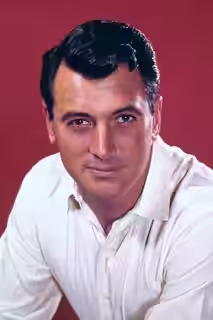
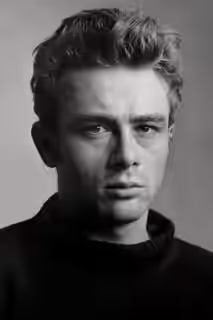
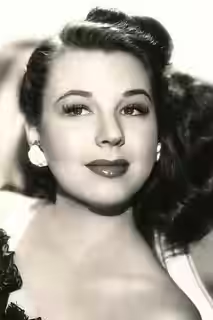
Jordan ‘Bick’ Benedict (Rock Hudson) runs Reata, a vast cattle ranch in Texas. He travels to Maryland to buy a horse from the Lynntons and comes home with a wife as well: Leslie (Elizabeth Taylor), a doctor’s daughter with opinions she sees no reason to keep quiet; Judith Evelyn plays her mother, Nancy. At Reata she finds a mansion standing alone on flat ground, a sister-in-law, Luz (Mercedes McCambridge), who has run the house for years and intends to keep running it, and a ranch hand, Jett Rink (James Dean), who resents the Benedicts and everything they own. Leslie wants a say in the place, including how the Mexican families who work it are treated. Bick wants Texas left exactly as he found it.

Plays from YouTube when you press play; nothing loads from them until then.

Fi1m review

George Stevens’s Texas saga is an hour too long and spends much of that hour telling us what it means. Before then it is a fine, large film about a marriage, with James Dean lit up in the corner of it.

George Stevens took Edna Ferber’s novel about Texas and made a film 201 minutes long, and the length is the first thing anyone says about it: it is an hour too much. Fred Guiol and Ivan Moffat’s screenplay follows one marriage on one cattle ranch while Texas turns from cows to oil, and it wants to say something about who the state belongs to and who it treats as hired help. It is handsome, earnest and too long, and the first two hours are good enough that we forgave it more than we should have.

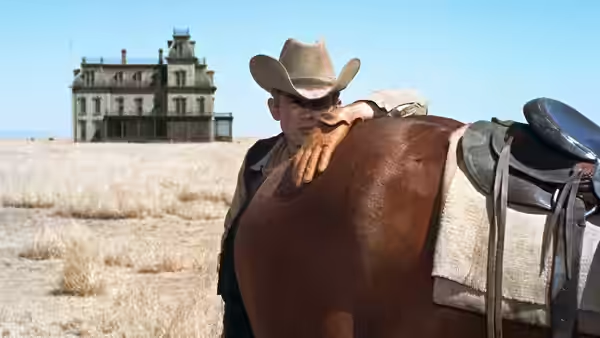
It looks tremendous. William C. Mellor shoots Texas flat and wide, the horizon a ruled line, and Boris Leven puts Reata, the Benedict mansion, alone in the middle of it. Mellor keeps the camera far back, so the house looks like something left on a table and the people around it are the size of pins. When years have to pass, Stevens and his editor William Hornbeck stack dissolves one over another, a child, a horse, a fence, and a decade is gone in a minute. Dimitri Tiomkin’s score is brass and drums, and it announces every wide shot as if Texas might otherwise have gone unnoticed.

The marriage holds it together. Elizabeth Taylor plays Leslie as a woman who has read a newspaper and does not see why that should stop at the state line, and Rock Hudson plays Bick as a decent, slow man who is wrong about most things and takes years to find out. Early on she walks into a room where the men are talking politics, is told to go and rest with the women, and declines; we bristled along with her, and so, for a moment, does Bick. Their quarrels are about small things, a chair at a table, a doctor for a sick baby, and every one of them is about the same large thing. Watch Hudson listen to her, and lose, and pretend he has not.

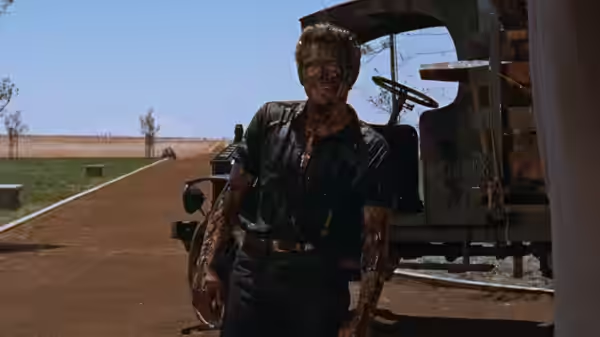
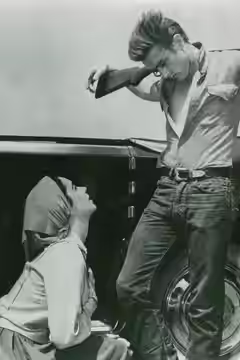
Then there is James Dean as Jett Rink, a ranch hand who hates the Benedicts and wants what they have. Dean mumbles, keeps his hat low and sits with his knees up like a boy, and every scene he is in tilts towards him. His one scene alone with Taylor, serving her tea in a shack full of junk, is the best acted thing in the film, two people being polite about the fact that neither belongs where they are. He also has the picture’s one indelible image, a man drenched black from head to foot, laughing on a porch, and we grinned at it as if we had struck the oil ourselves. He plays Jett into middle age with a rasp and a slump, and it half works.

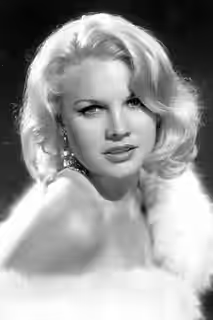
The last hour is where it goes wrong. The children grow up, Carroll Baker and Dennis Hopper as the young Benedicts, Sal Mineo as Angel Obregón, and the screenplay hands each of them a subject rather than a life. Racism, which the first half showed us in a kitchen and in a doctor’s refusal, becomes a topic, and the film starts telling us what it thinks in case the earlier scenes had not managed it. They had. Somewhere past the two-hour mark we were bored, and then irritated, because the first ninety minutes had been so sure of themselves. Stevens, who made Shane three years earlier and knew when to stop, seems to have kept everything.

Most critics have split between calling it a great screen epic and a long yawn, and the consensus has settled in the middle. We are a little warmer. A film about a marriage does not usually get this much land, money or time, and Taylor and Hudson use nearly all of it. The speeches are the part they cannot save.

Watch it at home, where the wide shots lose something and the kitchen arguments lose nothing, and give it the whole evening; the last hour only makes sense if you have lived with these people through the first two. It runs 201 minutes, carries a PG, and reached British cinemas on 3 January 1957.
Critical consensus AI synthesised

65
Positive
8
Mixed
2
Negative
3

Most critics like Giant, and the praise gathers around two things: the scale and James Dean. From the first notices onwards it is treated as a large, serious picture about Texas, oil and money, and several reviews credit it with unusual directness on racism for its period. Stevens’ handling of landscape, dissolves and blocking is admired, and Dean’s Jett Rink is named again and again as the performance to watch, with Taylor and Hudson praised more evenly.

The reservations gather around length. Nearly every review, including the warm ones, mentions the three-hour-plus running time; the mixed and negative ones find it plodding, heavy-handed about the American Dream and closer to soap opera than epic. The spread is wide. Variety and The New York Times are among the strongest notices, while The New Yorker, in the same week, finds it rambling and elementary, and Slant Magazine dismisses it as long and boring.

The New York Times
11 October 1956 · Bosley Crowther
90*

The film is a tremendously vivid picture-drama that gushes a tawdry tragedy and gives an almost documentary picture of how oil exaggerated and confused the feudalistic ways of Texas. It is a strong contender for the year's top-film award, with exciting performances from the cast including Elizabeth Taylor, Rock Hudson, and especially James Dean.

Read the full review →
Variety
10 October 1956 · Hift.
90*

For the most part an excellent film which registers strongly on all levels with breathtaking panoramic shots, personal dramatic impact, and a resounding message; performances by Taylor, Hudson, and Dean match the production values under Stevens’ direction. It is a powerful indictment of the Texas superiority complex and measures up to its expectations at the box office.

Read the full review →
Sight and Sound
13 December 2016 · Peter Tonguette
85*

The critic presents Giant as an ambitious, daring and weird epic whose vast canvas and visual poetry anticipate the unruly auteur films of 1970s New Hollywood. Particular praise goes to its painterly use of landscape, dissolves and scale.

Read the full review →
The Guardian
17 September 2025
80*

The critic praises George Stevens’ epic as a film of great conscience and scale, following a Texas family across decades as they confront social and political changes. Dean’s performance as Jett Rink is singled out as the film’s true standout.

Read the full review →
The Hollywood Reporter
10 October 2016 · James Powers
80*

The critic calls the film a monumental drama as big and inspiring as Texas itself, praising its epic scale, ambition, screenplay, and standout performances from Elizabeth Taylor, Rock Hudson, and especially James Dean. While noting the three-hour-plus runtime may lead to diminishing returns for some viewers, the review deems it one of the great screen epics.

Read the full review →
The AV Club
14 July 2003 · Noel Murray
70*

The review positions Giant as a sprawling yet intimate epic that studies characters and Texas life more than grand events, highlighting strong performances with Dean's magnetic method acting contrasting Hudson and Taylor's classicism, and praising Stevens' framing and blocking despite occasional awkward pacing.

Read the full review →

Straight answers AI written, from our review

Is Giant worth watching?
Giant is worth watching for anyone with a whole evening to spare for a large, handsome film about a marriage, and we scored it 74. Elizabeth Taylor and Rock Hudson quarrel over chairs and doctors and mean something bigger every time, and James Dean tilts every scene he is in towards him. The last hour turns into speeches, and we were bored by it.
How long is Giant, and what is it rated?
Giant runs 3h 21m and is rated NR by the MPA in the US. It is a drama and western film.
Where can I watch Giant in the US?
Giant is available to rent from Amazon Prime Video from $4.99. Availability is checked daily; the links above go straight to each service.
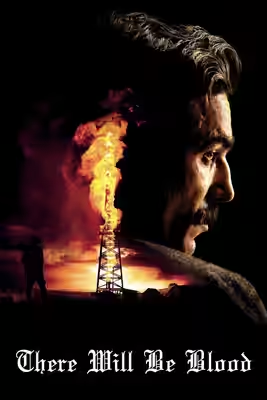
How does Giant compare to There Will Be Blood?
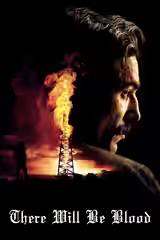
Giant is the warmer and longer of the two, a film about a marriage on a Texas ranch that happens to strike oil, while There Will Be Blood is a colder, frightening study of one greedy man on the plain. Anderson's film is the tighter and more gripping; Stevens's has more people to care about and a last hour it cannot save. Choose Giant for company, There Will Be Blood for dread.
Is Giant based on a true story or a book?
Giant is based on Edna Ferber's novel of the same name about Texas, not on a true story. Fred Guiol and Ivan Moffat's screenplay follows one marriage on one cattle ranch as the state turns from cattle to oil. You do not need to have read the book; the film spends its final hour making sure you know what it means anyway.
What should I watch after Giant?
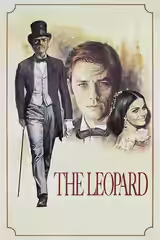
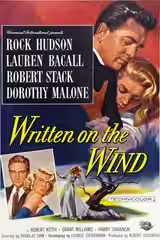
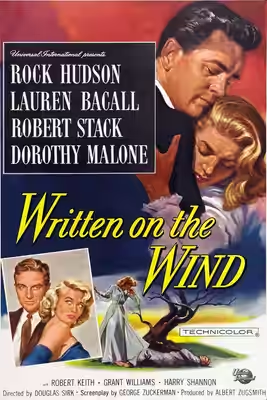
After Giant, try There Will Be Blood (2007, Fi1m 88): Oil, a lonely house on the plain and a far nastier man than Jett Rink. Then The Leopard (1963, Fi1m 88): Another landed family watching its world change, shot with the same patience and more grace; and Written on the Wind (1956, Fi1m 83): Hudson again, oil money again, and everything Giant keeps sober here turned lurid.

Cast

Awards

Academy Awards, 1957

Nominated
Best Actor
Nominated
Best Art Direction, Color
Nominated
Best Costume Design, Color
Nominated
Best Film Editing
Nominated
Best Original Dramatic or Comedy Score
Nominated
Best Picture
Nominated
Best Supporting Actress
Nominated
Best Writing, Adapted Screenplay
Won
Best Director

If you liked this, try…

  1. There Will Be Blood (2007, Fi1m 88)Oil, a lonely house on the plain and a far nastier man than Jett Rink.

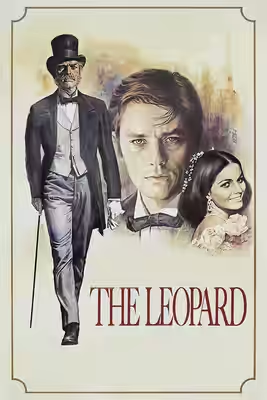
  2. The Leopard (1963, Fi1m 88)Another landed family watching its world change, shot with the same patience and more grace.

  3. Written on the Wind (1956, Fi1m 83)Hudson again, oil money again, and everything Giant keeps sober here turned lurid.

  4. East of Eden (1955) · not reviewed yetDean’s first lead, and the fidgeting, wounded manner Jett Rink is built from.

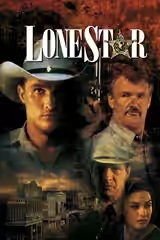
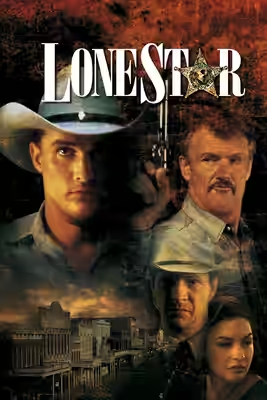
  5. Lone Star (1996, Fi1m 86)A Texas border town, buried history and the race question Giant only lectures about.

Free account

Know what to watch tonight

Two lists that know where things are streaming, collections you can share, your own score beside ours, and Discover that remembers what you have seen.

  • Want to see, sorted by what is streaming now
  • Seen, with your score out of ten
  • No adverts, ever