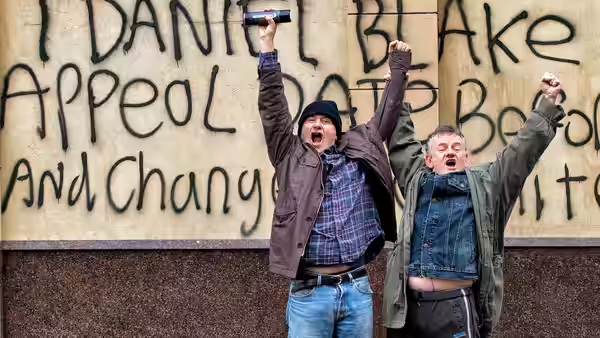
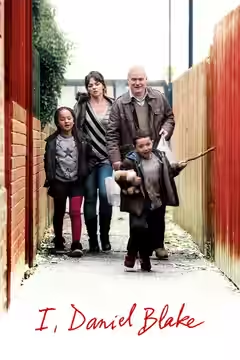
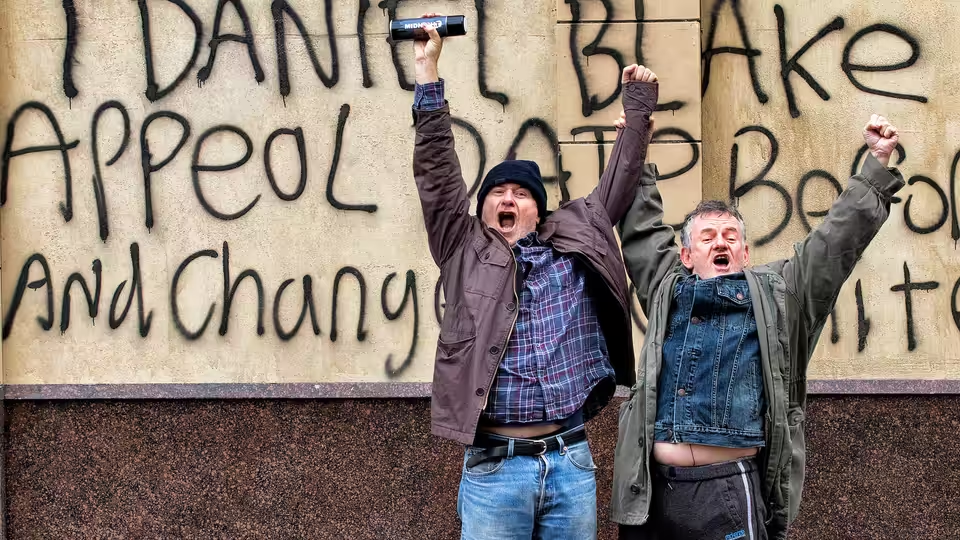
Dan (Dave Johns) and a companion raising their fists before a graffiti wall
Film review

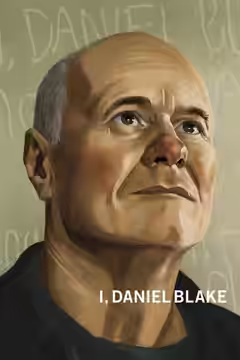
I, Daniel Blake

2016 · Directed by Ken Loach · 1h 40m · MPA R

In a sentenceWe would happily spend another hour with Dave Johns, provided the benefits office left him alone

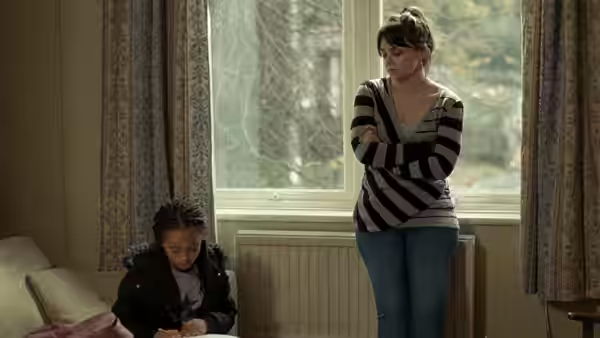
In austerity-era Tyneside, Dan (Dave Johns), a 59-year-old joiner, tries to secure benefits after a heart attack interrupts his working life. His claim brings him into contact with the Assessor (Amanda Payne) and a succession of bureaucratic obstacles. As he struggles to obtain support, he befriends Katie (Hayley Squires), a single mother who is also trying to get by. Their friendship brings some practical kindness into lives increasingly occupied by official demands. Dan wants help while he is ill, but obtaining it means negotiating a system that keeps putting obstacles in his way.

Plays from YouTube when you press play; nothing loads from them until then.

Fi1m review

Ken Loach’s welfare drama presses its case too hard at times, but Dave Johns and Hayley Squires give it warmth and stubborn humour. We recommend it, with a warning that its distress is difficult to shake.

Ken Loach’s I, Daniel Blake is moving and humane, though its script sometimes pushes too hard. We recommend it for Dave Johns and Hayley Squires, who make the central friendship worth caring about. Ken Loach wants us to understand how exhausting it is to seek help from an institution that keeps making the task harder. He spends 100 minutes attending to the people doing the asking.

Dave Johns gives Dan a sociability that prevents his illness and his claim from becoming everything we know about him. The humour matters: this is someone we might enjoy talking to, and the film lets him be likeable without requiring him to be charming every moment. We were angry long before his encounters with the benefits bureaucracy were over. His requests for help are so ordinary that the obstacles put before him begin to feel intolerable, and Dave Johns lets the frustration build without turning every exchange into an outburst.

Hayley Squires gives Katie a more guarded determination, and the difference makes their friendship persuasive. Her performance suggests the effort involved in accepting kindness when getting through the day already takes everything available. Paul Laverty’s screenplay is strongest when it allows these two people to offer each other something the official exchanges do not: patience, humour and attention. Their company holds our interest even when there is no fresh difficulty to negotiate.

Robbie Ryan’s cinematography keeps faces readable and surroundings plain, without inviting us to admire an attractive image of hardship. That restraint works because there is enough happening in the performances to hold our attention. Production designers Fergus Clegg and Linda Wilson make the everyday spaces feel used rather than arranged for our inspection. Their work helps the encounters with officialdom remain mundane, which matters: the treatment of claimants would be easier to dismiss if every room looked built to frighten them.

Jonathan Morris’s editing allows the bureaucratic encounters to become wearing, keeping our attention on the effort they demand from Dan. We have time to notice how a conversation becomes another obstacle. George Fenton’s restrained music leaves the actors room to register distress without competing with them, a useful discretion in a film whose screenplay can be so emphatic.

The reservation is with Paul Laverty’s habit of making each obstacle serve the same point. Too often, we can recognise the lesson a scene is heading towards before anyone has finished speaking, and the officials have less room to be people than Dan and Katie do. This narrows a film that is otherwise attentive to the difficulties of ordinary life. A little more uncertainty in those exchanges would have made the frustration more convincing. The actors supply some of the unpredictability that the writing leaves out.

Within social realism, this is familiar work, with little interest in disguising what it wants us to think. Its warmth is less predictable, and the friendship gives us reasons to stay that extend beyond agreement with its politics. We recommend it with a caveat about the script’s insistence, and no such reservation about the two leads. Do not choose it to unwind.

Critical consensus AI synthesised

68
Positive
10
Mixed
0
Negative
3

Most critics come down in favour, and their praise lands in the same places. Dave Johns and Hayley Squires are singled out again and again, both for playing it plain and lived-in, and the food bank scene is named repeatedly as the film’s strongest passage. Several reviews call this a return to form for Loach: spare, unflashy, angry in a quiet way, and timely on austerity and the benefits system. Even those who like it least tend to grant the performances.

Where they part is over subtlety. Admirers concede the film is didactic and occasionally heavy-handed; the dissenters say that is the whole of it. Little White Lies finds a blunt, ranty screed without nuance, the Evening Standard calls it propaganda that reveals little new about the system, and Slant finds the plotting schematic and the deck stacked. The spread is wide, from full marks to one star, though the middle ground is firmly positive.

The i Paper
19 October 2016 · ★★★★★ · Matthew Turner
100

The critic hails the film as a powerful and urgent social drama and scathing indictment of austerity Britain, praising the terrific performances of Dave Johns and Hayley Squires along with its basis in real research and emotional impact.

Read the full review →
Empire
17 October 2016 · Andrew Lowry
75*

The critic finds the film a profound sigh of disappointment rather than anger at the benefits system, praising its authentic portrayal of bureaucracy and strong lead performances, especially Hayley Squires as Katie, while noting the agenda-driven lack of subtlety.

Read the full review →
The Hollywood Reporter
12 May 2016 · festival review · David Rooney
75*

The film is quintessential Loach with familiar social-realist elements about ordinary people crushed by a hostile welfare bureaucracy, anchored by strong performances and urgent storytelling despite some didactic tendencies.

Read the full review →
Screen Daily
12 May 2016 · festival review
70*

The review highlights the film's potent empathetic anguish and fury as a timely protest against punitive austerity policies, while noting it does not break new ground.

Read the full review →
Little White Lies
13 May 2016 · festival review · David Jenkins
40*

The review describes the film as a blunt, ranty anti-government screed lacking nuance or subtlety, though it singles out Hayley Squires' naturalistic performance for praise.

Read the full review →
Evening Standard
21 October 2016 · David Sexton
35*

The review calls the film hard-hitting propaganda that reveals little new about the cruelty of the benefits bureaucracy and welfare rules, describing it as agitprop with an obvious unhappy ending and simplistic Marxist perspective.

Read the full review →

Straight answers AI written, from our review

Is I, Daniel Blake worth watching?
I, Daniel Blake is worth watching for anyone prepared for a welfare drama whose distress is difficult to shake, and we scored it 82. Dave Johns and Hayley Squires give the central friendship warmth and stubborn humour, though Paul Laverty's script presses its case too hard and lets us see each lesson coming. Do not choose it to unwind.
How long is I, Daniel Blake, and what is it rated?
I, Daniel Blake runs 1h 40m and is rated R by the MPA in the US. It is a drama film.
Where can I watch I, Daniel Blake in the US?
I, Daniel Blake is streaming on AMC+, The Roku Channel, Amazon Prime Video, Apple TV, Hulu and Paramount+ in the US, and it is also available to rent from Amazon Prime Video and Apple TV from $3.99. Availability is checked daily; the links above go straight to each service.
How violent or frightening is I, Daniel Blake, and is it suitable for children?
I, Daniel Blake carries a UK 15 certificate, and its weight is emotional rather than violent: we found its distress difficult to shake. The film follows a man seeking benefits after a heart attack, and the strain of his encounters with officialdom is what wears on a viewer. It is not for children; older teenagers who can sit with an upsetting, unhurried drama will manage it.
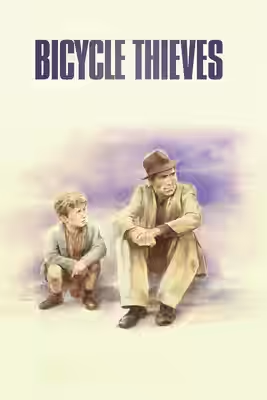
How does I, Daniel Blake compare to Bicycle Thieves?
I, Daniel Blake and Bicycle Thieves both follow a working man's struggle with patience and little protection from hardship, and the earlier film is the more painfully affecting of the two. Loach's film has more humour, thanks to Dave Johns and Hayley Squires, but its screenplay makes every obstacle serve the same point, where De Sica's fault is a score that presses too hard. Choose De Sica for the purer account of poverty, Loach for the warmer company.
What should I watch after I, Daniel Blake?
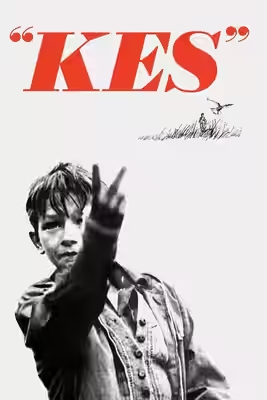
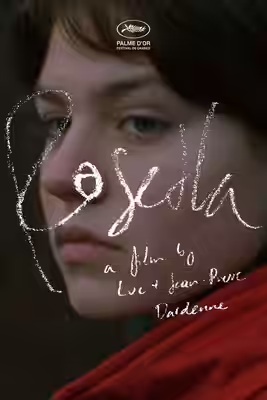
After I, Daniel Blake, try Bicycle Thieves (1948, Fi1m 93): For another working man’s struggle, told with patience and little protection from hardship. Then Kes (1969, Fi1m 88): Ken Loach finds humour and tenderness in another life with few allowances; and Rosetta (1999, Fi1m 82): An equally stubborn demand for work, filmed with less room to breathe.

Cast

Awards

Cannes Film Festival, 2016

Won
Palme d'Or

European Film Award for Best Actor, 2016

Nominated
European Film Award for Best Actor

European Film Award for Best Director, 2016

Nominated
European Film Award for Best Director

European Film Award for Best Film, 2016

Nominated
European Film Award for Best Film

European Film Award for Best Screenwriter, 2016

Nominated
European Film Award for Best Screenwriter

European University Film Award, 2016

Won
European University Film Award

If you liked this, try…

  1. Bicycle Thieves (1948, Fi1m 93)For another working man’s struggle, told with patience and little protection from hardship.

  2. Kes (1969, Fi1m 88)Ken Loach finds humour and tenderness in another life with few allowances.

  3. Rosetta (1999, Fi1m 82)An equally stubborn demand for work, filmed with less room to breathe.

  4. A Separation (2011, Fi1m 93)Family obligations and financial pressures complicate every attempt to do the decent thing.

  5. The Florida Project (2017, Fi1m 88)Children find room to play while the adults struggle to stay housed.

Free account

Know what to watch tonight

Two lists that know where things are streaming, collections you can share, your own score beside ours, and Discover that remembers what you have seen.

  • Want to see, sorted by what is streaming now
  • Seen, with your score out of ten
  • No adverts, ever