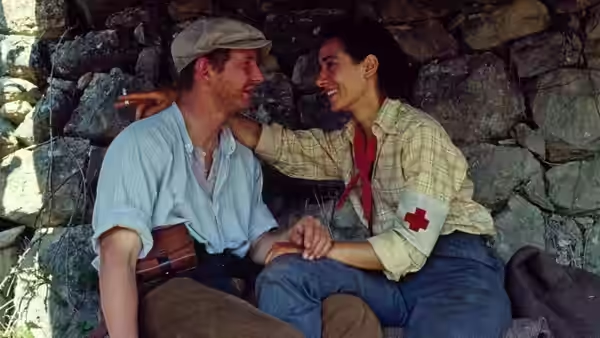
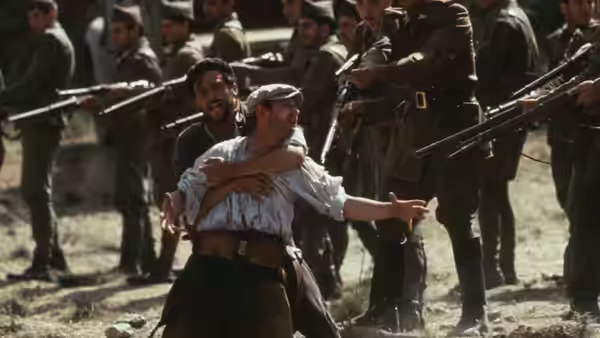
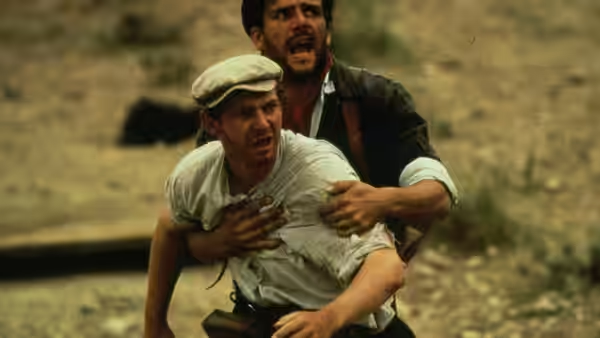
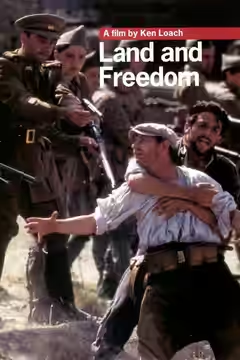
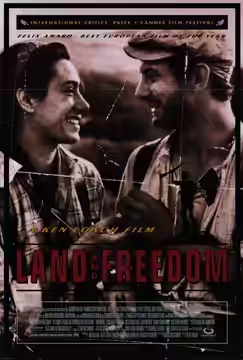
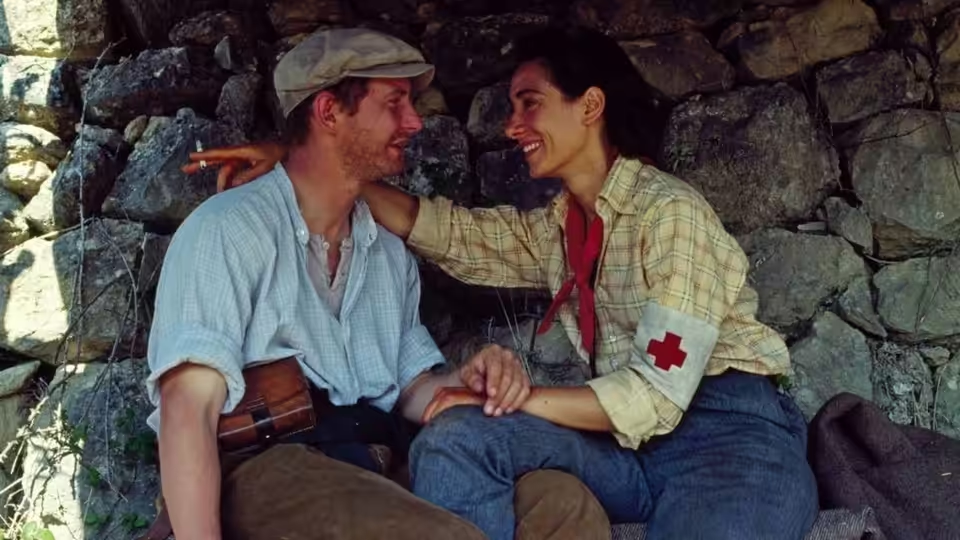
David Carr (Ian Hart) and Blanca (Rosana Pastor) sitting together by a stone wall
Film review

Land and Freedom

1995 · Directed by Ken Loach · 1h 49m

In a sentenceA war film that makes us want the meeting to run longer

David Carr (Ian Hart) leaves Liverpool to volunteer in the Spanish Civil War, joining a POUM militia. His experiences among the Republican fighters bring him into both front-line combat and arguments about the cause he has come to support. The volunteers share an enemy, but their political loyalties do not always agree, and the struggle asks more of Carr than his willingness to fight. Ken Loach directs, with Rosana Pastor as Blanca, Frédéric Pierrot as Bernard and Icíar Bollaín as Maite; a story involving Carr’s granddaughter frames his time in Spain.

Fi1m review

Ken Loach’s Spanish Civil War drama is moving because it lets its volunteers argue, doubt and think. Ian Hart keeps it human, even when the dialogue grows lengthy and the framing story explains too much.

Ken Loach’s Land and Freedom is a moving war film that takes political conviction seriously enough to let people explain it. That requires patience, and mostly rewards it. Jim Allen’s screenplay follows David Carr, an idealistic Liverpudlian volunteer, into the Spanish Civil War and a POUM militia. Loach wants us to understand why somebody would go to fight in another country, and why sharing an enemy might not be enough to keep the volunteers together.

Ian Hart gives David enough uncertainty to keep his idealism believable. He is not there simply to guide us through the history, and Hart makes the questions feel worth asking even when the dialogue becomes explanatory. The love story and the ensemble’s gentle humour give the volunteers something to do besides explain their beliefs. We can believe these people enjoy one another’s company, which gives their disagreements a personal cost.

Loach takes the disagreements within the Republican cause seriously, without assuming that being on the same side makes agreement easy. We were moved by the volunteers arguing over the cause they have risked their lives for. They are trying to decide what is worth fighting for while the fighting is still going on, and the uncertainty is painful. Loach gives their words enough weight that we understand why a disagreement cannot simply be put aside until the shooting stops.

Barry Ackroyd’s cinematography gives the front-line fighting a raw, immediate quality. The action is forceful without making the volunteers look invulnerable, and the documentary feel helps it sit beside the conversations rather than compete with them. Martin Johnson’s production design is persuasive in the Republican trenches, where the setting never distracts us from the people occupying it. These are places we accept as part of their daily lives.

Jonathan Morris’s editing allows the arguments space, a decision that carries a risk in a film with combat to return to. Allen occasionally lets a point go on after it is clear, but cutting every discussion to brisk exchanges would lose the sense of people thinking things through together. George Fenton’s score is a supporting presence, and that suits a film whose spoken exchanges already carry so much feeling. The slower passages are not all equally absorbing.

The framing story involving David’s granddaughter is less convincing. Loach and Allen seem anxious that we might fail to understand why this history matters, although the volunteers have already made that clear. It puts a faintly instructive tone around a film that is most persuasive when it lets people speak for themselves.

The attention to disagreements among allies makes a change from war dramas that ask us to admire unity and leave it there. Loach’s fighters can be brave, sincere and still unable to agree, and he allows that difficulty to occupy the film. The 109 minutes ask for concentration, particularly when political loyalties become difficult to follow. See it when you have the patience for people who believe an argument might change something.
Critical consensus AI synthesised

79
Positive
8
Mixed
0
Negative
0

The reviews are uniformly favourable, and they agree on the shape of the achievement: this is Ken Loach working on a larger canvas than usual, taking his plain, documentary-style method into the trenches of the Spanish Civil War without losing it. Most critics praise the performances, with Time Out singling out Ian Hart, and the action scenes, which are described as raw and intense rather than staged. Several find it moving, and the political arguments are thought lucidly handled.

The reservations are all about talk. Several reviews note that the militia debates run long, and the harsher ones call them didactic or pedantic. The New Yorker also finds the personal relationships handled awkwardly, and The Independent thinks the framing device with the granddaughter condescends to the audience. The spread is narrow, from warm to cautiously admiring, and nobody dissents from the view that the film is worth an evening.

Los Angeles Times
29 March 1996
90*

The film pays moving and thoughtful tribute to the thwarted romanticism of idealistic fighters in the Spanish Civil War through naturalistic treatment of human truths and refusal to shortchange passion. It enlarges Loach's scope while retaining his signature honest and heartfelt qualities as an epic working-class story.

Read the full review →
Variety
24 April 1995 · festival review · Variety Staff
90*

Loach's most ambitious film follows a Liverpudlian into the Republican trenches and political treachery of the Spanish Civil War, with superb performances, gentle humor, warmth, action sequences and a beautifully teased-out love story. Despite slight windiness in political discussions, it should be one of the must-see art movies of the year.

Read the full review →
Empire
1 January 2000 · Ian Nathan
85*

The critic calls it Ken Loach’s most epic film, noting its docu-realistic approach to the Spanish Civil War combined with a more poetic and eloquent style than his usual work. It highlights the focus on ordinary people’s struggles and soul-searching amid historical events, with strong performances, though it remains hard-edged.

Read the full review →
Little White Lies
18 July 2016 · James Clarke
80*

The critic highlights how the film blends personal stories with political debates to explore the Spanish Civil War, noting its relevance decades later and Loach's skill in showing characters' moral growth amid conflict.

Read the full review →
The Independent
7 October 1995 · Quentin Curtis
80*

The critic finds the film a lucid and moving history lesson that renders complex political arguments in cinematic terms through the eyes of an idealistic Liverpudlian volunteer. Loach is praised for his unsentimental, grounded depiction of the Spanish Civil War and its internal conflicts, though the framing device with the granddaughter is noted as a minor flaw that feels condescending.

Read the full review →
The New Yorker
18 March 1996 · Anthony Lane
70*

Loach's most adventurous project dramatizes the clear-cut morality of the Spanish Civil War through a Liverpudlian's journey to fight with a POUM militia. The film excels in its earnest political arguments and naturalistic style but shows gaucherie in personal relationships and clichéd elements.

Read the full review →

Straight answers AI written, from our review

Is Land and Freedom worth watching?
Land and Freedom is worth watching for anyone with the patience for a war film that lets its volunteers argue as well as fight, and we scored it 83. Ian Hart keeps David Carr's idealism human, and the disagreements among the Republican fighters are the most moving part. The framing story explains too much, and the slower passages are not all equally absorbing.
How long is Land and Freedom, and what is it rated?
Land and Freedom runs 1h 49m. It is a war and drama film.
Where can I watch Land and Freedom in the US?
Land and Freedom is not on any streaming or rental service in the US at the moment. It is available in 3 other countries; change your country at the top of the page to see where. Availability is checked daily.
How violent or frightening is Land and Freedom, and is it suitable for children?
Land and Freedom carries a UK 15 certificate, and its front-line combat is raw and immediate rather than frightening in a horror sense. Barry Ackroyd shoots the fighting so the volunteers never look invulnerable, so the violence has weight. It is not for children, and younger teenagers may find the long political arguments harder going than the battles.
How does Land and Freedom compare to The Battle of Algiers?
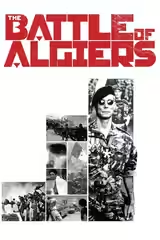
Land and Freedom is the warmer and more talkative of the two, while The Battle of Algiers is the tighter and harder to bear. Loach spends his time with volunteers arguing over what they are fighting for; Pontecorvo concentrates on the campaign itself, and leaves less room for the people caught in it. Choose Loach for the people, Pontecorvo for the grip.
What should I watch after Land and Freedom?
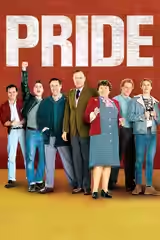
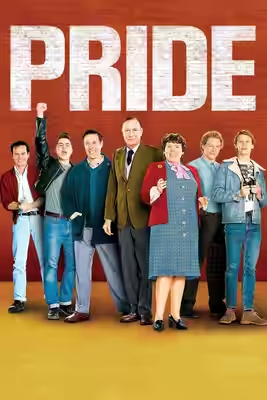
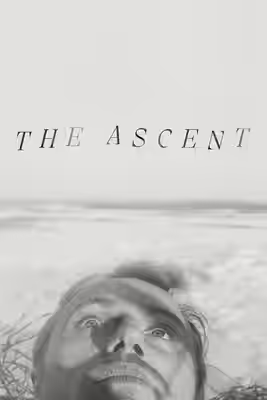
After Land and Freedom, try The Battle of Algiers (1966, Fi1m 93): Another political struggle made immediate through faces, streets and uncomfortable choices. Then Pride (2014, Fi1m 82): A warmer account of solidarity, with room for awkwardness and disagreement; and The Ascent (1977, Fi1m 88): For a harsher test of conviction when warfare makes decency costly.

Cast

Awards

César Award for Best Foreign Film, 1996

Won
César Award for Best Foreign Film

Sant Jordi Prize, 1996

Won
Sant Jordi Prize

Turia Awards, 1996

Won
Turia Awards

European Film Award for Best Film, 1995

Won
European Film Award for Best Film

Prize of the Ecumenical Jury Cannes, 1995

Won
Prize of the Ecumenical Jury Cannes

If you liked this, try…

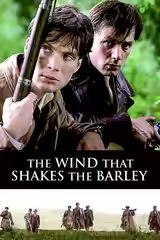
  1. The Wind That Shakes the Barley (2006) · not reviewed yetLoach returns to comrades divided by politics, with equally painful results.

  2. The Battle of Algiers (1966, Fi1m 93)Another political struggle made immediate through faces, streets and uncomfortable choices.

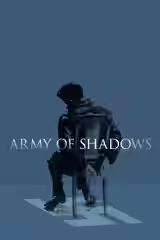
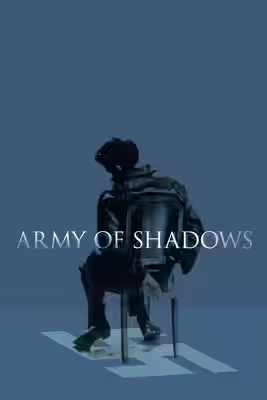
  3. Army of Shadows (1969) · not reviewed yetFor more resistance work stripped of reassurance, and comradeship under pressure.

  4. Pride (2014, Fi1m 82)A warmer account of solidarity, with room for awkwardness and disagreement.

  5. The Ascent (1977, Fi1m 88)For a harsher test of conviction when warfare makes decency costly.

Free account

Know what to watch tonight

Two lists that know where things are streaming, collections you can share, your own score beside ours, and Discover that remembers what you have seen.

  • Want to see, sorted by what is streaming now
  • Seen, with your score out of ten
  • No adverts, ever