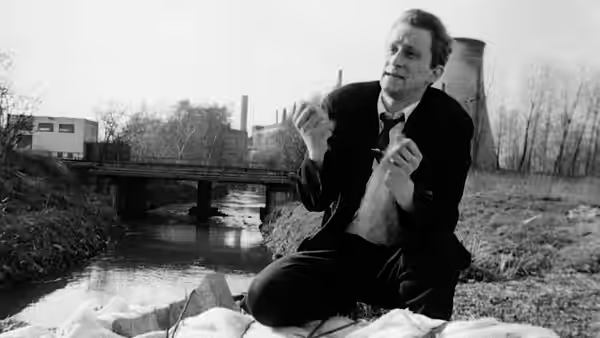
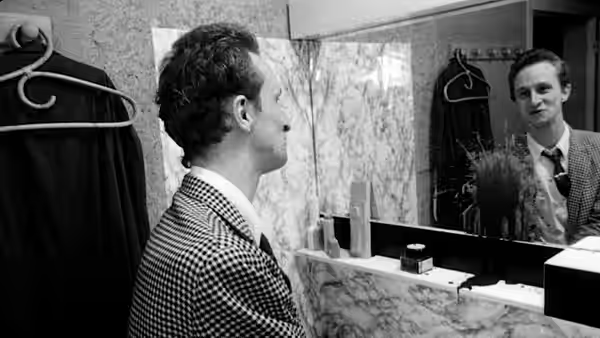
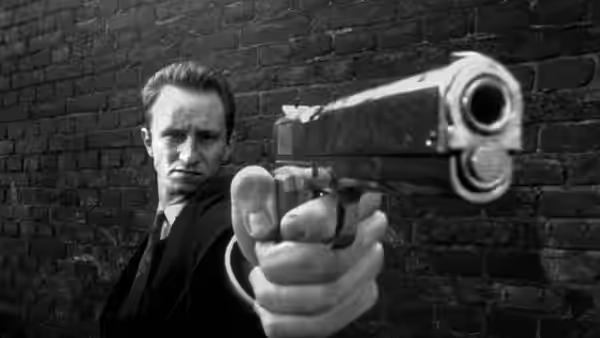
Ben (Benoît Poelvoorde) kneeling by a river gesturing with both hands
Film review

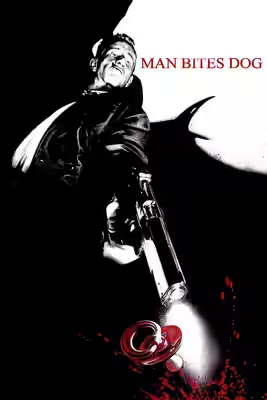
Man Bites Dog

1992 · Directed by Rémy Belvaux, Benoît Poelvoorde, André Bonzel · 1h 36m · MPA NC-17

In a sentenceThe camera crew seem to have mistaken a charming murderer for a good working relationship

Ben (Benoît Poelvoorde) is a killer being followed by a documentary crew. Rémy Belvaux and André Bonzel also appear as Rémy and André in this fictional account of filmmakers recording a violent subject. Ben’s charm gives the crew a personality to follow as well as crimes to capture, while their attention gives him an audience. The camera’s presence starts to affect the behaviour it is meant to observe. As murder becomes material for their film, the crew’s position raises questions about what separates documenting violence from encouraging it, and about the people who choose to watch.

Plays from YouTube when you press play; nothing loads from them until then.

Fi1m review

Man Bites Dog is a funny, disturbing mock documentary, led by Benoît Poelvoorde’s alarmingly likeable killer. The satire works, though its mounting shocks become repetitive and its treatment of the camera crew is sharper than its assumptions about the audience.

Man Bites Dog puts a camera crew beside a killer and asks how long filming can pass for an innocent activity. Directors Rémy Belvaux, André Bonzel and Benoît Poelvoorde make a black comedy out of the crew’s willingness to keep watching. It is nasty, funny and worth seeing if this is your kind of humour, although its appetite for further shocks outlasts their usefulness. The uncomfortable part is how much ordinary professional enthusiasm can resemble approval. The crew have a subject who holds their attention, and ours.

Poelvoorde plays Ben with the charm the film needs if its accusation is to mean anything. A merely repellent killer would make the crew easy to dismiss, and leave us congratulating ourselves for knowing better. We laughed at his affability, then felt ashamed of how readily we had accepted him as company. The violence being recorded gives that laughter a specific ugliness: the film has made the man engaging without making what he does any less appalling.

Bonzel’s cinematography uses the rough immediacy of documentary observation to make that closeness uncomfortable. The camera’s presence matters because Ben has someone to perform for, and an apparently practical reason for being watched. We are encouraged to attend to him as a subject worth recording. The method works because the filming itself becomes something to question, rather than a neutral means of showing us a crime. Ben’s behaviour is affected by the people filming him.

Editors Rémy Belvaux and Eric Dardill manage the changes between comic companionship and horror with considerable nerve. An abrupt change from humour to horror makes our readiness to be amused harder to ignore. The music, credited to Laurence Dufrene, Jean-Marc Chenut and Philippe Malempré, matters less to this discomfort than those shifts. The film lets a joke work before making the violence impossible to dismiss as part of the fun.

The writing by Bonzel, Poelvoorde and Vincent Tavier is strongest on the camera crew’s interest in their subject. Ben offers material, personality and the prospect of further incident, which makes their position as observers increasingly hard to defend. That is a precise complaint about people making images of violence. The suggestion that everyone watching those images must share their appetite is less convincing. A viewer can be disturbed by a film without accepting every charge it makes against them.

The trouble is that the accumulation of shocks gives us fewer fresh reasons to think about any of this. Once we understand why the crew keep filming, another appalling incident can feel repetitive without telling us anything more about their behaviour. The film sometimes relies on our disgust to do work the writing should be doing. Its mock-documentary form remains effective, but the later provocations are less exact about what they want us to notice.

Mock documentaries often depend on the audience feeling clever about recognising a fake. This one gives us little pleasure in that recognition, because the pretence of detached observation remains familiar even when the crimes are extreme. At 96 minutes, it has no need to keep proving how far it is prepared to go. We recommend it for the black humour, with a firm warning about the graphic violence.


Critical consensus AI synthesised

73
Positive
5
Mixed
1
Negative
0

Most critics respond positively to Man Bites Dog, with praise clustering around its mock-documentary style, black humour and examination of violence filmed as entertainment. The reviews find the combination of comedy and horror disturbing, particularly when laughter gives way to discomfort. Its scrutiny of filmmakers’ and audiences’ fascination with violence is the main point of agreement: the documentary format makes watching part of what the film asks critics to question.

The reservations concern how far that approach sustains itself through the graphic violence. The New York Times offers the most mixed assessment, treating the film as a grisly joke whose humour can just as readily appal. Empire argues that the critique of media complicity gives way to shocking set pieces. The AV Club remains appreciative of that critique but finds some shocks less effective with age. The spread is largely between qualified approval and stronger admiration.

Time Out
15 April 2015 · GA
85*

The film is a spoof fly-on-the-wall documentary that is funny, scary, provocative and profoundly disturbing in its exploration of filmmakers' and audiences' fascination with violence. It stands as one of the most resonant and caustic contributions to the cinema of violence since Peeping Tom, with its rigour forcing viewers to question why they are watching.

Read the full review →
Los Angeles Times
2 April 1993 · Kenneth Turan
80*

The critic describes the film as an assured and seductive chamber of horrors that marries nightmare with humor before abruptly removing the laughter. It singles out the audacious look at the nature of violence on film as its key achievement.

Read the full review →
The New Yorker
17 May 1993 · Anthony Lane
70*

The review portrays the mock documentary as a labor of love full of hateful things that dares viewers to confront every kind of murder. It notes the film's sneaky trade-off between genuine and fake elements in its cinema-verite style.

Read the full review →
Variety
4 June 1992 · festival review
70*

The review sees the film as reality programming meeting 'Henry, Portrait of a Serial Killer' in an offbeat, darkly hilarious portrait of a hit man documented by a crew. It calls it violent yet trenchant with potential to attract a cult following.

Read the full review →
The New York Times
9 October 1992 · festival review · Stephen Holden
50*

The critic calls the pseudo-documentary a grisly sick joke packed with graphic violence that some will find funny and others appalling. It satirizes sensationalist television while highlighting how the camera crew's presence incites the killer's savagery.

Read the full review →
Empire
1 January 2000 · Mark Salisbury

The film is a ferociously disturbing, bleak and raw debut that is sick, twisted and depraved. It starts as a scabrous black comedy questioning media complicity in violence but degenerates into shocking set pieces.

Read the full review →

Straight answers AI written, from our review

Is Man Bites Dog worth watching?
Man Bites Dog is worth watching for anyone with a taste for black comedy and a strong stomach, and we scored it 78. Benoît Poelvoorde's alarmingly likeable killer makes the satire about a camera crew's complicity work, though the mounting shocks in the later stretches become repetitive rather than revealing.
How long is Man Bites Dog, and what is it rated?
Man Bites Dog runs 1h 36m and is rated NC-17 by the MPA in the US. It is a comedy and crime film.
Where can I watch Man Bites Dog in the US?
Man Bites Dog is streaming on The Criterion Channel and The Roku Channel in the US, and it is also available to rent from Apple TV from $3.99. Availability is checked daily; the links above go straight to each service.
How violent or frightening is Man Bites Dog, and is it suitable for children?
Man Bites Dog is an 18 certificate and is not suitable for children or younger teenagers. It is a mock documentary about a murderer and shows graphic violence throughout, made harder to take because the film keeps switching abruptly from comic companionship to horror. The squeamish should stay away altogether.
How does Man Bites Dog compare to The Act of Killing?
Man Bites Dog is a fictional comedy, while The Act of Killing is a documentary in which real perpetrators stage their own crimes for the camera, which makes its questions about filming harder and more frightening. We recommend the documentary more strongly. The Belgian film is the choice for those who want black humour rather than history.
What should I watch after Man Bites Dog?
After Man Bites Dog, try The Act of Killing (2012, Fi1m 88): Real perpetrators perform for the camera, making the questions about filming harder. Then Funny Games (1997, Fi1m 74): For a harsher examination of the audience’s willingness to stay and watch; and This Is Spinal Tap (1984, Fi1m 91): A gentler mock documentary about performers who badly need someone to keep filming.

Cast

Awards

European Film Award for Best Achievement, 1993

Nominated
European Film Award for Best Achievement

Young European Film of the Year, 1993

Nominated
Young European Film of the Year

Sitges Film Festival Best Feature-Length Film award, 1992

Won
Sitges Film Festival Best Feature-Length Film award

If you liked this, try…

  1. Peeping Tom (1960) · not reviewed yetAnother camera makes looking at violence an uncomfortable part of the story.

  2. The Act of Killing (2012, Fi1m 88)Real perpetrators perform for the camera, making the questions about filming harder.

  3. Funny Games (1997, Fi1m 74)For a harsher examination of the audience’s willingness to stay and watch.

  4. Creep (2014) · not reviewed yetAn intimate filming arrangement turns its subject’s need for attention into a threat.

  5. This Is Spinal Tap (1984, Fi1m 91)A gentler mock documentary about performers who badly need someone to keep filming.

Free account

Know what to watch tonight

Two lists that know where things are streaming, collections you can share, your own score beside ours, and Discover that remembers what you have seen.

  • Want to see, sorted by what is streaming now
  • Seen, with your score out of ten
  • No adverts, ever