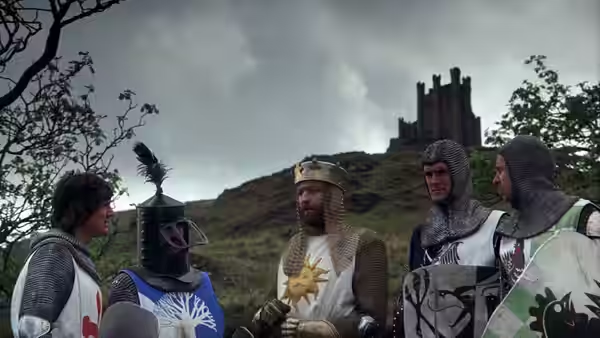
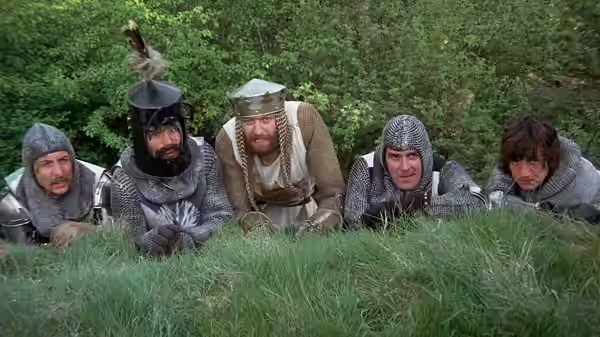
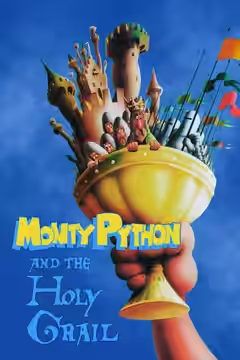
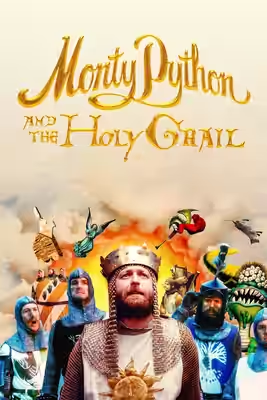
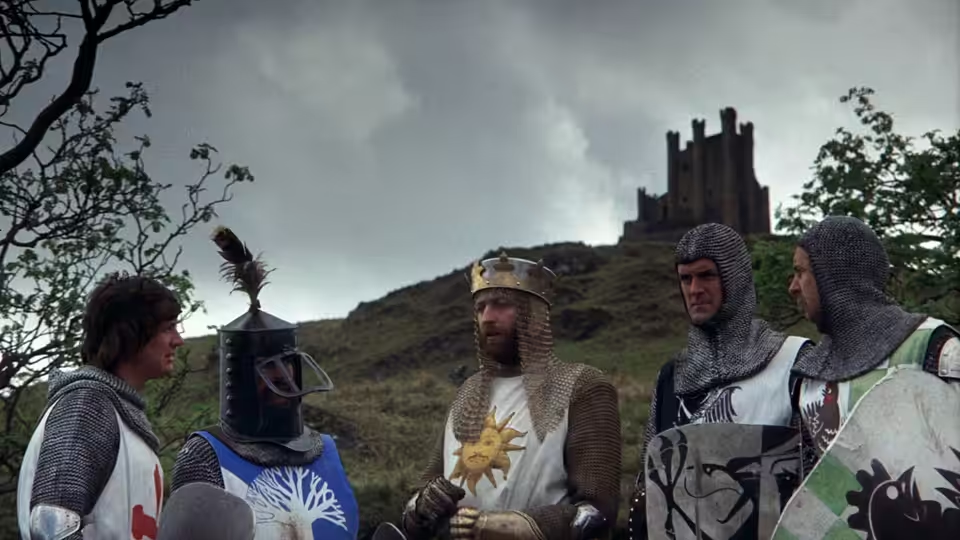
King Arthur and knights in armor stand on a hill before a castle
Film review

Monty Python and the Holy Grail

1975 · Directed by Terry Gilliam, Terry Jones · 1h 31m · MPA PG

In a sentenceKing Arthur has coconuts instead of horses and still expects a little respect

King Arthur (Graham Chapman) and the knights around him inhabit a medieval adventure where questions of bravery, belief and authority keep becoming arguments. John Cleese plays Sir Launcelot, Michael Palin plays Sir Galahad and Eric Idle plays Sir Robin, while Terry Jones appears as Sir Bedevere and Terry Gilliam as Patsy. The cast also double as guards, peasants and other figures in Arthur’s path. Horses give way to coconut shells, a witch trial turns justice into a public spectacle, and animation interrupts the live action. Jones and Gilliam direct this comic treatment of the Arthurian legends.

Plays from YouTube when you press play; nothing loads from them until then.

Fi1m review

Terry Jones and Terry Gilliam’s Arthurian comedy is persistently funny and more carefully made than its horse substitutes suggest. A few sketches outstay their welcome, but the cast’s straight faces make the nonsense worth taking seriously.

Monty Python and the Holy Grail is a richly funny attack on the seriousness of Arthurian adventure, with a few sketches that should have stopped sooner. Directors Terry Jones and Terry Gilliam understand that a king who expects respect is useful company for comedians determined not to give him any. Their film finds room for jokes about bravery, religious belief and the business of making a medieval film at all. It also gives Graham Chapman the sensible task of playing King Arthur as though there might still be some dignity in the job.

Chapman is the reason the silliness does not become exhausting. His earnest Arthur gives the others someone solid to work against, and the performance keeps asking us to recognise a king even when the film will not supply a horse. We laughed at the coconut shells because the pretence is so bare and the royal seriousness remains intact. The joke would be thinner if Chapman seemed pleased with it; by not advertising the comedy, he lets an absurd piece of business become ordinary transport.

Terry Bedford’s cinematography gives the landscapes a scale that would suit an adventure played straight. Roy Forge Smith’s production design keeps the medieval surroundings credible even when the means of getting about are plainly ridiculous. The visual care matters because the coconut shells are funnier against a convincing setting. Making every image look foolish would leave the performers with less to do, and the countryside is allowed to remain impressive without being made into another gag.

The witch trial shows how well the group can organise its foolishness. With Connie Booth as the accused and Jones as Sir Bedevere, the scene makes a public display of people treating bad reasoning as a sufficient reason to punish someone. We found it funny and unpleasant for the same reason: the certainty of the people conducting it. The satire works because the scene lets their reasoning expose them, rather than pausing to offer a sensible explanation of why they are wrong.

John Hackney’s editing is especially important in a film assembled from loosely connected set pieces. The pauses and abrupt changes are part of the comedy, and much of the pleasure comes from being denied the continuation a scene appears to promise. Gilliam’s animation extends that freedom, allowing another kind of visual nonsense to interrupt the actors. These interruptions are funny in their own right, though we sometimes wished the live-action sketches had been cut with the same impatience.

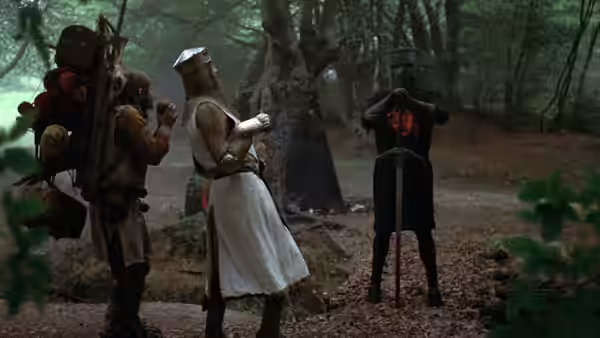
Not every exchange deserves the time it gets, and some of the talkier passages make the next interruption feel overdue. Jones and Gilliam occasionally seem too fond of a joke to notice that it has already worked. John Cleese’s Black Knight makes stubbornness amusing, but the gruesome fighting asks for an appetite for repetition that we do not always share. At 91 minutes, the film can afford these irritations without becoming a chore.

The film gets further with Chapman’s affronted dignity than many adventure spoofs get with a succession of familiar scenes and altered names. He gives the jokes someone to inconvenience, which keeps them funny even when the story barely advances. A taste for disconnected sketches helps, and a tolerance for arguments that have long since lost their original subject helps more. Watch it with someone who will let the cast finish the lines.
Critical consensus AI synthesised

80
Positive
12
Mixed
2
Negative
0

Most critics like it a great deal: twelve of the fourteen reviews are positive and none is negative. The praise gathers around the set pieces, with the coconut shells standing in for horses, the Knights Who Say Ni, the French taunters and the killer rabbit named again and again. Critics admire how thoroughly the film sends up Arthurian legend, chivalry and costume pictures, and several single out Gilliam’s animations and Graham Chapman’s earnest, put-upon Arthur.

The reservations are about shape. Several reviews call it a string of sketches rather than a story, and the ending divides opinion: Radio Times finds it a let-down and Paste thinks the nonsense thins out late, while Consequence thinks it lands well. The two mixed notices, from Variety and the Los Angeles Times, find it more amusing than hilarious, with talky patches and fight scenes some will find gruesome. The Times and the Los Angeles Times both think Life of Brian is the funnier film.

Time Out
12 October 2015 · ★★★★★ · Tom Huddleston
100

One of the most original, hilarious and visually striking comedies ever made. Its unnecessary gorgeousness and goofy, slapstick laughs stand out.

Read the full review →
Slant Magazine
1 December 2006 · Arthur Ryel-Lindsey
90*

The critic praises the film's brilliant satire of medieval legends and lifestyles combined with strong comic timing and irreverent humor. They highlight its youthful charm, energy, and the troupe's freedom in creating an accessible, singular work despite its amateurish production qualities.

Read the full review →
The New York Times
28 April 1975 · Vincent Canby
90*

The film is a marvelously lunatic endeavor that sends up the King Arthur legend, courtly love, bravery, costume movies and movie violence. It features nonstop gags, some inspired, with Graham Chapman as an earnest but doomed Arthur.

Read the full review →
Empire
1 January 2000 · Rob Fraser
85*

Feature films bring out the best in the Pythons, resulting in a focused comedy packed with killer lines, sight gags and absurdity that qualifies as a medieval-on-your-ass laff-riot. Highlights singled out include the homicidal bunny, the wedding guest massacre and the use of coconut shells for horses.

Read the full review →
The Guardian
15 October 2015 · Peter Bradshaw
85*

The critic praises the film's anarchic daring and subversive elements of anticlimax, noting its bridgehead into international stardom. Gilliam’s animations are singled out as timelessly brilliant.

Read the full review →
Radio Times
★★★★ · David Parkinson
80

A wonderfully inventive comedy that brilliantly debunks the Dark Ages and legends of chivalry. Highlights include the witch trial and Holy Hand Grenade sequence, though the ending disappoints.

Read the full review →

Straight answers AI written, from our review

Is Monty Python and the Holy Grail worth watching?
Monty Python and the Holy Grail is worth watching for anyone with a taste for disconnected sketches and straight-faced nonsense, and we scored it 87. Graham Chapman's earnest Arthur keeps the silliness from wearing thin, though a few talky passages run on after the joke has landed. Watch it with someone who will let the cast finish their lines.
How long is Monty Python and the Holy Grail, and what is it rated?
Monty Python and the Holy Grail runs 1h 31m and is rated PG by the MPA in the US. It is an adventure and comedy film.
Where can I watch Monty Python and the Holy Grail in the US?
Monty Python and the Holy Grail is streaming on Amazon Prime Video, Peacock, The Roku Channel and Pluto TV in the US, and it is also available to rent from Amazon Prime Video from $1.99. Availability is checked daily; the links above go straight to each service.
How violent or frightening is Monty Python and the Holy Grail, and is it suitable for children?
Monty Python and the Holy Grail carries a 15 certificate in the UK and a PG in the US, and its violence is comic rather than distressing. The Black Knight fight is gruesome and repetitive, with blood played for laughs, and the witch trial is funny and unpleasant at once. Older children used to slapstick will be fine; the squeamish may look away once or twice.
How does Monty Python and the Holy Grail compare to The Princess Bride?
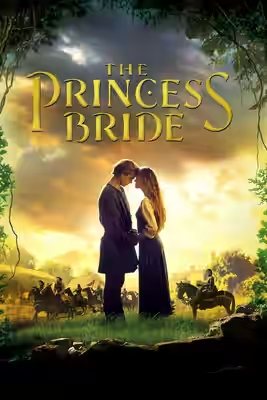
Monty Python and the Holy Grail is the sharper and stranger of the two, while The Princess Bride is the warmer and more coherent. Both enjoy puncturing heroic self-importance, but the Python film is a run of loosely connected sketches with a king to inconvenience, and Reiner's is a proper storybook adventure that takes its characters seriously. Choose the Grail for jokes, the Bride for company.
What should I watch after Monty Python and the Holy Grail?
After Monty Python and the Holy Grail, try The Princess Bride (1987, Fi1m 86): A warmer storybook adventure, with similar affection for puncturing heroic self-importance. Then Daisies (1966, Fi1m 85): For the appetite for destruction, abrupt interruptions and jokes that refuse good behaviour.

Cast

If you liked this, try…

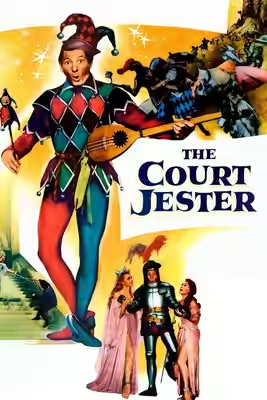
  1. The Court Jester (1955) · not reviewed yetAnother medieval comedy that makes elaborate nonsense depend on exact comic timing.

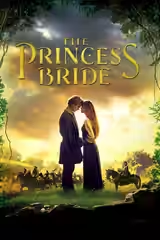
  2. The Princess Bride (1987, Fi1m 86)A warmer storybook adventure, with similar affection for puncturing heroic self-importance.

  3. Daisies (1966, Fi1m 85)For the appetite for destruction, abrupt interruptions and jokes that refuse good behaviour.

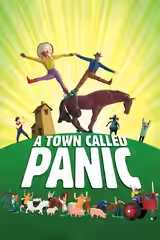
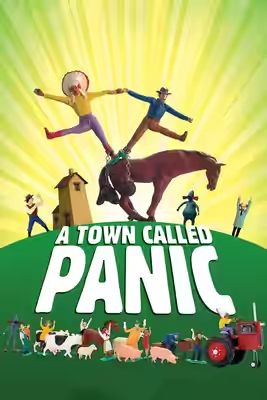
  4. A Town Called Panic (2009) · not reviewed yetStop-motion chaos with the same conviction that absurd behaviour needs no apology.

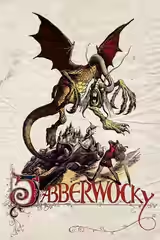
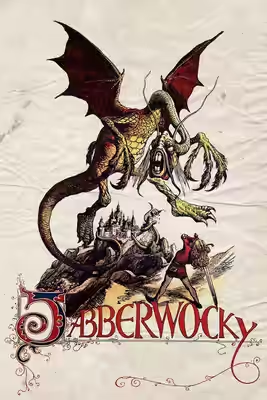
  5. Jabberwocky (1977) · not reviewed yetKings, servants and fools find fresh reasons to regret one another’s company.

Free account

Know what to watch tonight

Two lists that know where things are streaming, collections you can share, your own score beside ours, and Discover that remembers what you have seen.

  • Want to see, sorted by what is streaming now
  • Seen, with your score out of ten
  • No adverts, ever