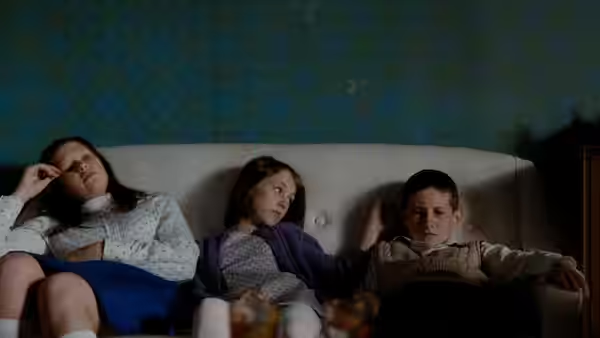
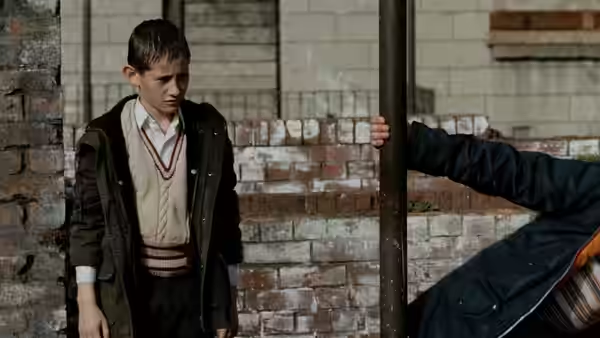
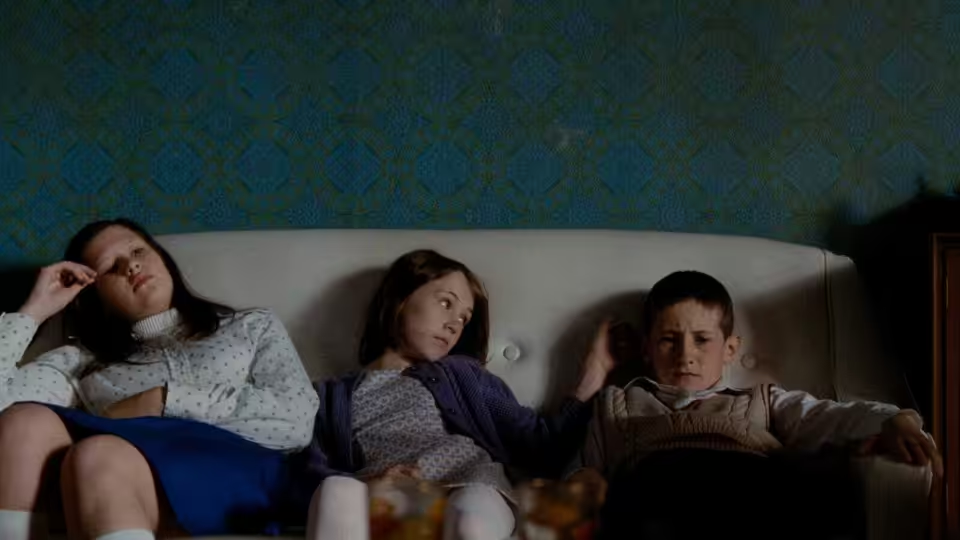
Three children sit together on a white sofa in a living room
Film review

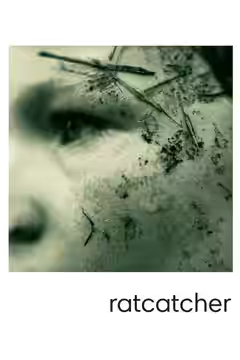
Ratcatcher

1999 · Directed by Lynne Ramsay · 1h 34m · MPA NR

In a sentenceEven a Glasgow bin strike cannot persuade children to have a reliably miserable time

In 1970s Glasgow, a dustmen’s strike leaves rubbish accumulating around a group of children. Twelve-year-old James (William Eadie) carries a sense of guilt as he navigates life in a working-class neighbourhood. His world includes Da (Tommy Flanagan), Ma (Mandy Matthews), Margaret Anne (Leanne Mullen) and Kenny (John Miller). Writer-director Lynne Ramsay follows James through encounters with family and other children, attending to what he sees, touches and imagines. Domestic strain and the dirt of the city shape his days, while humour and physical affection remain part of childhood.

Plays from YouTube when you press play; nothing loads from them until then.

Fi1m review

Lynne Ramsay’s Ratcatcher is a moving, unsentimental account of childhood amid guilt and squalor. Its young cast and attention to physical detail reward patience, though some relationships remain too thinly drawn.

Lynne Ramsay makes childhood feel sharply particular in Ratcatcher, a moving drama that sometimes leaves too much of its family life unexplored. James is twelve, Glasgow’s dustmen are on strike, and rubbish is becoming part of the everyday surroundings. Ramsay is interested in what a child notices in such a place, including things an adult might hurry past. The dirt is impossible to ignore, yet James still has curiosity, a sense of humour and an imagination to occupy him.

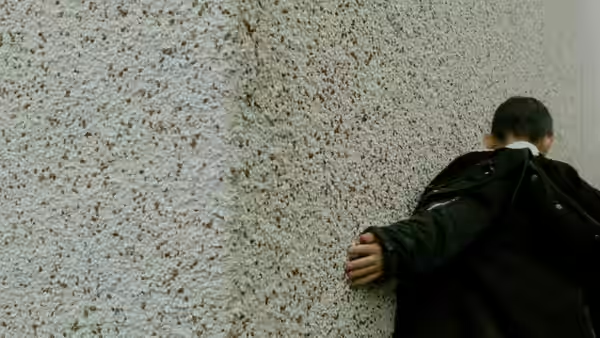
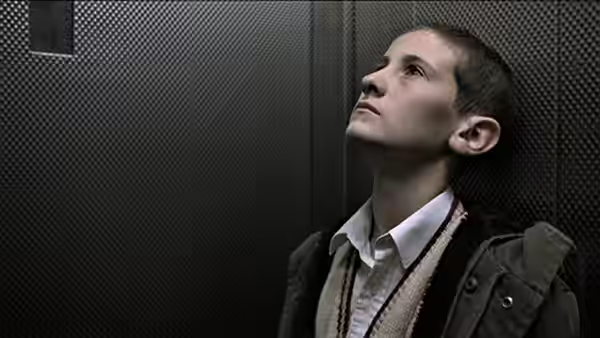
Alwin H. Küchler’s cinematography gives the grime and the light close, almost tactile attention. We are encouraged to look at surfaces for long enough to imagine how they feel, an effective way of bringing us nearer to James without an explanation from him. Jane Morton’s production design makes the accumulated rubbish an insistent presence around the children. There is a risk of making deprivation too attractive to look at, but the attention to dirt keeps these images uncomfortable.

William Eadie’s James is allowed to be difficult to read. The guilt does not conveniently explain every response, and Eadie’s performance makes room for ordinary curiosity. Leanne Mullen as Margaret Anne and John Miller as Kenny help make the children’s company feel unpredictable, with humour that never sounds supplied for the audience’s benefit. We were moved by the moments of human touch amid the filth: physical affection matters here because there is so little else to make these surroundings bearable.

Lucia Zucchetti’s editing lets impressions accumulate at an unhurried pace, allowing everyday hardship and the boy’s imaginative life to sit close together. Those changes in mood work because Ramsay does not insist that humour is an interruption for which the serious story must apologise. Rachel Portman’s music lends warmth to the tenderness, though the faces have already done most of the work.

The weakness is in Ramsay’s writing of relationships beyond James’s immediate feelings. Tommy Flanagan’s Da and Mandy Matthews’s Ma are part of a troubled family life that we understand in glimpses, and some of those glimpses need more development. We can accept uncertainty about what a child understands of the adults around him; we still want enough of their behaviour to judge them fairly. Here the spareness occasionally feels limiting, leaving characters who interest us without quite enough room.

As a coming-of-age film, it resists the expectation that every childhood experience must become a lesson. Ramsay’s humour is particularly valuable here, since it lets the children be awkward company without requiring us to stop caring about them. The imaginative passages belong to the same boy who lives among the rubbish, and their presence makes his life feel fuller. Even at its bleakest, the film remains interested in what he might find worth looking at.

At 94 minutes, this is a compact film that needs an attentive evening. The pace gives small changes of feeling time to register, and impatience with its gaps may keep some viewers at a distance. Choose it when there is no requirement for the film to cheer everyone up.

Critical consensus AI synthesised

82
Positive
15
Mixed
0
Negative
0

The reviews are unanimous in their approval of Lynne Ramsay’s first feature, and most of them reach for the same word: poetic. Critics agree that the film finds beauty on a rundown Glasgow estate during the 1973 bin strike, seen through the eyes of a guilt-ridden boy, and that it does so without sentiment. The praise clusters on Ramsay’s eye for light, colour and the textures of everyday things, on the naturalistic performances from a young and largely non-professional cast, William Eadie’s in particular, and on the flashes of dry humour that stop the bleakness becoming a wallow.

The spread is narrow. The cooler notices, several of them written from festival screenings in 1999, admire the visual style and the light touch but stop short of calling it a major work. Sight and Sound goes furthest, finding the plot contrived in places and some of the relationships between characters underdeveloped. Nobody disputes that a distinctive director has arrived.

Empire
1 January 2000 · Trevor Lewis
90*

The critic calls Ratcatcher one of the finest recent British films about childhood, praising its raw authenticity, naturalistic young cast, quirky humour and sparingly used lyricism amid the bleakness.

Read the full review →
IndieWire
6 April 2000 · festival review
90*

The film offers a sublime portrait of youth where childhood stinks yet transcends its grim circumstances in 1970s Glasgow. It captures the contrast of filth and fantasy through a child's perspective during a waste collectors' strike.

Read the full review →
Los Angeles Times
1 November 2000 · Kenneth Turan
90*

Ramsay’s exquisite feature debut combines social consciousness with remarkable visual imagination and poetic images, creating a new kind of magical realism. It stands out for its unhurried artistry and unblinking assurance in depicting a bleak Glasgow childhood.

Read the full review →
The Guardian
12 November 1999 · Peter Bradshaw
90*

The critic calls Ratcatcher a stunning and spellbinding feature debut that makes one proud of British cinema again. He singles out its hyper-real, poetic rendering of a child's tactile perception of everyday textures and light amid the grim setting of the Glasgow bin strike.

Read the full review →
The New York Times
13 October 2000 · Elvis Mitchell
90*

The brilliant directorial debut of Lynne Ramsay is a gorgeous blend of beauty and squalor, packed with imagery that lingers. It follows a guilt-ridden 12-year-old boy in a rat-infested Glasgow during a garbage strike.

Read the full review →
The Times
12 April 2024 · Ed Potton
90*

The critic praises Lynne Ramsay’s debut as an extraordinary lyrical work about a boy processing guilt on a rundown Glasgow estate in 1973, highlighting its hypnotic style and the standout acting debut of William Eadie.

Read the full review →

Straight answers AI written, from our review

Is Ratcatcher worth watching?
Ratcatcher is worth watching for anyone prepared to give an unhurried, unsentimental drama about childhood their full attention, and we scored it 88. Lynne Ramsay's account of a boy in 1970s Glasgow during a dustmen's strike rewards patience with its physical detail and young cast, though the adult relationships are thinly drawn. Choose it when nobody needs cheering up.
How long is Ratcatcher, and what is it rated?
Ratcatcher runs 1h 34m and is rated NR by the MPA in the US. It is a drama film.
Where can I watch Ratcatcher in the US?
Ratcatcher is streaming on HBO Max, The Criterion Channel, Hulu, The Roku Channel and Amazon Prime Video in the US. It leaves HBO Max on 30 September. Availability is checked daily; the links above go straight to each service.
How violent or frightening is Ratcatcher, and is it suitable for children?
Ratcatcher carries a UK 15 certificate and is not a film for children, despite being about one. Its discomfort comes less from violence than from squalor, guilt and domestic strain, shown at a slow pace that asks viewers to sit with hardship rather than look away. Older teenagers with patience for quiet, bleak drama may find it absorbing.
How does Ratcatcher compare to Kes?
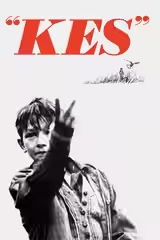
Ratcatcher and Kes are both unsentimental British films about working-class boys whose humour survives the hardship around them. Ken Loach's film is the funnier and more direct of the two, built around David Bradley's boy and his kestrel; Lynne Ramsay's is quieter and more attentive to surfaces, and slightly the better made, though its family life is less fully drawn.
What should I watch after Ratcatcher?
After Ratcatcher, try Kes (1969, Fi1m 88): Another unsentimental British childhood, with humour that survives the hardship. Then The Spirit of the Beehive (1973, Fi1m 87): For a child’s imagination given patient attention and little adult explanation; and Pather Panchali (1955, Fi1m 93): Children find things worth noticing while their family struggles to manage.

Cast

If you liked this, try…

  1. Kes (1969, Fi1m 88)Another unsentimental British childhood, with humour that survives the hardship.

  2. The Spirit of the Beehive (1973, Fi1m 87)For a child’s imagination given patient attention and little adult explanation.

  3. Pather Panchali (1955, Fi1m 93)Children find things worth noticing while their family struggles to manage.

  4. Nobody Knows (2004, Fi1m 87)Patient observation of children whose resourcefulness cannot make the adults reliable.

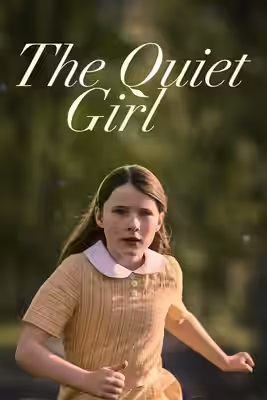
  5. The Quiet Girl (2022, Fi1m 84)A quieter account of childhood, alert to the importance of small kindnesses.

Free account

Know what to watch tonight

Two lists that know where things are streaming, collections you can share, your own score beside ours, and Discover that remembers what you have seen.

  • Want to see, sorted by what is streaming now
  • Seen, with your score out of ten
  • No adverts, ever