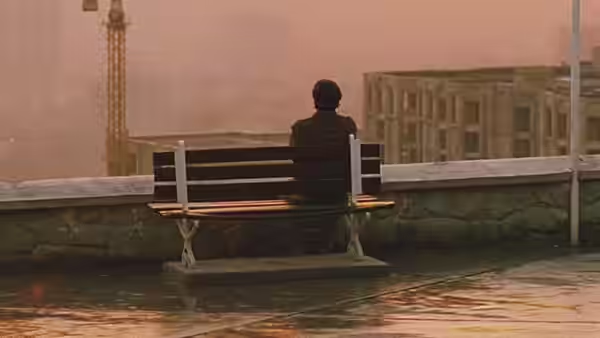
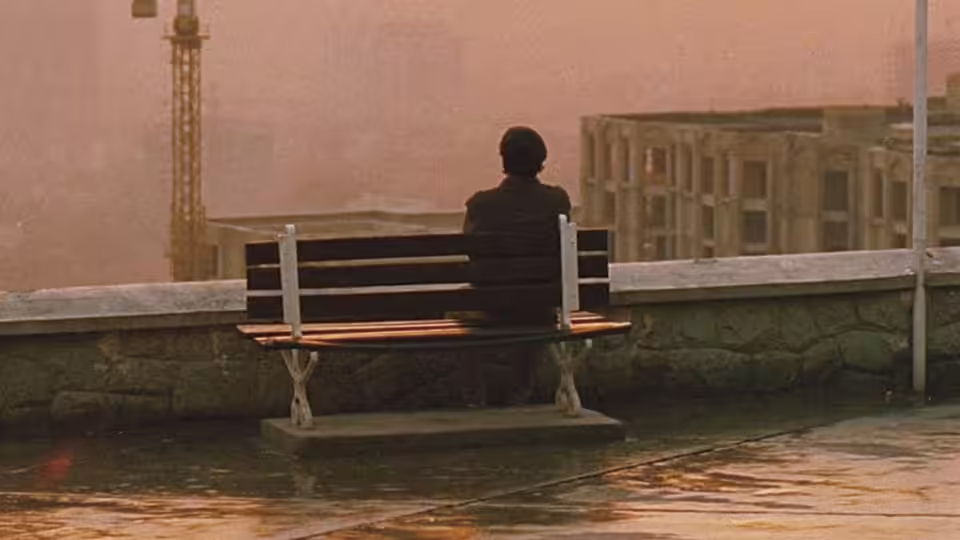
Man in dark jacket seated on bench overlooking hazy city with crane
Film review

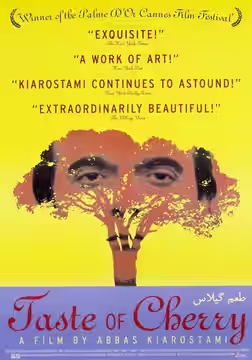
Taste of Cherry

1997 · Directed by Abbas Kiarostami · 1h 39m

In a sentenceThis drive around Tehran made us want to ring a friend

Mr. Badii (Homayoun Ershadi) drives around Tehran looking for someone willing to bury him after his planned suicide. While the middle-aged man tries to secure this help, the city’s working life continues around him. His encounters raise questions about what one person can ask of another, and what responsibility comes with listening to such a request. Abbas Kiarostami writes and directs, with Safar Ali Moradi playing a soldier, Mir Hossein Noori a seminarian and Abdolrahman Bagheri Mr. Bagheri. The conversations bring Badii’s purpose into contact with other men’s views about life and death.

Fi1m review

Abbas Kiarostami makes a deeply moving drama from a man’s search for help with his planned suicide. The repeated conversations can test patience, but Homayoun Ershadi gives us someone worth staying with.

Taste of Cherry is a moving, demanding film about how difficult it can be to listen when another person’s wishes frighten us. Abbas Kiarostami gives Mr. Badii, played by Homayoun Ershadi, a practical purpose: he drives around Tehran looking for someone to bury him after his planned suicide. The request is clear, while the ethical problem it poses grows harder the longer we consider it. Kiarostami asks us to spend time with that difficulty, and largely earns the attention he requires.

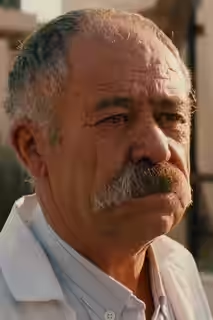
Ershadi’s contained performance helps because a more demonstrative one could have told us what to feel before anyone had replied. He gives Badii enough reserve to make us work at staying close to him. That can be frustrating, particularly when we want an explanation that would make his purpose easier to understand. Yet we remain concerned about what happens to this man, even when the talk starts to turn him into a philosophical problem.

Homayun Payvar’s cinematography makes the changing scenery and colour worth attending to without offering an easy escape from the conversation. We keep looking at the world Badii is travelling through, and there is more happening in it than his immediate business. We were moved by the noisy industrial desert, where the activity around Badii makes his isolation harder to bear. Physical work carries on in a place that might otherwise seem empty. It gives Kiarostami a concrete way to place this private suffering among other people’s daily concerns.

Kiarostami also edits, and he lets the repeated encounters establish an unhurried pace, giving us time to consider what is being asked. Each new conversation alters how we judge the request. The repetitions do sometimes feel overextended, particularly when we have grasped a speaker’s position and are ready to move on. At those points Kiarostami seems reluctant to end a discussion whose terms are already clear.

The soldier played by Safar Ali Moradi and the seminarian played by Mir Hossein Noori help Kiarostami keep the encounters distinct. Their presence gives each conversation a different starting point, though Badii’s need remains the same. As a writer, Kiarostami is interested in the pressure put on the person being asked for help: agreeing is difficult, but so is sending the man away. We are left considering what we would actually say, with little confidence that it would be useful.

A drama about suicide can become a succession of speeches about why life is worth living. This film’s suggestions that nature might offer comfort are modest enough to be taken seriously. There is room to find comfort in what the men say and still recognise the limits of their advice. The film respects the seriousness of Badii’s despair, and its interest in ordinary life never requires us to think him foolish for suffering.

At 99 minutes, this is not a long film, though its repetitions can make it feel longer. It needs an evening when there is no particular hurry, and a willingness to hear out people whose answers may seem inadequate. That is a fair demand for a film as humane as this one. Watch it with someone who will let the conversation continue afterwards.

Critical consensus AI synthesised

68
Positive
7
Mixed
0
Negative
2

Most critics take the film to be Kiarostami at his most distilled: a man drives the outskirts of Tehran asking strangers to help him with his own death, and the pleasure, such as it is, lies in the talk and the terrain rather than in incident. Praise clusters around the direction and the plain, patient shooting, with several reviews singling out the conversations with the men he picks up, one about the sweetness of fruit in particular, and the dusty industrial landscape. Seven of nine call it a serious and humane piece of work.

The dissent is sharp rather than mild. Roger Ebert finds it excruciatingly dull and calls the slow, monotone style an affectation; Empire likes the shifts of scenery and colour but feels cheated by the ending. Even admirers hedge on that ending, which Variety expects to disappoint some, though The Playlist argues that calling the film dull misses the point. The spread is wide: enthusiasm or impatience, little in between.

Los Angeles Times
27 March 1998 · Kevin Thomas
90*

Kiarostami’s soaring parable follows a middle-aged man in Tehran seeking someone to bury him after his planned suicide, turning into an odyssey on life’s meaning and human dignity through encounters with various men. Every shot attests to the director’s mastery, inviting viewers to think deeply about life and nature’s consolations.

Read the full review →
Slant Magazine
24 July 2020 · Budd Wilkins
90*

The critic praises Kiarostami’s understated rumination on existential despair and suicide, highlighting the film's use of landscape, conversations with outsiders, and the remarkable transition from fiction to behind-the-scenes footage with music.

Read the full review →
The New York Times
27 September 1997 · NYT Critic’s Pick · Stephen Holden
70*

Kiarostami contrasts the vitality of Iranian working life with the suicidal despair of a middle-aged man driving around Tehran seeking someone to bury him after he takes sleeping pills. The film offers an epic yet minuscule vision of human scale and dignity.

Read the full review →
Time Out
10 September 2012 · GA
70*

The critic describes the film's slow revelation of a man's search for help with his planned suicide, drawing viewers into his psychological and ethical dilemma. They praise the subtle, deceptively simple mise-en-scène, particularly a noisy industrial desert scene and the ambiguous penultimate sequence.

Read the full review →
Variety
25 May 1997 · festival review · Deborah Young
70*

Kiarostami’s linear and accessible parable follows a despairing man seeking discreet help to bury him after suicide, with a bleak premise partially offset by arguments for nature’s consolations, though the abrupt cerebral ending may disappoint some. The director cuts masterfully with fable-like repetitions and symbolic visuals.

Read the full review →
Empire
1 January 2000 · William Thomas
30*

The critic finds the film fascinating for its subtle shifts of scenery and colour but questions its Palme d'Or win and criticises the ending for leaving viewers feeling deprived.

Read the full review →

Straight answers AI written, from our review

Is Taste of Cherry worth watching?
Taste of Cherry is worth watching for anyone prepared to sit with a slow, serious film about a man seeking help with his planned suicide, and we scored it 86. Homayoun Ershadi's reserved performance keeps us close to Mr. Badii, though the repeated conversations can test patience. Choose an evening when there is no hurry.
How long is Taste of Cherry, and what is it rated?
Taste of Cherry runs 1h 39m. It is a drama film.
Where can I watch Taste of Cherry in the US?
Taste of Cherry is streaming on HBO Max, The Roku Channel and Amazon Prime Video in the US. Availability is checked daily; the links above go straight to each service.
How does Taste of Cherry compare to Close-Up?
Taste of Cherry is the more demanding of the two, a spare drama about a man asking strangers to bury him, while Close-Up turns a real impersonation case into something patient, funny and unexpectedly moving. Both films ask us to listen closely to someone others might dismiss. Those new to Kiarostami will find Close-Up the warmer way in; Taste of Cherry rewards viewers ready for its repetitions.
What should I watch after Taste of Cherry?
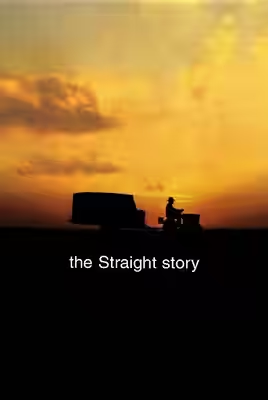
After Taste of Cherry, try Close-Up (1990, Fi1m 92): Kiarostami finds comparable tension in listening closely to someone others might dismiss. Then Ikiru (1952, Fi1m 92): Another patient encounter with despair, where ordinary acts carry the emotional weight; and The Straight Story (1999, Fi1m 88): A quiet road journey whose encounters make the travelling worth our time.

Cast

Awards

Cannes Film Festival, 1997

Won
Palme d'Or

If you liked this, try…

  1. Close-Up (1990, Fi1m 92)Kiarostami finds comparable tension in listening closely to someone others might dismiss.

  2. Ikiru (1952, Fi1m 92)Another patient encounter with despair, where ordinary acts carry the emotional weight.

  3. The Straight Story (1999, Fi1m 88)A quiet road journey whose encounters make the travelling worth our time.

  4. Oslo, August 31st (2011) · not reviewed yetConversations and familiar streets make one man’s isolation increasingly difficult to bear.

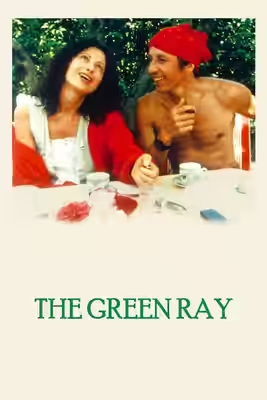
  5. The Green Ray (1986) · not reviewed yetLoneliness and the natural world, observed with patience and an occasional sharp laugh.

Free account

Know what to watch tonight

Two lists that know where things are streaming, collections you can share, your own score beside ours, and Discover that remembers what you have seen.

  • Want to see, sorted by what is streaming now
  • Seen, with your score out of ten
  • No adverts, ever