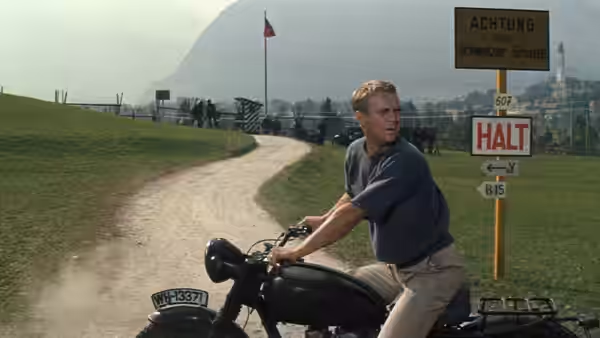
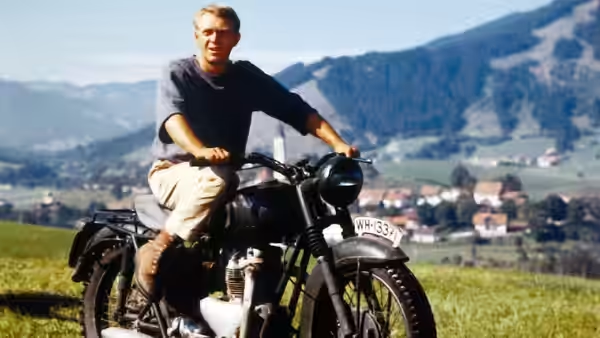
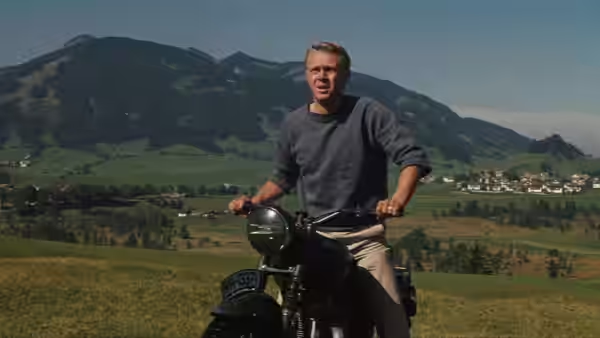
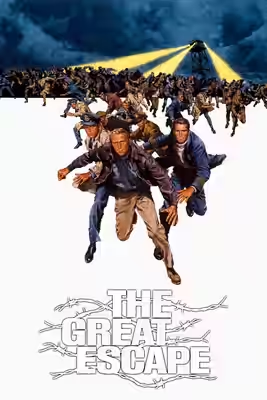
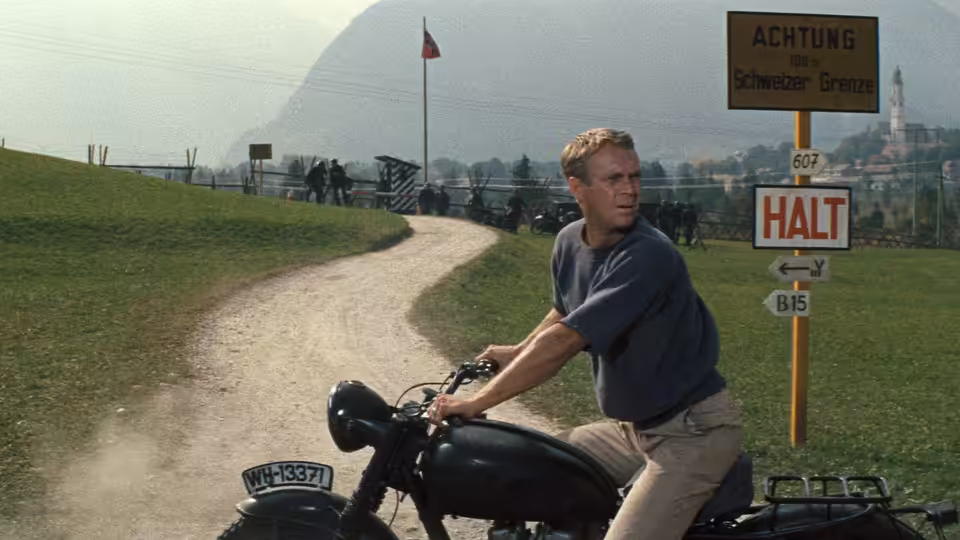
Hilts (Steve McQueen) riding a motorcycle past a border sign
Film review

The Great Escape

1963 · Directed by John Sturges · 2h 53m · MPA NR

In a sentenceA prison camp full of men we would happily spend three hours with

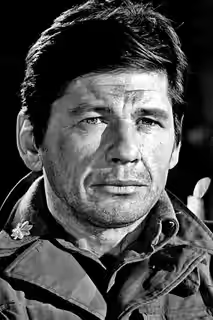
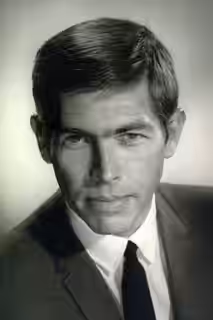
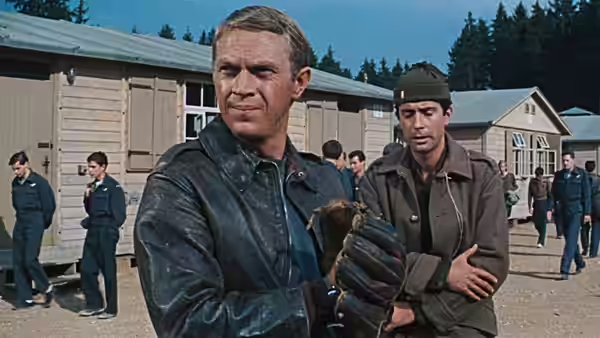
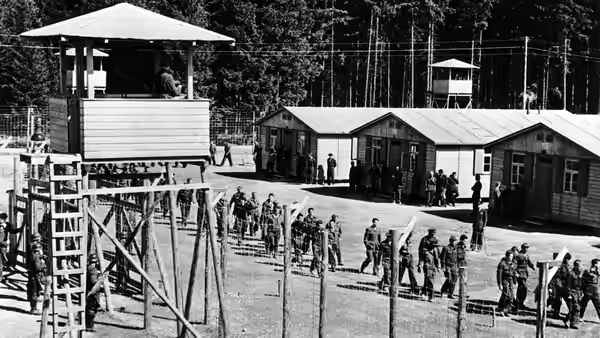
During the Second World War, Allied prisoners of war plan a mass escape from their camp. Richard Attenborough plays Bartlett, known as Big X, and Steve McQueen is Hilts, the Cooler King. James Garner is Hendley, the scrounger, Donald Pleasence is Blythe, the forger, and Charles Bronson is Danny, one of the tunnel diggers. Their scheme depends on men with different skills working together, making preparations under the authority of camp commandant Von Luger, played by Hannes Messemer. John Sturges directs an ensemble adventure about the work involved in getting beyond the wire.

Plays from YouTube when you press play; nothing loads from them until then.

Fi1m review

John Sturges makes the practical business of escape absorbing, with Steve McQueen and a strong ensemble supplying the pleasure. The hardships of captivity are softened, but this is a war adventure we warmly recommend.

The Great Escape is a thoroughly enjoyable war adventure, provided we accept how comfortably its prisoners wear their heroism. John Sturges puts the practical business of a mass breakout at the centre, and gives us enough distinct personalities to make the work worth following. There is pleasure in seeing a complicated job divided among people who know what they are doing. The film’s account of captivity is considerably less persuasive, but that limitation need not spoil an evening spent with this cast.

Steve McQueen’s Hilts is the conspicuous attraction, carrying the Cooler King nickname with an ease that makes confinement seem like a personal inconvenience. His confidence is funny without requiring him to tell jokes. Richard Attenborough gives Bartlett a more serious weight, while James Garner makes Hendley’s resourcefulness companionable rather than smug. Sturges handles these contrasting performances well: the men remain distinguishable even when the collective effort has to take precedence over any one of them.

The supporting cast helps because the specialities are immediately legible. Donald Pleasence’s Blythe is the forger, Charles Bronson’s Danny a tunnel digger, and James Coburn’s Sedgwick the manufacturer; we understand what each contributes before we need much biography. The screenplay by James Clavell and W.R. Burnett is efficient about that division of labour. It is also restrictive: the nicknames and occupations sometimes tell us almost everything the film cares to know about a man.

Daniel L. Fapp’s photography is clear and unshowy, giving the ensemble enough space for the preparations to remain readable. Sturges can direct our attention to one man without making the rest seem like extras waiting for permission to move. Ferris Webster’s editing keeps the separate tasks connected, so the scheme remains easy to follow despite the number of personalities involved. That clarity is a substantial part of the entertainment, particularly when several men’s contributions have to be understood together.

We were gripped by the tunnel-building, and surprised by how little we needed anyone to hurry it along. Sturges understands the pleasure of watching capable people solve a practical problem, then gives that problem enough attention for us to care about its solution. The digging and preparations never need to become background business while the stars do something more important. These passages give the supporting players a purpose beyond keeping us amused until McQueen next takes our attention.

Elmer Bernstein’s score supplies much of the buoyancy, treating defiance as an activity these men can get on with together. It is an effective accompaniment to the cast’s confidence, although it also makes the camp feel a little too manageable. That is the larger reservation about Sturges’s approach: the prisoners’ assurance can make captivity resemble an elaborate competition, with hardship kept conveniently out of the way. The cast’s warmth carries us past much of this, but it cannot make the film a searching account of imprisonment.

The useful comparison is with a heist film, where the allocation of skills can be as satisfying as the job itself. Sturges gets that pleasure right, and the actors make us willing to stay with the preparations. At 173 minutes, a little less of the camaraderie would not hurt; he occasionally lingers after a personality has been established. Give it the full evening, with a little scepticism about the cheerfulness.

Critical consensus AI synthesised

70
Positive
7
Mixed
2
Negative
1

Most critics come down in favour. The reviews return to the same things: Sturges’s patient staging of the tunnelling and the escape plan itself, the size and ease of the ensemble, and Steve McQueen, whose cool sits at the centre of nearly every notice. Elmer Bernstein’s score is picked out more often than any other department, and the motorcycle chase in the last half hour is named as the sequence people remember. Several also credit the film with making a real wartime event approachable for audiences who would otherwise never have met it.

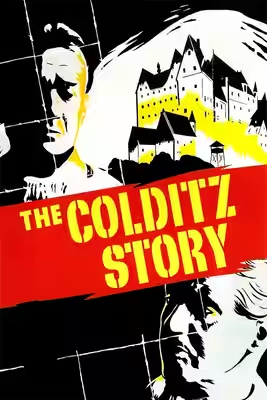
The spread is wide. The commonest reservation is that the film softens the grimmer side of the prisoner-of-war experience in favour of adventure, and a few find it old-fashioned even for its time. The New York Times, reviewing on release, calls it artificial and mechanical, its men made up rather than lived. The Evening Standard admires the scale but prefers smaller British escape films such as The Colditz Story.

Radio Times
★★★★★ · Andrew Collins
100

This is one of the all-time great war movies, celebrating the indomitable spirit of Allied POWs through an intricate escape plan. Sturges excels at detailed staging and ensemble casting, with McQueen's supercool performance and Bernstein's score standing out.

Read the full review →
Los Angeles Times
4 August 1996 · Glenn Lovell
90*

The critic highlights the restored widescreen Panavision presentation of the 1963 POW classic and praises its large-scale action sequences and emotional depth, noting why director Sturges considered it one of his best efforts.

Read the full review →
Variety
31 December 1962 · Variety Staff
80*

The critic praises the film for entertaining, captivating, thrilling and stirring the audience through its depiction of a bold POW escape plot, highlighting strong performances especially by Steve McQueen and Richard Attenborough, and Elmer Bernstein's score.

Read the full review →
Empire
1 January 2000 · Bob McCabe
70*

The film humanises a significant WWII event and introduces generations to war through its story of the mass POW escape. It singles out Steve McQueen's iconic motorcycle jump and Elmer Bernstein's defiant score for praise.

Read the full review →
Slant Magazine
21 May 2013 · Chris Cabin
70*

The critic praises Sturges's focus on the prisoners' collaborative tunnel-building effort and international teamwork as a metaphor for filmmaking, while noting that the film soft-pedals the grim realities of the POW experience.

Read the full review →
The AV Club
18 May 2004 · Scott Tobias
70*

The critic calls the film a workmanlike adventure epic that excels in its authentic heist-like breakout sequences and lighthearted diversions but struggles with the grim historical outcome, crediting McQueen's motorcycle scenes for providing a rousing close.

Read the full review →

Straight answers AI written, from our review

Is The Great Escape worth watching?
The Great Escape is worth watching for anyone who enjoys a long, well-organised war adventure with a strong ensemble, and we scored it 82. Steve McQueen, Richard Attenborough and James Garner make the preparations a pleasure to follow, and the tunnel-building gripped us. It softens the hardships of captivity, and at 173 minutes it lingers, so bring some patience and a little scepticism.
How long is The Great Escape, and what is it rated?
The Great Escape runs 2h 53m and is rated NR by the MPA in the US. It is an adventure and drama film.
Where can I watch The Great Escape in the US?
The Great Escape is streaming on Amazon Prime Video in the US, and it is also available to rent from Amazon Prime Video and Apple TV from $3.99. Availability is checked daily; the links above go straight to each service.
How violent or frightening is The Great Escape, and is it suitable for children?
The Great Escape is a PG-certificate war film, and the certificate is a fair guide: it is far more concerned with planning and camaraderie than with suffering. The hardships of imprisonment are kept largely out of sight, and the tone stays confident and cheerful, so most children of school age should manage it. Its length is the more likely obstacle for younger viewers.
How does The Great Escape compare to Logan Lucky?
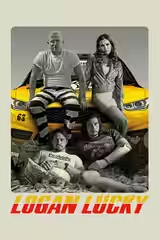
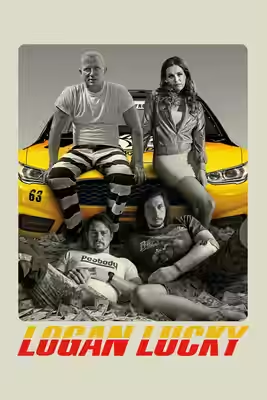
The Great Escape is the more disciplined film of the two, while Logan Lucky is the looser and funnier. Both take their pleasure from watching a team divide a complicated job by skill, but Sturges keeps every task legible across three hours, whereas Soderbergh's heist comedy is fonder of its people than of its plan and runs on after the job is finished. For a steady, absorbing evening choose the older film; for laughs and Daniel Craig, the newer.
Is The Great Escape based on a true story or a book?
The Great Escape is based on a book by Paul Brickhill, adapted for the screen by James Clavell and W.R. Burnett. Our review does not measure the film against its source, so we cannot say how closely it follows the book. No knowledge of it is needed: the film explains each man's speciality as he appears, and the plan is easy to follow on its own.
What should I watch after The Great Escape?
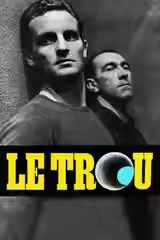
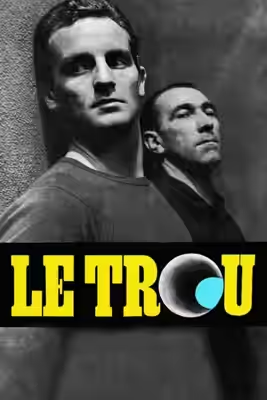
After The Great Escape, try Le Trou (1960, Fi1m 88): The practical work of escape becomes absorbing, with far less reassurance. Then Logan Lucky (2017, Fi1m 76): For the pleasure of watching an unlikely team organise a complicated robbery.

Cast

Awards

Academy Awards, 1964

Nominated
Best Film Editing

If you liked this, try…

  1. The Colditz Story (1955) · not reviewed yetAnother escape ensemble, with less swagger and closer attention to confinement.

  2. Le Trou (1960, Fi1m 88)The practical work of escape becomes absorbing, with far less reassurance.

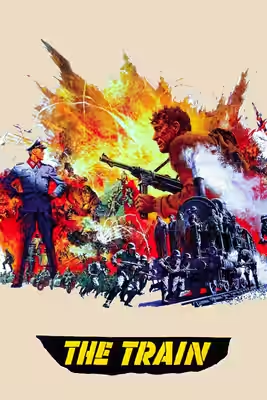
  3. The Train (1964) · not reviewed yetWartime resistance built around practical skills, stubborn people and difficult choices.

  4. Logan Lucky (2017, Fi1m 76)For the pleasure of watching an unlikely team organise a complicated robbery.

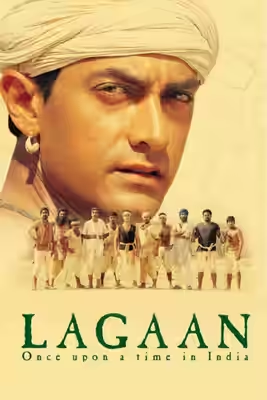
  5. Lagaan (2001) · not reviewed yetAnother long evening of collective defiance, with cricket taking the place of tunnels.

Free account

Know what to watch tonight

Two lists that know where things are streaming, collections you can share, your own score beside ours, and Discover that remembers what you have seen.

  • Want to see, sorted by what is streaming now
  • Seen, with your score out of ten
  • No adverts, ever