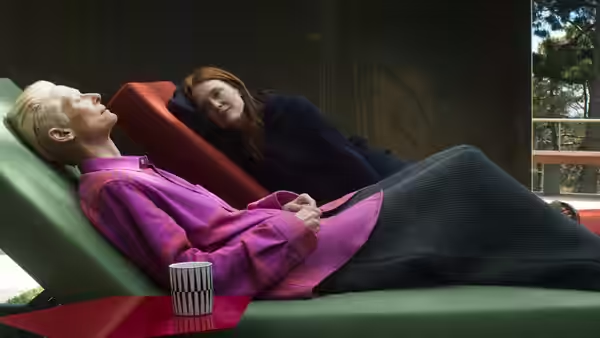
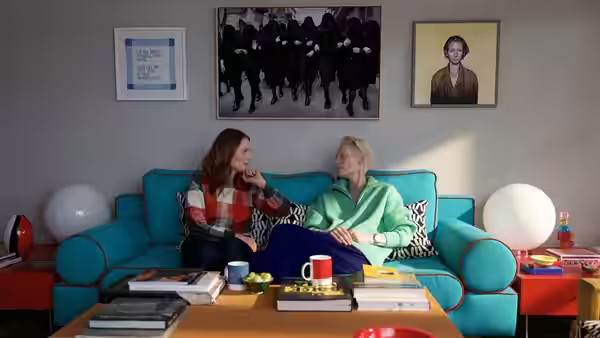
Tilda Swinton reclines on a lounge chair beside Julianne Moore
Film review

The Room Next Door

2024 · Directed by Pedro Almodóvar · 1h 46m · MPA PG-13

In a sentenceA good death, a handsome house, and a script that talks the way people write

Ingrid (Julianne Moore) is a novelist who has just published a book about her fear of death. At a signing in New York she learns that Martha (Tilda Swinton), a war correspondent she was close to years ago, is in hospital with cancer. Ingrid visits, and the two women pick up more or less where they left off. When Martha’s treatment fails, she tells Ingrid she has obtained a pill and intends to choose her own time, in a rented house in the country, and she asks Ingrid to be in the room next door when she does. John Turturro plays Damian, a former lover of both women. Pedro Almodóvar adapts Sigrid Nunez’s novel in his first English-language feature.

Plays from YouTube when you press play; nothing loads from them until then.

Fi1m review

Almodóvar’s first film in English puts Tilda Swinton and Julianne Moore in a mid-century house in upstate New York to talk about dying, and the house is the best thing in it. Swinton is plain and level and gets to us; the dialogue never stops sounding written.

Ingrid (Julianne Moore) is a novelist who has just published a book about her fear of death, and she is signing copies of it when a friend tells her that Martha (Tilda Swinton) is in hospital. They were close once, years ago, and then drifted, in the way people do. Ingrid visits. Martha, a war correspondent with a cancer that is not responding to treatment, is glad to see her and does not pretend otherwise. Pedro Almodóvar, adapting Sigrid Nunez’s novel for his first feature in English, sets all this up quickly and cleanly. Then Martha makes her request.

She has bought a pill. She intends to take it at a rented house in the country, on a date of her choosing, and she wants Ingrid in the house when she does: not to help, just to be in the room next door. Each morning Ingrid will check Martha’s door. Open, and they have another day; closed, and it is done. It is a strong premise for a chamber piece, and for about half of its 106 minutes the film is one.

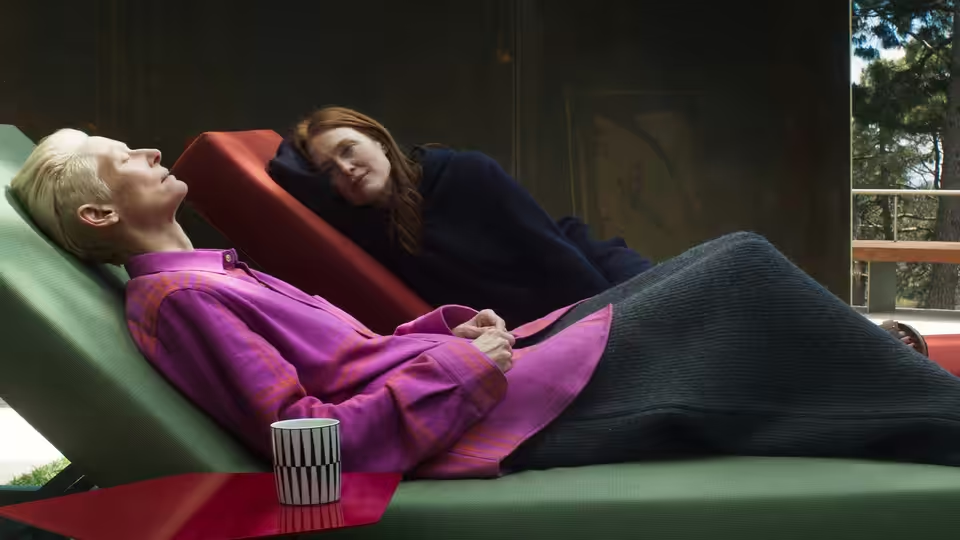
The house is the best thing in it. Inbal Weinberg’s production design gives the two women a mid-century house in upstate New York, and Almodóvar frames it with the symmetry he has always liked. Eduard Grau keeps the colours strong and the contrast high, so the rooms look like Almodóvar rooms even with English being spoken in them. Bina Daigeler’s costumes are cut from the same palette. It looks at all times like an Almodóvar film, which is not a small thing to manage in another language.

Swinton is the reason to watch. She plays Martha without any of the tremble a dying-woman part usually comes with; the voice stays level, the eyes stay dry, and she describes what the illness is doing to her memory as though filing a report from somewhere else. The scene in which she lays out the plan moved us more than we expected, and it did so because she asks for what she wants as a favour between adults. We had braced for a speech. There is not one.

The trouble is what comes out of everyone else’s mouth, and quite often out of Swinton’s too. Almodóvar’s people speak in complete paragraphs. They announce their feelings, quote from books, recall the past in tidy order and never interrupt each other. Moore has the harder job, which is to listen and be frightened, and she does it with her hands and her breathing, but the script keeps handing her lines that tell us what her face has already told us. John Turturro arrives as Damian, a former lover of both women, and is given a long speech about the state of the world. He delivers it well and it belongs in another film.

The flashbacks do not help. Esther-Rose McGregor plays the younger Martha and Alex Høgh Andersen plays Fred, and the stretch of the past they occupy plays like a short film someone has slipped into the middle of this one. Teresa Font cuts back to the present each time, and those cuts were the moments we were most glad of. Alberto Iglesias’s score, mostly strings, does what it can to supply warmth. We believed the two women had known each other; we did not believe they had missed each other.

Almodóvar has made films about women, illness and the body before, and in Spanish they had a heat this one keeps at arm’s length. Nothing here is overwrought, which is a sentence we did not expect to write about him, and we are not sure it is praise. The melodrama has been tidied away with the clutter, and what remains is handsome, thoughtful and a little cold. Most critics have liked it more than we did. The handful who found it stagy heard what we heard.

It is a 12A and almost entirely conversation, so nobody need be afraid of it. Watch it for Swinton and for the house, and be patient in the middle stretch, where the men turn up with their opinions. There is a turn in the last half hour we will not describe, except to say it is the one scene in which somebody is caught off guard, and the film is better for it.

Critical consensus AI synthesised

76
Positive
9
Mixed
5
Negative
0

Most critics like The Room Next Door, and nearly all of them like it for the same reason: Tilda Swinton and Julianne Moore. Review after review singles out the pairing, whether as a delicate two-hander, a piece of casting against type, or the thing that rescues an uneven film. The second cluster of praise is visual, with Almodóvar’s colour and Inbal Weinberg’s production design named repeatedly.

The reservations gather around the move into English. Several critics find the dialogue stilted or the structure too much like a play, with people talking about death rather than facing it. The Guardian finds the central friendship cool and thin on lived-in detail, and The Telegraph calls it a clunky disappointment, the harshest verdict of the set. The spread is wide, from full marks to a low pass, but the doubters mostly grant the acting and the look, and nobody writes the film off entirely. The festival notices run cooler than those written for release.

Time Out
3 September 2024 · ★★★★★ · Kaleem Aftab
100

The critic hails it as a glorious rumination on mortality, praising Almodóvar’s successful venture into English-language cinema with strong performances from Moore and Swinton, and its blend of melodrama and political commentary on America. They single out the electrifying chemistry between the leads.

Read the full review →
Film Comment
18 October 2024 · Molly Haskell
85*

The critic praises Almodóvar's adaptation as a slow-burn miracle and chamber drama, highlighting the subtle and nuanced performances of Moore and Swinton as they navigate friendship and mortality in a delicate pas de deux.

Read the full review →
The AV Club
19 December 2024 · B+ · Natalia Keogan
83

Almodóvar’s most death-obsessed film to date meditates on mortality with tender performances from Moore and Swinton and an intact eye for color and contrast. The English-language translation mutes the director’s Spanish sensibility and melodramatic leanings, making some elements feel off-kilter or corny.

Read the full review →
Los Angeles Times
18 December 2024 · Tim Grierson
80*

The critic calls the film a tough, tender and brittlely funny portrait of two women facing death and a difficult request. He singles out the casting against type, with Swinton as the frail but determined Martha and Moore as the anxious Ingrid.

Read the full review →
Radio Times
★★★★ · James Mottram
80

The critic describes it as a powerful euthanasia drama, commending the performances of Moore and Swinton, the immaculate production design, and the film's thoughtful questions on end-of-life ethics. They single out the sophisticated cast and Inbal Weinberg's production design.

Read the full review →
The i Paper
25 October 2024 · Francesca Steele
80*

The review finds the film ultimately moving and fresh in its handling of death and friendship. It singles out the career-best performances by Tilda Swinton and Julianne Moore for particular praise.

Read the full review →

Straight answers AI written, from our review

Is The Room Next Door worth watching?
The Room Next Door is worth watching for Tilda Swinton and for the house, and we scored it 68. Swinton plays a dying war correspondent without any tremble and moved us more than we expected, and Inbal Weinberg's mid-century house is beautifully framed. The trouble is a script in which everyone speaks in complete paragraphs, so patience is needed in the middle stretch.
How long is The Room Next Door, and what is it rated?
The Room Next Door runs 1h 46m and is rated PG-13 by the MPA in the US. It is a drama and comedy film.
Where can I watch The Room Next Door in the US?
The Room Next Door is streaming on Netflix in the US, and it is also available to rent from Amazon Prime Video from $3.99. Availability is checked daily; the links above go straight to each service.
How violent or frightening is The Room Next Door, and is it suitable for children?
The Room Next Door is a 12A, almost entirely conversation, and contains nothing violent or frightening. Its subject is a woman with cancer who intends to choose her own time to die, discussed calmly and at length, so it is a film about death rather than a film that shows any. Children would be bored rather than upset; it is a film for adults who want to talk afterwards.
How does The Room Next Door compare to Cries and Whispers?
The Room Next Door is the gentler and colder of the two, and Cries and Whispers is the better film. Both put a dying woman in a striking house and let the colour carry the mood, but Bergman's film is harrowing where Almodóvar's is handsome and level. Choose Almodóvar if you want conversation and comfort; choose Bergman if you can bear severity.
Is The Room Next Door based on a true story or a book?
The Room Next Door is based on a novel by Sigrid Nunez, not on a true story. Pedro Almodóvar adapts it for his first feature in English, and its bookish, complete-paragraph dialogue suggests a source that reads better than it speaks. You need not have read the novel; the premise is set up quickly and cleanly in the first twenty minutes.
What should I watch after The Room Next Door?
After The Room Next Door, try Cries and Whispers (1972, Fi1m 87): Bergman’s dying sister, her siblings and a red house; the colour does the grieving. Then Amour (2012, Fi1m 88): Haneke shuts two old people in a Paris flat and refuses to look away; and Ikiru (1952, Fi1m 92): Kurosawa’s clerk learns he is dying and finally does something; still unmatched.

Cast

Awards

European Film Award for Best Film, 2024

Nominated
European Film Award for Best Film

Venice Film Festival, 2024

Won
Golden Lion

If you liked this, try…

  1. Cries and Whispers (1972, Fi1m 87)Bergman’s dying sister, her siblings and a red house; the colour does the grieving.

  2. The Sea Inside (2004) · not reviewed yetAmenábar’s assisted-dying drama argues its case through one stubborn, funny man.

  3. Amour (2012, Fi1m 88)Haneke shuts two old people in a Paris flat and refuses to look away.

  4. Wit (2001) · not reviewed yetEmma Thompson’s professor faces cancer with footnotes; talkier than this, and warmer.

  5. Ikiru (1952, Fi1m 92)Kurosawa’s clerk learns he is dying and finally does something; still unmatched.

Free account

Know what to watch tonight

Two lists that know where things are streaming, collections you can share, your own score beside ours, and Discover that remembers what you have seen.

  • Want to see, sorted by what is streaming now
  • Seen, with your score out of ten
  • No adverts, ever