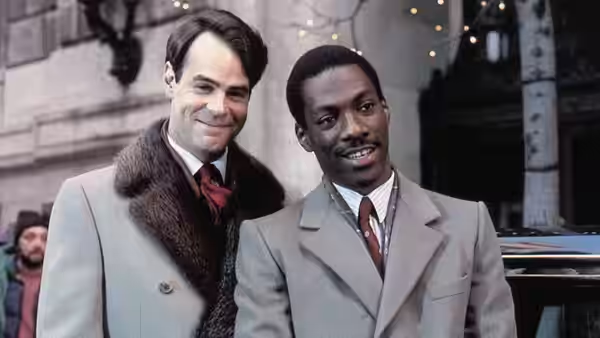
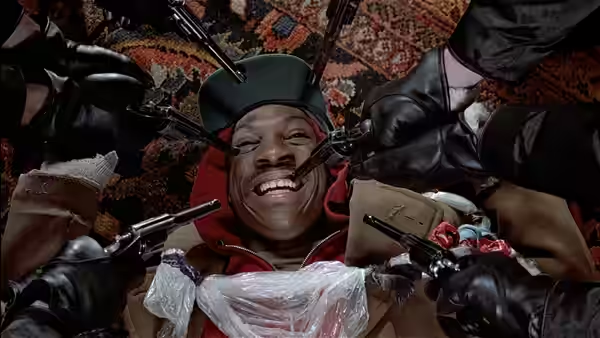
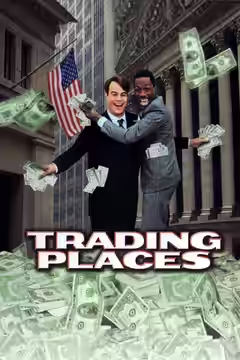
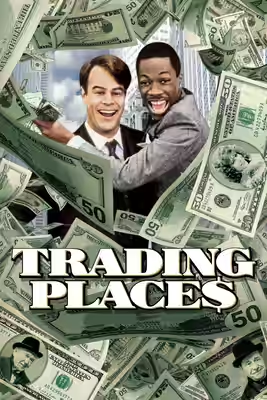
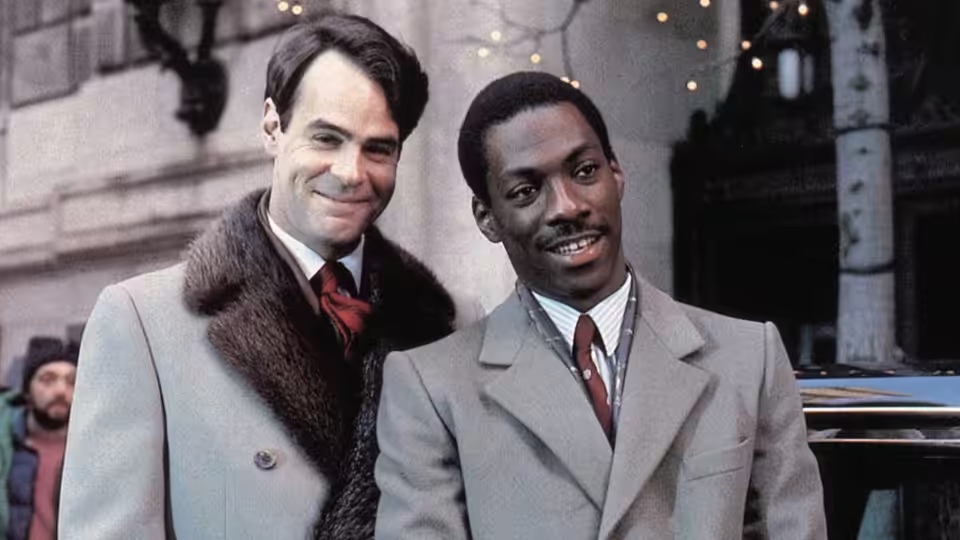
Louis Winthorpe III (Dan Aykroyd) and Billy Ray Valentine (Eddie Murphy) standing together outdoors
Film review

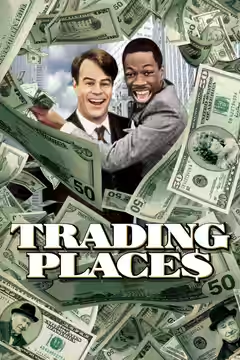
Trading Places

1983 · Directed by John Landis · 1h 56m · MPA R

In a sentenceEddie Murphy can get a laugh just by waiting for a rich man to finish speaking

Louis Winthorpe III (Dan Aykroyd) is a wealthy trader, while Billy Ray Valentine (Eddie Murphy) makes his living as a con man. Their fortunes change when businessmen Randolph Duke (Ralph Bellamy) and Mortimer Duke (Don Ameche) make a wager that exchanges the two men’s circumstances. Against a Christmas backdrop, Louis has to cope without his accustomed advantages, and Billy Ray encounters the privileges that come with money. The cast also includes Jamie Lee Curtis as Ophelia, Denholm Elliott as Coleman and Paul Gleason as Clarence Beeks.

Plays from YouTube when you press play; nothing loads from them until then.

Fi1m review

John Landis’s comedy of exchanged fortunes is funny enough to survive its timid politics. Eddie Murphy and Dan Aykroyd lead a cast that makes familiar jokes work, though the middle could use a firmer edit.

John Landis has a good comic subject here: rich men so accustomed to getting their own way that other people’s lives become material for a wager. Trading Places is a thoroughly enjoyable farce, with a cast that keeps finding laughs in this unpleasant arrangement. Its social criticism is less determined, and the slack middle is noticeable, but neither weakness ruins the pleasure of watching these actors work. The screenplay by Timothy Harris and Herschel Weingrod understands how much comedy there is in watching proud men adjust to being treated differently.

Eddie Murphy’s Billy Ray Valentine is the main reason it works so well. His confidence gives the exchanged fortunes some plausibility: we can believe that this con man would take quickly to his changed circumstances. Murphy is alert to how ridiculous the people around him are, but he does not spend every moment asking us to applaud him for noticing. There is room between his jokes for us to watch him think, and that makes the character worth following even when the next comic development is easy to predict.

Dan Aykroyd gives Louis Winthorpe III a different problem: his assurance depends on everyone else continuing to treat him as important. The performance lets us enjoy the damage to his dignity without making him too empty to care about. Ralph Bellamy’s Randolph Duke and Don Ameche’s Mortimer Duke supply a particularly good contrast, Bellamy’s genial manner making Ameche’s impatience funnier. We laughed at their confidence in treating other people’s fortunes as a private amusement. They make the wager feel horribly ordinary to the men arranging it.

Robert Paynter’s cinematography gives the farce an old-fashioned grandeur that suits the businessmen’s self-regard. Gene Rudolf’s production design makes the differences in comfort easy to see, so the change in circumstances matters before the actors say anything. Elmer Bernstein’s music shares that grandeur, and the use of Mozart helps give these ridiculous people a measure of borrowed dignity. The presentation is formal enough for bad behaviour to be funny without additional encouragement from the camera.

Malcolm Campbell’s editing is less consistently helpful. A stretch in the middle gives us time to grow familiar with the reversal without supplying enough fresh laughs. Jamie Lee Curtis as Ophelia and Denholm Elliott as Coleman help because they suggest people with interests beyond the next gag. Landis seems reluctant to move on once a comic situation has yielded its obvious laughs, although the supporting cast usually makes the extra company welcome.

For a comedy built on swapped fortunes, the obvious question is why money should determine how much respect a person receives. Harris and Weingrod set that question up cleanly, then let it recede as Landis favours slapstick. The wealthy are easy to dislike, but the film rarely makes their advantages feel like anything more troubling than privileges held by the wrong people. We wanted it to press harder there, particularly because Bellamy and Ameche make casual cruelty look so respectable.

That limitation matters, but it need not spoil an evening spent with performers this responsive to one another. The comedy remains generous towards its displaced men even when the writing takes an easy route to a laugh. See it for the cast, and save the argument about capitalism for afterwards.

Critical consensus AI synthesised

69
Positive
7
Mixed
1
Negative
1

Most critics like Trading Places, and the praise lands almost entirely on the cast. Murphy is named in nearly every review as the reason to watch, with Aykroyd as his foil, and the veterans Ameche and Bellamy, as the wagering brothers, come in for nearly as much credit. The reviews settle on it as a polished, likeable farce: an old role-reversal story told with confidence rather than anything new, and warmer for its Christmas setting.

The reservations cluster around the satire. Several critics think the jabs at money and class are softer than the film believes, with Landis choosing slapstick over bite, and one or two find the message laid on heavily. Variety notes a stretch in the middle without laughs. The spread is narrow, most reviews landing around seventy, with one dissent: The New Yorker finds it drab and static, carried by Murphy alone. Den of Geek sits at the other end, calling it a sharp comedy too often overlooked at Christmas.

Radio Times
★★★★ · David Parkinson
80

This is a rattling comedy showcase for the talents of Murphy and Aykroyd, with acting honors going to veterans Ameche and Bellamy as the wagering businessmen. Landis pulls his satirical punches and settles for slapstick, but the film remains very entertaining.

Read the full review →
Time Out
11 November 2014 · CPea
75*

The critic describes the premise as a re-run of the Prince and the Pauper theme with Christmas warmth, praising Murphy's confident performance as fulfilling his promise from 48 HRS. The satire on Reaganite capitalism is not as biting as it thinks, but the film is still the best hoot since Arthur.

Read the full review →
Empire
1 January 2000 · Pat Reid
70*

The critic finds the film a solid, funny update of classic role-reversal tales with some social commentary, though the message is delivered a bit heavily. Murphy's energetic performance as the hustler is singled out for particular praise as a career highlight.

Read the full review →
RogerEbert.com
9 June 1983 · Roger Ebert
70*

The critic praises the film as good comedy that develops its characters' quirks beyond sitcom tropes or obvious racial commentary. The engaging performances, especially by Murphy and Aykroyd as perfect foils, stand out alongside strong supporting turns.

Read the full review →
The New York Times
8 June 1983 · Janet Maslin
70*

The critic calls it a shrewd but likable, polished farce geared to a wide audience, more slick than Landis's prior work. It features an amusing turnabout gimmick and strong performances from the well-chosen cast, especially Aykroyd and Murphy.

Read the full review →
Variety
31 December 1982 · Variety Staff
70*

The review describes it as a light romp powered by Aykroyd and Murphy's schtick, aided greatly by veterans Bellamy, Ameche, and Elliott. Both leads are in top form reacting to their swapped situations, though there is a mid-section stretch without laughs.

Read the full review →

Straight answers AI written, from our review

Is Trading Places worth watching?
Trading Places is worth watching for anyone who wants a farce carried by its cast, and we scored it 80. Eddie Murphy and Dan Aykroyd make familiar jokes about swapped fortunes work, with Ralph Bellamy and Don Ameche making the wager feel horribly ordinary. The middle sags and the politics stay timid, but neither spoils the pleasure of these performers.
How long is Trading Places, and what is it rated?
Trading Places runs 1h 56m and is rated R by the MPA in the US. It is a comedy film.
Where can I watch Trading Places in the US?
Trading Places is streaming on Amazon Prime Video in the US, and it is also available to rent from Amazon Prime Video and Apple TV from $3.99. Availability is checked daily; the links above go straight to each service.
How violent or frightening is Trading Places, and is it suitable for children?
Trading Places is a 15 in the UK and rated R in the US, so it is not for children. It is a comedy rather than a violent or frightening film, and our review does not note anything that would alarm the squeamish. The certificate points to adult language and content aimed at grown-ups, and teenagers of fifteen and over are its natural audience.
How does Trading Places compare to Parasite?
Trading Places and Parasite both build comedy out of class resentment, but the earlier film stays a warm farce while Bong Joon Ho's turns considerably nastier. Landis lets his question about money and respect recede in favour of slapstick; Parasite keeps pressing until the joke stops being funny. Choose Trading Places for an easy evening with a fine cast, and Parasite if you want a gripping thriller and can bear regretting your laughter.
What should I watch after Trading Places?
After Trading Places, try My Man Godfrey (1936, Fi1m 82): A wealthy household gets a lesson in decency without the comedy turning solemn. Then Parasite (2019, Fi1m 91): Class resentment and domestic comedy turn considerably nastier; approach without reading the plot.

Cast

Awards

Academy Awards, 1984

Nominated
Best Original Song Score

If you liked this, try…

  1. My Man Godfrey (1936, Fi1m 82)A wealthy household gets a lesson in decency without the comedy turning solemn.

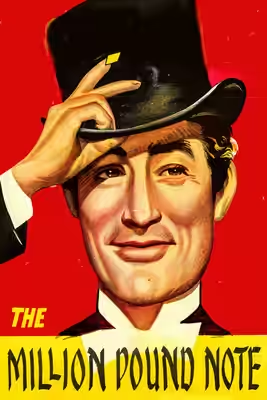
  2. The Million Pound Note (1954) · not reviewed yetMoney changes everyone’s manners in another farce about the absurdity of financial respectability.

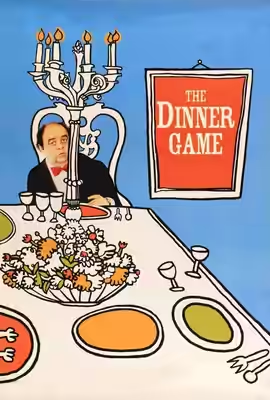
  3. The Dinner Game (1998) · not reviewed yetSmug men arrange someone else’s humiliation and discover how badly planning can go.

  4. The Castle (1997) · not reviewed yetFor warmer class comedy about people whose worth cannot be measured in property.

  5. Parasite (2019, Fi1m 91)Class resentment and domestic comedy turn considerably nastier; approach without reading the plot.

Free account

Know what to watch tonight

Two lists that know where things are streaming, collections you can share, your own score beside ours, and Discover that remembers what you have seen.

  • Want to see, sorted by what is streaming now
  • Seen, with your score out of ten
  • No adverts, ever