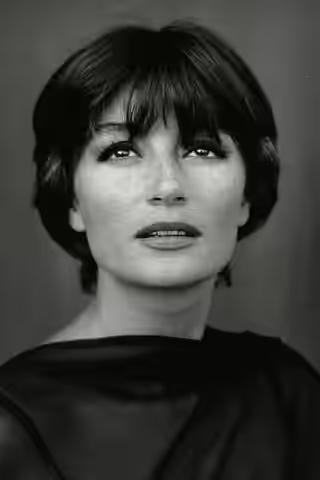
Anouk Aimée's gift was holding back. In two Fellini films she stands a little apart from the noise, listens, and lets us read what the men cannot; when a film gave her something to withhold, she was hard to look away from.
Fi1m perspective
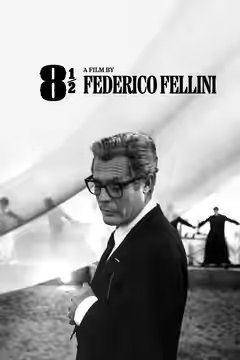
In 8½ (1963) she arrives as Luisa, the director's wife, in a short crop and severe spectacles, and does almost nothing. Guido lies to her and she watches him do it. It is the most honest thing in a film otherwise delighted by its own dishonesty, and we felt, watching Luisa watch Guido, a fatigue we recognised from our own kitchens: the particular weariness of hearing someone you love say something you both know is untrue, and deciding not to argue. Around her Fellini piles up mistresses, producers, cardinals and a girl in white with a glass of water, and Aimée stands at the edge of all of it, tired of him. Rossella Falk, as her friend Rossella, gets the sharpest lines.
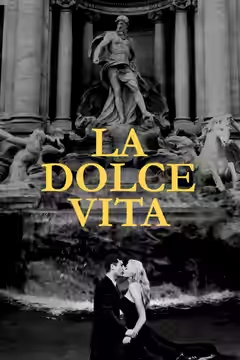
She had done a version of it for Fellini three years earlier. Maddalena in La Dolce Vita (1960) is rich, bored and briefly generous to Marcello Mastroianni's Marcello Rubini, and Aimée plays her without asking for our sympathy or our disapproval. Anita Ekberg fills the screen; Aimée draws back from it, and the drawing back is what you remember. She gave Fellini the credit: "It was Fellini who taught me this: The most important thing of all is to listen, just listen to what the other characters say. And don’t take [yourself] too seriously." She made two films with him, both opposite Mastroianni.
Between the two Fellini films Jacques Demy gave her the title role in Lola (1961), a cabaret dancer and single mother, and the part she later said she could no longer separate from herself. Then Claude Lelouch's A Man and a Woman (1966), opposite Jean-Louis Trintignant, made her famous everywhere and fixed the image most people carry of her: sophisticated, sad, beautifully coated. She made eight films with Lelouch in all, and the last of them, The Best Years of a Life (2019), put her and Trintignant back in the same roles more than fifty years on. It was her final appearance on screen.
The reserve needed a director who trusted it. Fellini and Demy did. Hollywood did not: Justine (1969) is the example usually given of her miscast, in a part that wanted more than she was willing to show. Her reputation rests, fairly or not, on the 1960s. She admitted she sometimes took work for the director or the fee rather than the script, and from the 1970s the parts were mostly supporting, often mothers, with occasional prestige cameos such as Simone Lowenthal in Robert Altman's Prêt-à-Porter (1994).
Start with the two Fellini films, which we can vouch for, and watch her in the wide shots, where she is doing nothing and you keep checking on her anyway. The films with Lelouch explain why she was famous. The films with Fellini explain why she was good.
Biography
Anouk Aimée was a French actor. Born Nicole Françoise Florence Dreyfus in Paris on 27 April 1932, she made her screen debut at the age of 14 in La Maison sous la mer (1947). The name Anouk came from that role; Jacques Prévert suggested the surname Aimée for her first lead part in Les Amants de Vérone (1949).
She appeared in approximately 70 films between 1947 and 2019. Aimée gained international recognition for her roles in Federico Fellini’s La dolce vita (1960) and 8½ (1963), Jacques Demy’s Lola (1961), and Claude Lelouch’s A Man and a Woman (1966). For the latter she received a Golden Globe for Best Actress – Motion Picture Drama and an Academy Award nomination for Best Actress. She won the Cannes Film Festival Award for Best Actress for Salto nel vuoto (1980).