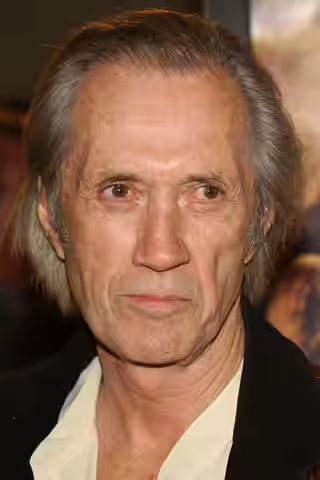
David Carradine could make a quiet voice more unsettling than a raised one. We rate him most when a director gives that spare, dry delivery something substantial to do; Kill Bill: Vol. 2 makes the case.
Fi1m perspective
In Kill Bill: Vol. 2 (2004), Bill announces himself with a flute outside a wedding chapel, and David Carradine's voice reaches us before his face does. He sounds courteous, patient and quite comfortable with himself. We felt uneasy because his soft, reasonable voice made the threat harder to judge. Robert Richardson's wide framing makes the fuss inside the chapel a useful contrast to that unhurried voice. Carradine does not underline the danger, and the entrance works because he gives us so little help in deciding what this man might do.
That mixture of restraint and the possibility of violence had served him long before Bill. As Kwai Chang Caine, the wandering Shaolin monk of Kung Fu (1972–1975), he became associated with a thoughtful outsider who could also fight. Bound for Glory (1976) gave him Woody Guthrie, another outsider suited to his understated delivery. We would not send someone to Martin Scorsese's Mean Streets (1973) to understand Carradine: his part is a drunk, and a small one. The leading roles gave that terse manner more room to work.
Later decades brought long stretches of direct-to-video work, and Quentin Tarantino's casting of him as Bill restored his prominence. In Kill Bill: Vol. 1 (2003), though, he is a voice on a telephone and a pair of hands. The casting makes economical use of his manner, but there is too little of him to treat it as a substantial performance. We prefer the second film because it gives him time to speak, rather than merely promising that he will matter.
Tarantino gets the most from him by allowing the courtesy to remain intact: Carradine need not advertise Bill's cruelty with a growl. His calm makes us listen for the threat in an ordinary sentence, and gives Uma Thurman something to respond to beyond another physical challenge. The qualification is that this depends on the writing; those pauses need words worth waiting for. The film supplies them, though we still think it runs about twenty minutes too long, and Carradine cannot make every conversation necessary. For Carradine, make time for both parts, and forgive the second a little of its dawdling.
Biography
David Carradine was an American actor. Born John Arthur Carradine Jr. in Hollywood, California, he was the eldest son of actor John Carradine and a member of the Carradine acting family.
He trained at San Francisco State University and began his career in theatre before appearing in films and television. He is best known for playing Kwai Chang Caine in the 1970s series Kung Fu and Bill in Quentin Tarantino’s Kill Bill: Vol. 1 (2003) and Kill Bill: Vol. 2 (2004). He also appeared in Martin Scorsese’s Boxcar Bertha (1972) and Mean Streets (1973).
Carradine received Golden Globe and Emmy Award nominations for Kung Fu and further Golden Globe nominations for Bound for Glory (1976), North and South (1985) and Kill Bill: Vol. 2. He won the Saturn Award for Best Supporting Actor for the latter.