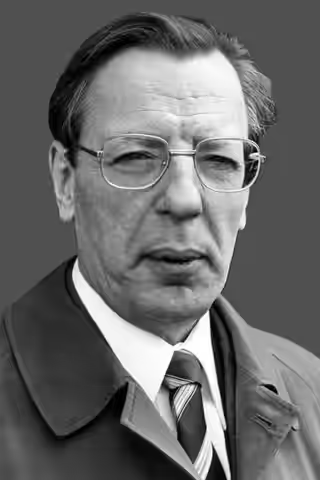
Jean Bouise spent thirty years playing men behind desks, ministers, factory bosses, station chiefs, and never raised his voice to do it. The films that used him best, above all Besson's first, gave him a stranger to be courteous to.
Fi1m perspective
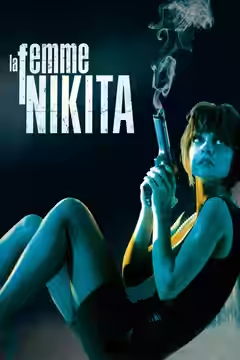
Look at what Jean Bouise does with a desk. In Z (1969) he is a deputy, in Coup de tête (1979) a factory owner who also runs the football club, in Subway (1985) a station chief, in Nikita (1990) an embassy attaché. Each is a man who holds the power and knows it, and Bouise plays that knowledge as stillness. He does not bark. He waits, and the scene comes to him.
He was a theatre actor first and stayed one. He came to acting from chemistry, met Roger Planchon in 1950 and with him founded the company in Lyon that became the Théâtre de la Cité in Villeurbanne, where he remained through the 1970s. That is a company man's career, not a star's, and the film work followed the same shape: supporting parts from the early 1960s onwards for Costa-Gavras, Sautet, Losey and Yves Boisset, and seven films with Robert Enrico, among them Le Vieux Fusil (1975), where he is François, the friend, and does the quiet work that holds the picture steady.
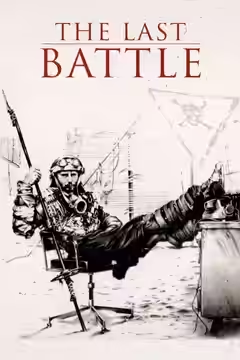
From 1983 he was in every film Luc Besson made, four in a row, and the first is the one to see. The Last Battle (1983) has no dialogue at all, and Bouise, who had lived on text for thirty years, is its heart. His Doctor is courteous in a world that has no further use for courtesy, and there is a passage in the middle where he shares his food, his shelter and his one remaining pleasure with a stranger who has no claim on him. We were moved by it far more than a black-and-white film about the end of the world had any right to move us, and it is because Bouise plays good manners as the last thing standing, not as a joke. Jean Reno, with whom he made seven films, is the Brute outside hammering at the door; Bouise inside laying out what he has is the whole film in two men. He once said, "C'est souvent en regardant les autres qu'on apprend le mieux. En se taisant", that you learn best by watching other people and keeping quiet. The Last Battle is where you can watch him do it.
The later Besson films gave him less to do. He is Uncle Louis in Le Grand Bleu (1988) and the attaché in Nikita, and in Nikita the part is small enough that our own review does not mention him, which is a fair measure of it. That was the pattern of the whole career: almost nothing in the lead after the early 1960s, and a long shelf of parts that last ten minutes and are done properly. Some actors need the film built around them. Bouise needed a chair and someone to be polite to.
Nikita was his last film and carries a dedication to him. Start with The Last Battle; then go back to the seventies and watch for the man behind the desk who is not shouting. It is usually him.
Biography
Jean Bouise was a French actor. Born in Le Havre on 3 June 1929, he helped found the Théâtre de la Cité in the 1950s and performed with the company before entering films in the 1960s.
He appeared in supporting roles in films including Z (1969), The Old Gun (1975), Mr. Klein (1976) and several works by Luc Besson: The Last Battle (1983), Subway (1985), The Big Blue (1988) and Nikita (1990). He received César Award nominations for The Old Gun and Judge Fayard Called the Sheriff (1977), and won Best Supporting Actor for Hothead (1979). Bouise died in Lyon on 6 July 1989.