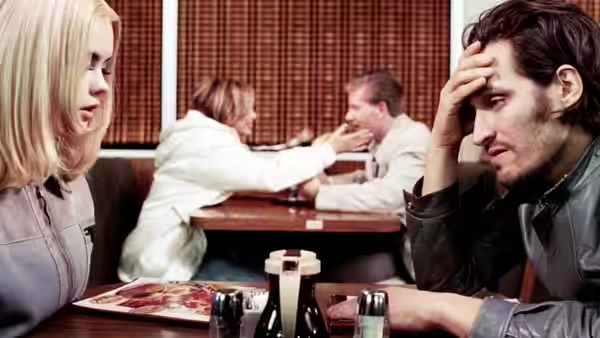
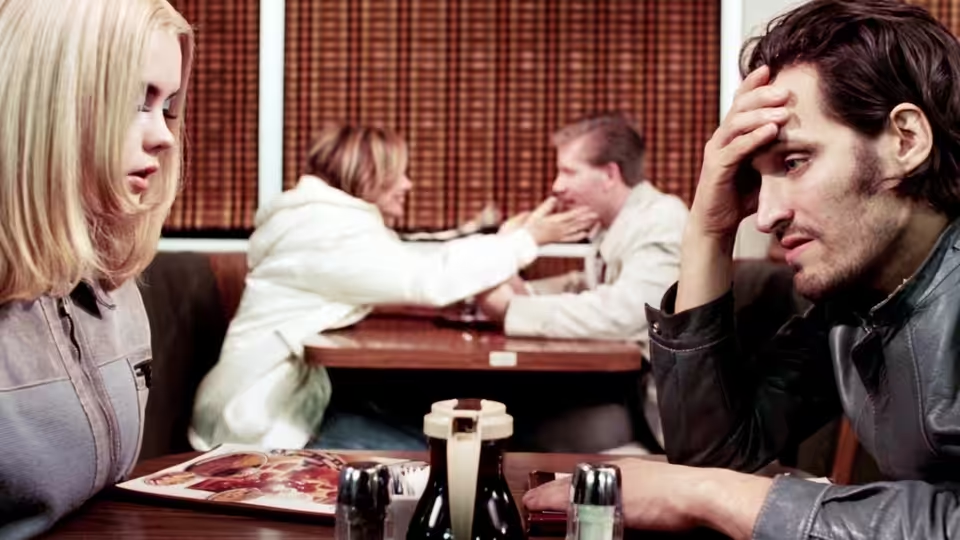
Layla (Christina Ricci) watches Billy Brown (Vincent Gallo) hold his head in a diner
Film review

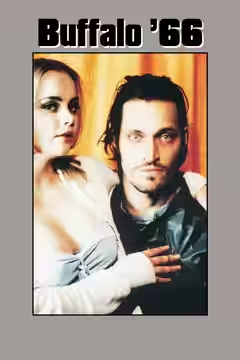
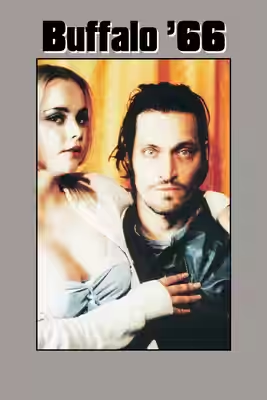
Buffalo '66

1998 · Directed by Vincent Gallo · 1h 50m · MPA R

In a sentenceEven a kidnapped pretend wife is expected to make an effort with the in-laws

Billy Brown (Vincent Gallo) leaves prison and heads home to see his parents, whose approval he wants. He kidnaps Layla (Christina Ricci), a tap dancer, and requires her to pose as his wife during the visit. Layla is drawn into a family encounter under an assumed identity, while Billy tries to present a version of his life that his parents will accept. The story follows their enforced partnership as resentment, embarrassment and a desire for affection complicate the arrangement. Ben Gazzara and Anjelica Huston also feature.

Plays from YouTube when you press play; nothing loads from them until then.

Fi1m review

Vincent Gallo’s abrasive comedy is worth seeing for Christina Ricci and its uncomfortable family visit. The romance asks too much indulgence, though there is enough humour and feeling here to keep us with these difficult people.

Vincent Gallo gives Billy Brown a simple wish: to go home from prison and be welcomed. Billy’s method is to kidnap a tap dancer, Layla, and have her impersonate his wife for the visit. Buffalo ‘66 expects us to find tenderness in this ugly arrangement, which is a considerable request. We think it works as a bruised comedy, although its romance depends on accepting a woman’s patience without being told enough about her.

Gallo plays Billy with an exhausting energy that suits a man so desperate for approval and so ill-equipped to receive it. He allows the neediness to become embarrassing, and that is where the performance gets past mere aggression. We laughed at the family visit and were surprised to feel sorry for Billy. He has brought a kidnapped stranger home to help him secure the affection he wants, which makes his desperation difficult to miss.

Christina Ricci is the reason we keep watching that arrangement. Her sweetness keeps Layla from seeming merely a reward for Billy’s suffering, even when the writing seems ready to settle for that. She makes the attraction seem possible from one exchange to the next, without quite answering the larger question of what Layla wants for herself. Gallo and co-writer Alison Bagnall needed to give her wishes some of the attention they give his.

Lance Acord’s stark compositions give the encounters an uncomfortable formality, making these people seem exposed even when they are trying to bluff. Gideon Ponte’s production design helps make the family setting feel unwelcoming, with little comfort to be found in Billy’s homecoming. The controlled staging is effective, though it can also make the characters seem arranged for our inspection. Gallo’s tendency to turn a difficult family into a collection of grotesques limits how much we can believe in them.

Curtiss Clayton’s editing accommodates the digressions rather than hurrying the pair towards the next piece of plot. We appreciate the space that gives the performances, although some pauses feel like scenes waiting for a reason to continue. Gallo also supplies the music, which helps the shifts between grimness and romantic fantasy feel less abrupt. The surreal musical passages are welcome interruptions to Billy’s grievances, but not every departure from the story earns its place. At 110 minutes, the film has stretches we would happily lose.

In a more conventional romantic comedy, the false-wife business would be an excuse for misunderstandings. Here, the lie tells us how Billy thinks: he needs his parents to see evidence that somebody wants him, and he cannot imagine obtaining it honestly. That is a bleak enough starting point to give the humour some force. Gallo can be self-absorbed, but his willingness to make Billy look so humiliatingly needy keeps us interested.

Ricci gives the film enough warmth that its sourness never becomes the whole experience. We recommend it if the thought of a disreputable romantic comedy appeals, and if Billy’s self-absorption does not sound like too much work. Just do not mistake our sympathy for him for approval of his approach to courtship.

Critical consensus AI synthesised

67
Positive
8
Mixed
1
Negative
2

With only 5 reviews in so far, the consensus leans positive, with praise clustering around Gallo’s rough originality, the mixture of grimness and tenderness, and Ricci’s performance. Critics find personal feeling beneath the eccentric storytelling, though they differ on how much the visual flourishes contribute. Reservations centre on Gallo’s self-indulgence and the credibility of the romance. The Guardian praises the chemistry between Gallo and Ricci; The AV Club finds the relationship contrived and the characters closer to caricatures. The divide is chiefly over whether the emotional connection survives the stylistic display.

The Guardian
9 April 1999 · Rob Mackie
90*

The critic calls it an alarmingly good writer-directorial debut that is disarmingly charming, perceptive, very funny and hugely original, even making the bungled-kidnap plot work. They single out the superb set-pieces and the chemistry between Gallo and Ricci for particular praise.

Read the full review →
Film Comment
festival review
85*

The film is an idiosyncratic study in American miserabilism and the redemption of a beautiful loser, destined for cult status. It supplies an antidote to indie film’s fixation on killer couple road films, with a tentative, petrified holding of hands as its most transgressive act.

Read the full review →
Time Out
10 September 2012 · TCh
85*

Gallo's directorial debut is an eccentric, provocative comedy that blends a poignant love story with sombre naturalism and surreal musical elements. The critic praises the film's personal, deeply felt story and its innovative, individual film grammar.

Read the full review →
RogerEbert.com
7 August 1998 · Roger Ebert
75*

The film is an interesting collision of half-baked visual ideas and urgent personal need, with an astonishing performance by Christina Ricci. It features improvisational, unconventional storytelling focused on family wounds and quirky sequences rather than conventional plot payoffs.

Read the full review →
Los Angeles Times
17 July 1998 · Kevin Thomas
70*

Gallo's compelling debut as writer-director blends grit and romanticism in a story of an ex-con craving parental approval after prison. It is alternately satirical and romantic, full of pain and humor, with striking images and a terrific instinct for mixing reality and fantasy.

Read the full review →
The New York Times
3 April 1998 · festival review · Janet Maslin
70*

Gallo's deadpan original mixes pathos with bravado as a volatile ex-con kidnaps a tap dancer to pose as his wife for a nightmarish family visit. Cool stark compositions and a strong cast give the autobiographical film a memorable look despite occasional narrative lulls.

Read the full review →

Straight answers AI written, from our review

Is Buffalo '66 worth watching?
Buffalo '66 is worth watching if a disreputable, abrasive romantic comedy appeals, and we scored it 77. Christina Ricci and the excruciating family visit are the reasons to see it, and Vincent Gallo makes Billy's neediness funnier and sadder than his aggression suggests. The romance asks you to indulge a kidnapping without learning enough about the woman who tolerates it.
How long is Buffalo '66, and what is it rated?
Buffalo '66 runs 1h 50m and is rated R by the MPA in the US. It is a drama and romance film.
Where can I watch Buffalo '66 in the US?
Buffalo '66 is streaming on Amazon Prime Video, Tubi and The Roku Channel in the US, and it is also available to rent from Apple TV and Amazon Prime Video from $3.99. It leaves Tubi on 1 October. Availability is checked daily; the links above go straight to each service.
How violent or frightening is Buffalo '66, and is it suitable for children?
Buffalo '66 is an adult film, rated R in the United States and without a UK certificate, and it is not suitable for children. The story turns on a man kidnapping a stranger and forcing her to pose as his wife, and the humour is sour and uncomfortable rather than frightening. Teenagers used to bleak comedy may manage it; younger viewers have no business here.
How does Buffalo '66 compare to Punch-Drunk Love?
Buffalo '66 and Punch-Drunk Love both follow an angry, lonely man into an unlikely romance, but Paul Thomas Anderson's film is the tighter and more controlled of the two. Gallo's is rougher, more self-absorbed and harder to like, though its family scenes bite deeper. Both give the woman too little of her own; Ricci and Emily Watson each rescue the courtship anyway.

Cast

Awards

Independent Spirit Awards, 1999

Nominated
Best First Feature

Open Palm Award, 1998

Nominated
Open Palm Award

If you liked this, try…

  1. Minnie and Moskowitz (1971) · not reviewed yetA ragged courtship whose difficult people get room to be funny and unhappy.

  2. The Match Factory Girl (1990) · not reviewed yetDeadpan humour and family cruelty, with much less patience for romantic rescue.

  3. The Lovers on the Bridge (1991) · not reviewed yetFor the reckless affection and the refusal to make damaged lovers presentable.

  4. Punch-Drunk Love (2002, Fi1m 84)Another angry, lonely man finds love, with tighter control of the comedy.

  5. On Body and Soul (2017) · not reviewed yetAn unusual courtship that gives both awkward lovers a full emotional life.

Free account

Know what to watch tonight

Two lists that know where things are streaming, collections you can share, your own score beside ours, and Discover that remembers what you have seen.

  • Want to see, sorted by what is streaming now
  • Seen, with your score out of ten
  • No adverts, ever