a bearded man holds a rifle beside a rusted van in the desert
Film review

Foxtrot

2017 · Directed by Samuel Maoz · 1h 53m · MPA R

In a sentenceGrief in a designer flat, boredom in a sinking box, and a camel that outranks everyone at the barrier

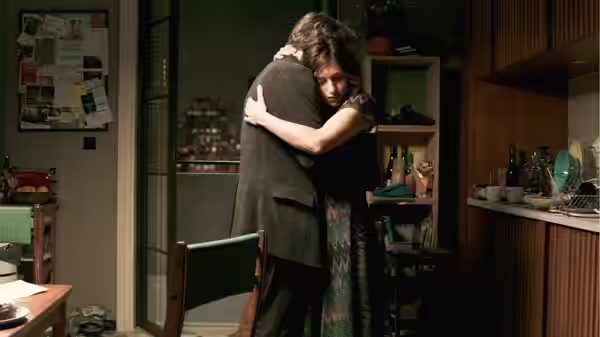
Two soldiers ring the bell of the Feldmann flat in Israel and Daphna (Sarah Adler) collapses before they have spoken. Her husband Michael (Lior Ashkenazi) is told that their son Jonathan (Yonatan Shiray), a soldier, has fallen in the line of duty. The army has a procedure and it runs: a sedative for Daphna, a rabbi to plan the funeral, a young officer who sets an alarm on Michael’s phone so that he drinks a glass of water every hour. Michael feeds the dog, breaks the news to his mother (Karin Ugowski), who cannot hold on to it, and receives his brother Avigdor (Yehuda Almagor). Their daughter Alma (Shira Haas) comes home. Michael wants to be told what happened, and nobody will tell him.

Plays from YouTube when you press play; nothing loads from them until then.

Fi1m review

Samuel Maoz’s second film gives a soldier’s parents the worst news, then spends two chapters showing how such news gets made. It is exact, strange and often funny, and a final turn ties the knot tighter than it needed to be.

Two soldiers ring the bell, and Daphna Feldmann (Sarah Adler) has understood before either of them has opened his mouth. She goes down in the doorway. Her husband Michael (Lior Ashkenazi) stays on his feet and is told that their son Jonathan has fallen in the line of duty. Then the army’s procedure takes over: a sedative for the wife, a rabbi to talk about the funeral, and a young officer who sets an alarm on Michael’s phone so that he remembers to drink a glass of water every hour. Samuel Maoz, who wrote and directed, plays this without music and hardly takes the camera off Ashkenazi’s face. It is the most controlled half hour of the film.

Arad Sawat has built the Feldmann flat as a large, expensive, geometric place, tiles laid in patterns that Giora Bejach shoots from directly overhead, so that Michael crossing a room or lying on the bathroom floor looks like a counter being moved on a board. That is the idea and Maoz does not labour it. Ashkenazi plays a man who has decided to be practical because the alternative is unthinkable; he feeds the dog, he scalds his hand under a hot tap, the alarm goes and he drinks the water. Yehuda Almagor arrives as his brother Avigdor, kind and useless in the way brothers are. Karin Ugowski, as Michael’s mother, is told what has happened and does not retain it. Adler is asleep for most of the chapter, and her one waking scene was harder for us to watch than the news itself.

Then the first chapter ends on a turn we will not describe, and the film goes somewhere else entirely: a checkpoint in the desert, a barrier across a road almost nobody uses, four young soldiers and a shipping container that is sinking, slowly, into the mud. They measure the tilt by rolling a tin along the floor. A camel wanders up now and then and they lift the gate for it. Jonathan (Yonatan Shiray) draws comic strips in a notebook. One of the others (Etay Axelrod) dances a foxtrot with his rifle. Bejach shoots this section in wide, level frames the colour of wet sand, and the editors, Arik Lahav-Leibovich and Guy Nemesh, cut it to the rhythm of boredom: long holds, nothing, then headlights.

The cars are where we were horrified. A vehicle pulls up, papers are handed over, the boys decide whether to raise the barrier, and a couple in evening clothes are made to stand in the rain while their boot is emptied. Maoz stages these stops quietly. What frightened us was how routine the evening is for the people holding the rifles and how far from routine it is for the people in the car, and that the film never has to say which of them will remember it. One night it goes wrong, and we will not say how. The score by Ophir Leibovitch and Amit Poznansky, spare throughout, stays out of it altogether, which is the right call.

The third chapter returns to the parents, and to Shira Haas as their daughter Alma, who has been at the edge of the frame until now and is finally given something to do. Adler, awake, is the best thing in it: a woman being reasonable in a voice that could break at any second. She and Michael share a joint on the kitchen floor and talk, and for ten minutes the film is as plain and sad as anything Maoz has made. Then the mechanism shows. The title is a dance that, however far it travels, ends where it began, and the last stretch of the film insists on that a little too hard.

The reviews so far have split on that ending, and we are with the doubters, though not all the way. It does not undo what came before. It just squares off something that had been better left rough. Maoz’s earlier film, Lebanon, kept us inside a tank for its whole length. This one has a flat, a desert and a road, and the people in them are not much freer. We would rather he had left us with the mud and the camel.

It runs 113 minutes, in Hebrew. Watch it in one sitting and read nothing about it first; the chapters only work in the order Maoz has put them. Then argue about the last five minutes, as we did.


Critical consensus AI synthesised

82
Positive
19
Mixed
2
Negative
0
Film Comment
7 December 2017 · Michael Sragow
90*

The critic praises Maoz’s marvelous, harrowing drama for its paradoxes, blending intimate parental grief with absurdist soldier scenes at a remote checkpoint. The film is lauded for its original vision, stylistic range, and emotional depth as an effective antiwar statement.

Read the full review →
IndieWire
3 September 2017 · festival review · Eric Kohn
90*

Samuel Maoz’s second feature is beautiful deadpan satire with many surprises in store, offering a brilliant portrait of Israeli frustrations. It stands out for its formal audacity and emotional depth as a festival standout.

Read the full review →
Los Angeles Times
7 December 2017 · Kenneth Turan
90*

The ambitious film combines intense emotional drama with visual pizazz and bursts of unexpected surrealism in an intricate, dazzling cinematic dance. It is profound and moving, wild and crazy at the same time, offering both a specific story and an emotional snapshot of a country at risk.

Read the full review →
RogerEbert.com
2 March 2018 · Brian Tallerico
90*

The film is a searing examination of grief, fate, and the music of chance, inspired by a personal near-tragedy. It blends stark realism with striking, memorable imagery across its tripartite structure, proving both specific to Israeli experience and universal.

Read the full review →
Screen Daily
1 September 2017 · festival review
90*

The critic describes the film as a shattering, restrained portrait of family grief structured like a three-act tragedy. They single out its obsessive visual economy and the way it unveils layers of past guilt in the characters beyond mere mourning.

Read the full review →
Sight and Sound
10 September 2017 · Paul O’Callaghan
90*

The critic praises Maoz’s follow-up to Lebanon as an elegant, multifaceted film that expands on themes of trauma with absurdism and rage. It singles out the film’s compelling structure and bitterly cruel final twist for particular note.

Read the full review →

Straight answers AI written, from our review

Is Foxtrot worth watching?
Foxtrot is worth watching for anyone prepared to sit with grief for 113 minutes without much comfort, and we scored it 80. Samuel Maoz's film is exact, strange and unexpectedly funny across its three chapters, and Lior Ashkenazi and Sarah Adler are both excellent. Our one reservation is a final turn that squares things off harder than it needed to.
How long is Foxtrot, and what is it rated?
Foxtrot runs 1h 53m and is rated R by the MPA in the US. It is a drama film.
Where can I watch Foxtrot in the US?
Foxtrot is available to rent from Amazon Prime Video from $2.99. Availability is checked daily; the links above go straight to each service.
How violent or frightening is Foxtrot, and is it suitable for children?
Foxtrot is not for children: it carries a US R certificate and has no UK rating, and its subject is the death of a soldier and the parents left behind. On-screen violence is brief and staged quietly, but one checkpoint stop goes badly wrong, and the film's grief is unrelenting. It suits adults and older teenagers who can take a slow, sad drama.
How does Foxtrot compare to The Sweet Hereafter?
Foxtrot and The Sweet Hereafter are both films about grief told out of order and without consolation, but Maoz's is the stranger and funnier of the two. Egoyan's film is quieter and more patient, and its fragmented telling can feel over-arranged; Foxtrot is bolder in its three-chapter shape, then over-insists at the close. Choose Egoyan for stillness, Maoz for surprise.
What should I watch after Foxtrot?
After Foxtrot, try Beau Travail (1999, Fi1m 86): Soldiers with nothing to do, filmed as dance; the desert and the boredom rhyme. Then The Sweet Hereafter (1997, Fi1m 88): Egoyan’s town after a bus crash; grief told out of order, without comfort; and Waltz with Bashir (2008, Fi1m 83): Animated memory of a war nobody wants to remember; pairs well with Maoz.

Cast

Awards

European Film Award for Best Director, 2018

Nominated
European Film Award for Best Director

European University Film Award, 2018

Nominated
European University Film Award

IFFR audience award, 2018

Nominated
IFFR audience award

International Submission to the Academy Awards, 2018

Nominated
International Submission to the Academy Awards

If you liked this, try…

  1. Lebanon (2009) · not reviewed yetMaoz’s first film, fought entirely from inside a tank; tighter and angrier than this.

  2. Beau Travail (1999, Fi1m 86)Soldiers with nothing to do, filmed as dance; the desert and the boredom rhyme.

  3. Zero Motivation (2014) · not reviewed yetThe Israeli army as office comedy; the checkpoint chapter’s funnier cousin.

  4. The Sweet Hereafter (1997, Fi1m 88)Egoyan’s town after a bus crash; grief told out of order, without comfort.

  5. Waltz with Bashir (2008, Fi1m 83)Animated memory of a war nobody wants to remember; pairs well with Maoz.

Free account

Know what to watch tonight

Two lists that know where things are streaming, collections you can share, your own score beside ours, and Discover that remembers what you have seen.

  • Want to see, sorted by what is streaming now
  • Seen, with your score out of ten
  • No adverts, ever