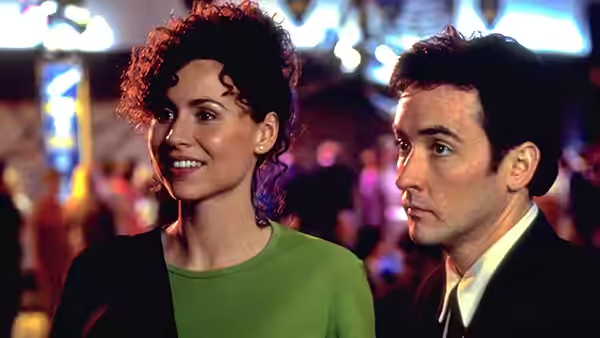
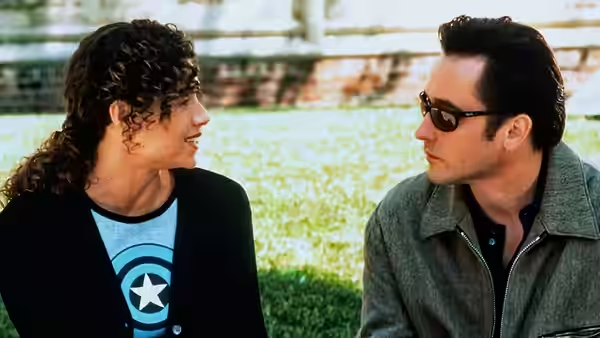
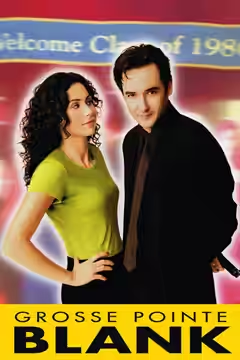
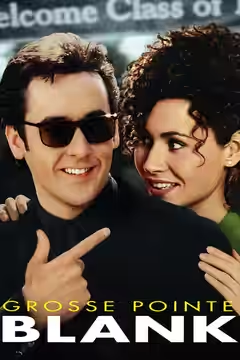
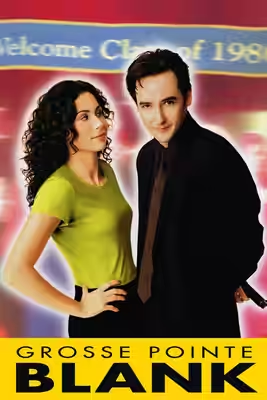
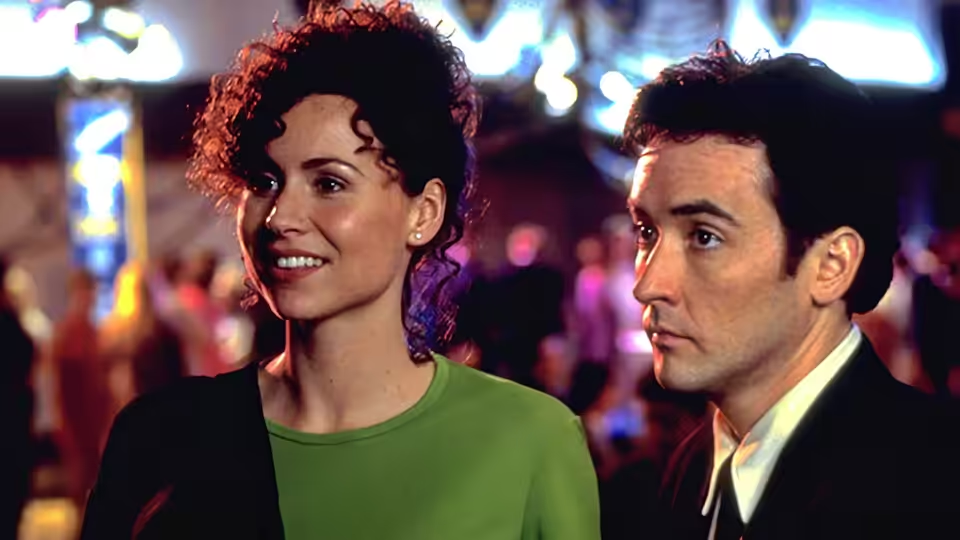
Debi Newberry (Minnie Driver) smiling beside Martin Blank (John Cusack) at a reunion
Film review

Grosse Pointe Blank

1997 · Directed by George Armitage · 1h 47m · MPA R

In a sentenceEven a hitman can become the bore at a school reunion

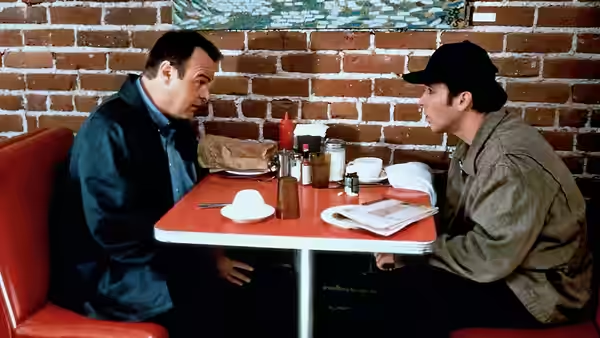
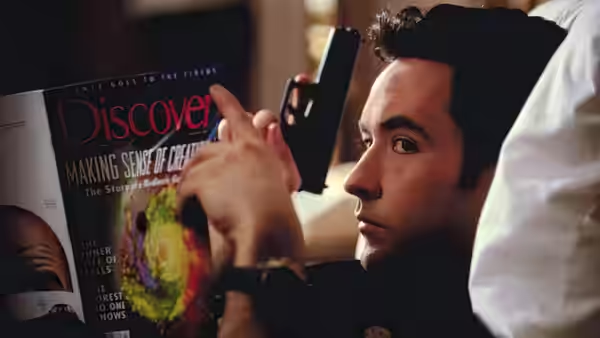
Martin Q. Blank (John Cusack) earns his living as a hitman and is struggling to find meaning in it. A high-school reunion brings his professional life into contact with the people and expectations of his past. Debi Newberry (Minnie Driver) is part of that return, as Martin confronts questions about who he has become and what he wants next. His occupation complicates the usual business of catching up. Dan Aykroyd plays Grocer, Joan Cusack plays Marcella and Alan Arkin plays Dr. Oatman in a story that mixes the reunion with romance and a killer’s identity crisis.

Fi1m review

John Cusack and Minnie Driver make an unlikely romance worth following, and the early comedy is sharp. But Grosse Pointe Blank grows pleased with its own cleverness and never finds enough to do with its premise.

Grosse Pointe Blank has a useful answer to the anxiety of a school reunion: at least most of the guests do not kill people for a living. George Armitage puts John Cusack’s Martin Q. Blank through the familiar business of wondering what became of his life, with an occupation that ought to make the question harder to answer. The opening is funny and the romantic leads are appealing. But this is a mixed comedy, increasingly content to keep its central joke going without making it more uncomfortable.

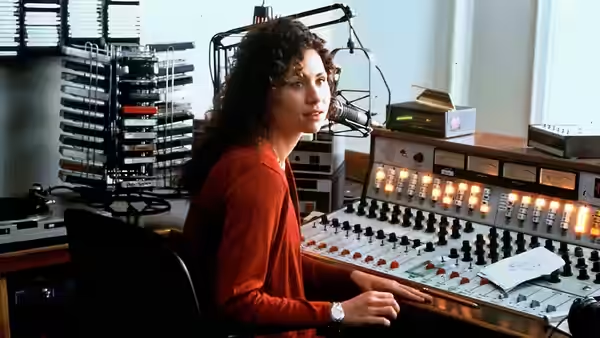
Cusack is good at making Martin’s self-questioning sound quite ordinary, which is where the early humour comes from. We laughed at those opening comic duets because his dry delivery lets the killer’s worries sound almost sensible. Minnie Driver’s Debi Newberry gives the romance enough warmth that spending time with these two remains pleasant even as our interest in Martin’s predicament begins to fade. Their appeal is considerable, and it lets the film postpone awkward questions about why this man should deserve our affection.

The screenplay, credited to Tom Jankiewicz, D.V. DeVincentis, Steve Pink and John Cusack, is alert to the embarrassment behind the reunion. Martin’s profession makes the usual doubts about work and identity seem absurd, and the dialogue gets good laughs from treating both problems with similar gravity. That is a sound basis for a short exchange. Across 107 minutes, the joke becomes wearing, especially when the film asks us to take his unhappiness seriously without making his self-examination much more searching.

Armitage handles the changes between romance, action and comedy with enough control that the mixture seldom feels forced. Jamie Anderson’s cinematography serves the deadpan tone, keeping our attention on the performers rather than trying to add another joke. Brian Berdan’s editing is most effective in the opening exchanges, where the dialogue has a snap that the film cannot sustain. As those exchanges give way to more of Martin’s crisis, the pace begins to feel leisurely without becoming more revealing.

Joe Strummer’s music sits alongside the 1980s songs, which do much of the work of making the reunion feel personal. The soundtrack is inviting, though the familiar records eventually do too much of the emotional work. Stephen Altman’s production design keeps the reunion setting ordinary enough for Martin’s profession to remain the conspicuous oddity. These choices make the film welcoming, sometimes to the detriment of a story about a professional killer.

The trouble becomes clearest when judged as black comedy. A killer worrying about his identity offers opportunities for uglier laughs than the film seems willing to pursue, and Martin’s charm gradually becomes a way of avoiding them. Armitage’s steady handling keeps the tone consistent, but it also protects Martin from seeming as troubling as his occupation suggests. We need not dislike him, but the film could afford to make liking him a little more difficult.

There is enough wit here to explain the film’s appeal, and Driver keeps the romance from becoming merely another clever complication. The problem is how little the later stretches add to what the opening has already established. The actors remain agreeable company long after Martin’s crisis has ceased to surprise. For a sharper black comedy, we would look elsewhere.

Critical consensus AI synthesised

74
Positive
16
Mixed
1
Negative
1

The reviews lean firmly positive. Most critics enjoy the mixing of hitman black comedy with high-school-reunion romance, and the praise gathers around John Cusack, whose contract killer in a midlife crisis is credited with making an absurd premise human, and around his chemistry with Minnie Driver. The script’s dry, ironic dialogue is singled out repeatedly, as are the supporting turns from Dan Aykroyd and Alan Arkin. Several critics also point to the 1980s soundtrack as the source of the film’s wistful mood, and to Armitage’s direction for keeping the tone steady while the plot wanders.

Reservations are few and the spread is narrow. The two dissenters both wrote in 1997: RogerEbert.com calls it a near-miss, admiring the dialogue and the leads but faulting a conventional action climax, while The New Yorker finds a sharp opening giving way to a film that loses momentum and grows self-satisfied. The later retrospective pieces are warmer than the original notices and treat it as an under-appreciated favourite of its era.

Empire
1 January 2000 · Caroline Westbrook
90*

The review calls the film a real oddity and genre-hopper that succeeds admirably as a risk-taker, highlighting the clever script with ironic witticisms, attractive leads, taut direction that avoids gratuitous violence, and the nostalgic 80s soundtrack. It concludes that the result is one of the smartest, most original studio offerings in a long while and is hugely recommended.

Read the full review →
The Independent
8 August 1997
90*

The critic praises the film's disarming coolness and sparkling comedy, noting its fluid feel and complex issues beneath a typical Hollywood redemption story. They single out the witty script, strong character and emotion, poignant and darkly funny scenes reconciling past and present, Armitage's direction, and the imaginative use of the 1980s soundtrack.

Read the full review →
The Telegraph
28 April 2022
90*

The critic finds the film hugely charming and one of the decade’s hippest oddities, mixing black hitman humour with screwball romance and middle-age ponderings, punctuated by stylish gunplay and intense fight scenes.

Read the full review →
The AV Club
29 March 2002 · Keith Phipps
85*

The critic calls it a very funny dark comedy that smartly underplays its absurd situations and lets the characters shine without forced wackiness. Strong praise goes to the comic turns from Cusack and the supporting cast, especially Dan Aykroyd.

Read the full review →
Little White Lies
7 May 2020 · Adam Woodward
80*

The critic celebrates the film as a comforting rewatch that offers soothing familiarity, highlighting the supercool chemistry between John Cusack and Minnie Driver as the ultimate on-screen pairing.

Read the full review →
Los Angeles Times
11 April 1997 · Kenneth Turan
70*

A wild, anarchic comedy follows a hit man to his reunion with darkly playful energy and consistently surprising incidents. Director Armitage and the Cusack-led ensemble keep the comic attitude intact amid the mayhem.

Read the full review →

Straight answers AI written, from our review

Is Grosse Pointe Blank worth watching?
Grosse Pointe Blank is a mixed comedy, worth an evening only for admirers of John Cusack and Minnie Driver, and we scored it 55. The opening is sharp and the romance is warm, but the joke of a hitman fretting about his life wears thin across 107 minutes. For a bleaker black comedy, look elsewhere.

How long is Grosse Pointe Blank, and what is it rated?
Grosse Pointe Blank runs 1h 47m and is rated R by the MPA in the US. It is an action and comedy film.
Where can I watch Grosse Pointe Blank in the US?
Grosse Pointe Blank is available to rent from Amazon Prime Video from $3.99. Availability is checked daily; the links above go straight to each service.
How violent or frightening is Grosse Pointe Blank, and is it suitable for children?
Grosse Pointe Blank carries a UK 15 certificate, so it is not for children. It is an action comedy about a professional killer, and the certificate implies violence and adult language, though the tone stays deadpan rather than frightening. Older teenagers who can take the premise should be fine; anyone hoping for a gentle reunion comedy should note the occupation.
How does Grosse Pointe Blank compare to Something Wild?
Something Wild is the better film, because its romance turns dangerous and its comedy grows less comfortable as it goes, which is exactly what Grosse Pointe Blank declines to do. Cusack and Driver are agreeable company, but their film protects its killer from ever seeming troubling. Choose Demme's for bite, Armitage's for an easier evening.
What should I watch after Grosse Pointe Blank?
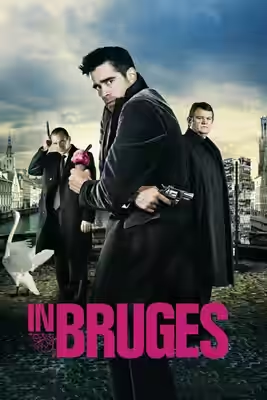
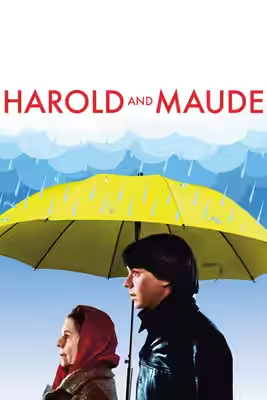
After Grosse Pointe Blank, try Something Wild (1986, Fi1m 82): Romance turns dangerous, and the comedy gets less comfortable as it goes. Then In Bruges (2008, Fi1m 83): For hired killers whose guilty consciences are allowed to spoil the holiday; and Harold and Maude (1971, Fi1m 81): A stranger romance, equally dry about death and more willing to unsettle.

Cast

If you liked this, try…

  1. The Matador (2005) · not reviewed yetAnother hired killer discovers that professional competence does not settle personal problems.

  2. Something Wild (1986, Fi1m 82)Romance turns dangerous, and the comedy gets less comfortable as it goes.

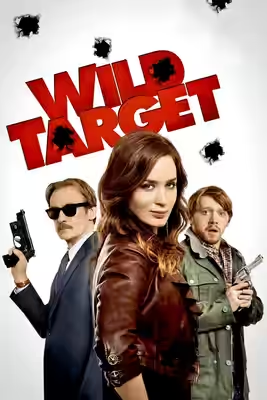
  3. Wild Target (2010) · not reviewed yetA British assassin comedy with patient absurdity and little respect for professional discipline.

  4. In Bruges (2008, Fi1m 83)For hired killers whose guilty consciences are allowed to spoil the holiday.

  5. Harold and Maude (1971, Fi1m 81)A stranger romance, equally dry about death and more willing to unsettle.

Free account

Know what to watch tonight

Two lists that know where things are streaming, collections you can share, your own score beside ours, and Discover that remembers what you have seen.

  • Want to see, sorted by what is streaming now
  • Seen, with your score out of ten
  • No adverts, ever