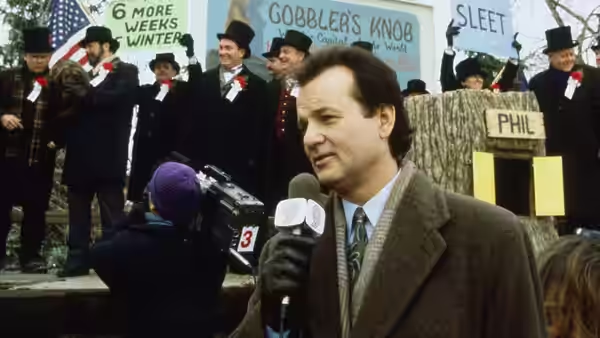
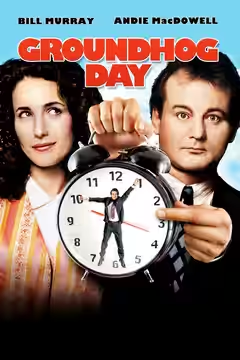
Bill Murray makes repeated irritation remarkably funny in Harold Ramis’s warm, sharp comedy about being stuck with yourself. The romance gives Andie MacDowell too little room, but the jokes and the patience with Phil’s bad behaviour earn our recommendation.
Harold Ramis’s Groundhog Day takes a premise that could have produced a short sketch and finds enough in it for a rich, funny 101 minutes. We recommend it for Bill Murray’s sourness as much as for its warmth. Phil Connors, a cynical weatherman, has to live the same day repeatedly, which puts severe pressure on his belief that everybody else is the problem. Ramis and co-writer Danny Rubin understand the comic value of making such a man endure other people’s company.
The screenplay is curious about what Phil can do within that situation, and trusts us to follow without an elaborate explanation of the loop. Repetition gives the jokes a useful second chance: once we recognise a situation, Murray can change our response with a different degree of irritation. Pembroke J. Herring’s editing is crucial here. Familiarity needs enough time to register, but not so much that we begin anticipating every beat, and the cutting usually gets that balance right.
Murray makes contempt look almost reasonable, which is where the film gets its bite. Stephen Tobolowsky’s Ned Ryerson is particularly useful company: his comic persistence gives Murray something firm to push against. We laughed at Murray’s impatience, then felt slightly ashamed of recognising it. He makes the effort of listening to another person look like an unreasonable demand, and Ramis lets that ugliness remain visible beneath the joke. Tobolowsky has his own comic rhythm; he does not merely wait for the star’s response.
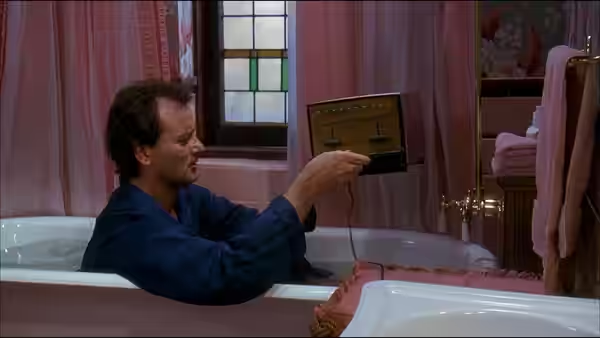
John Bailey’s cinematography is sensibly interested in Murray’s face. A small change of expression can alter a repeated encounter, and the images leave us room to catch it. David Nichols’s production design gives the familiar surroundings a useful ordinariness; Phil cannot blame his contempt on some grotesquely exaggerated setting. These contributions suit Ramis’s restrained direction, keeping the fantasy close to an everyday social embarrassment. The joke remains readable without the film having to make a spectacle of the loop.
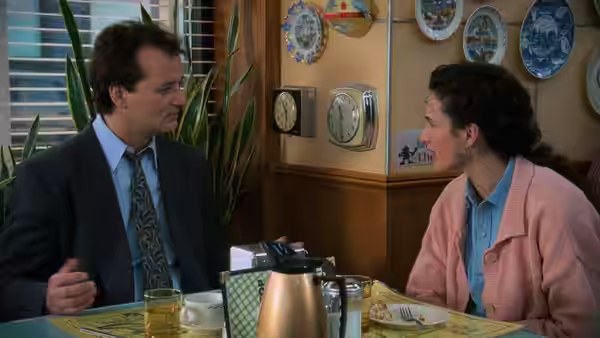
The romance is less evenly written. Andie MacDowell’s Rita Hanson gives Phil a credible reason to look beyond himself, and MacDowell’s directness is a good answer to Murray’s evasions. But Rubin and Ramis give us much more reason to wonder about Phil than about Rita; she can feel like someone the screenplay approves of before it has properly introduced her. George Fenton’s music occasionally adds more sweetness than these performances need. The film is already quite capable of making a small shift in Phil’s manner count.
Fantasy comedies often hurry through the possibilities of their central idea so they can get on with a familiar lesson. This one spends time on the awkward business of being Phil, and that makes its interest in better behaviour persuasive. There are changes of tone that sit a little awkwardly together, but the film is willing to let a joke become uncomfortable without immediately reassuring us. It does not treat being pleasant as something that comes naturally to everyone. Watch it with someone who has had to put up with your bad moods.