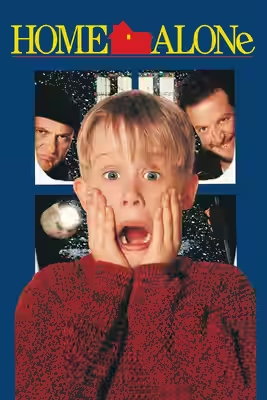
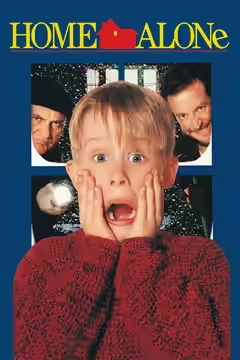
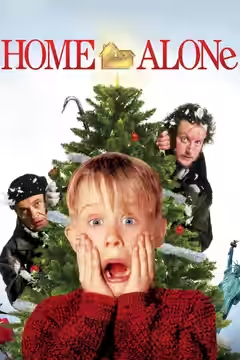
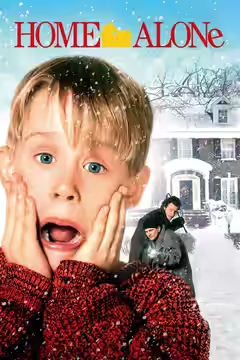
Macaulay Culkin makes Home Alone a funny, agreeably unkind family comedy, and the slapstick is timed with care. The sentiment needs less encouragement than Chris Columbus gives it, but the laughter earns our recommendation.
Home Alone understands the attraction of having the adults disappear, and the difficulty of knowing what to do once they have. Chris Columbus and screenwriter John Hughes turn a child left behind at Christmas into a funny, confidently acted family comedy, with more cruelty than its seasonal setting might suggest. We recommend it, though the insistence on making everything touching can be wearing. Its strongest idea is to let a small boy be pleased with himself without requiring him to be particularly nice.
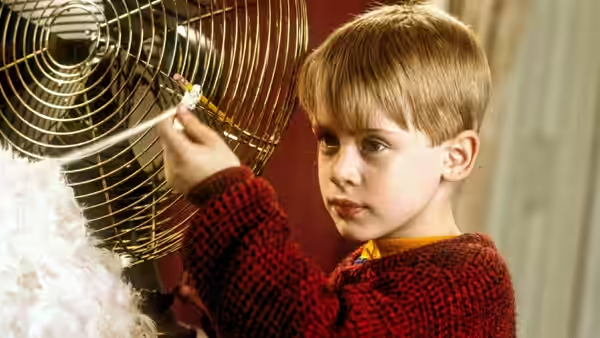
Macaulay Culkin’s Kevin makes that possible. His confidence is funny because it has the force of a child’s certainty: being alone seems to prove he can manage alone. Culkin lets self-importance and uncertainty sit close together, so the performance does not become a long demonstration of how adorable he is. There is enough abrasiveness here to make his resourcefulness satisfying, and enough childishness to keep him from seeming like an adult who happens to be short.
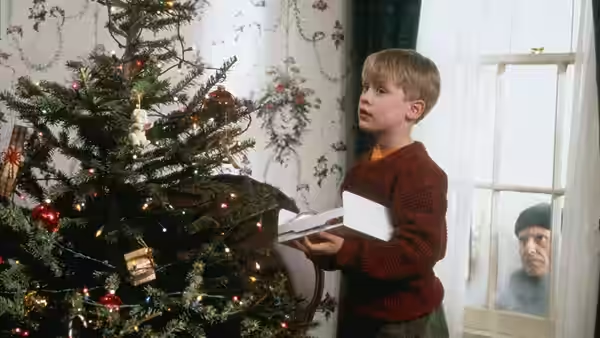
Julio Macat’s cinematography keeps the physical comedy legible, giving the performers’ reactions their proper share of the joke. John Muto’s production design makes the house feel like somewhere Kevin knows well enough to use to his advantage. We accept his command of the place, which gives the increasingly improbable comedy a useful starting point. That familiarity matters when the jokes depend on a child being better prepared than the adults.
Joe Pesci’s Harry and Daniel Stern’s Marv supply the adult bodies required for the punishment, and both understand how much indignity the comedy needs. Their broad performances let us accept the burglars as fair targets, even when the punishment is excessive. We felt slightly guilty about how much we laughed. The boy’s ingenuity is being measured in the discomfort of two grown men, and Columbus allows us to enjoy a good deal of that discomfort. Neither performer is too grand to look thoroughly foolish.
Editor Raja Gosnell earns much of that laughter by judging how long anticipation can last before a gag needs to arrive. His timing gives even the broadest physical jokes a welcome precision. John Williams’s score is generous with feeling, and its warmth helps the film make room for Kevin’s loneliness. The music gives that loneliness enough weight that the return to broad comedy does not simply erase it.
The weakness is Hughes’s determination to make family feeling as emphatic as the physical jokes. The move from a child’s gleeful independence to the ache of being without his family is persuasive enough; the extra nudging is not always necessary. Catherine O’Hara, as Kate, supplies an urgency that makes the adults worth attending to, even when the script seems anxious to tell us what to feel. Columbus sometimes presses the sweetness too hard, slowing a comedy that is otherwise happy to trust its performers. The interruptions are noticeable because Culkin needs so little help.
Family comedies can be so worried about setting an example that nobody is allowed an unattractive thought. This one gives its child a streak of selfishness and its adults a shortage of dignity, which leaves the actors something to play. At 103 minutes, it asks for a little patience with the sweetness, but the comic performances repay it. Make it a family evening, with a firm agreement that none of the ingenuity is to be tried afterwards.