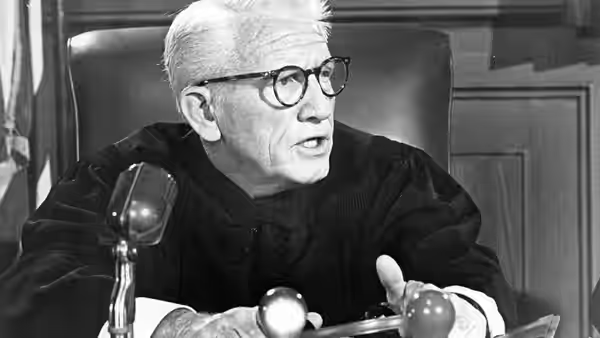
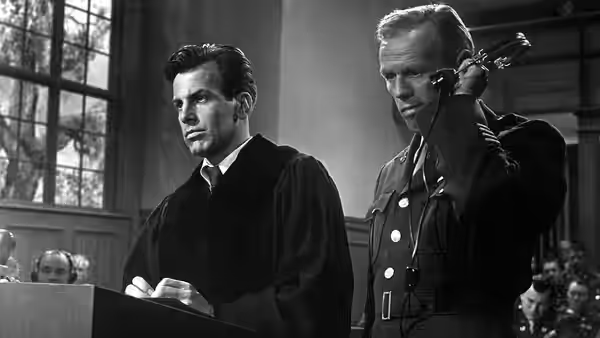
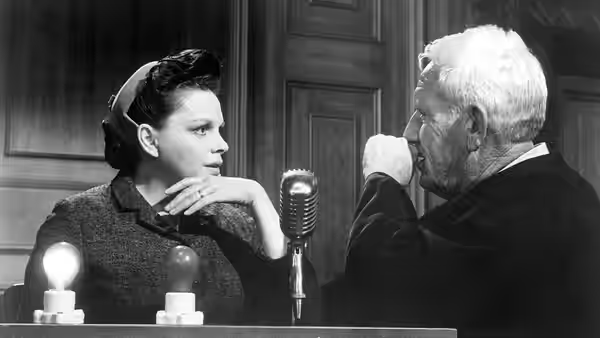
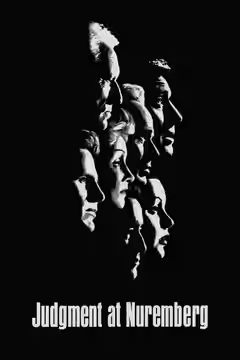
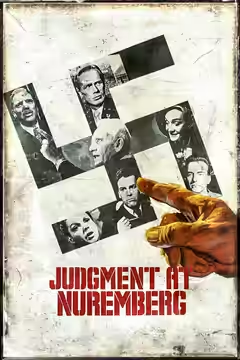
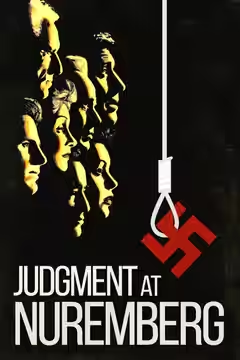
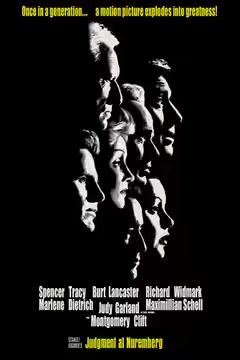
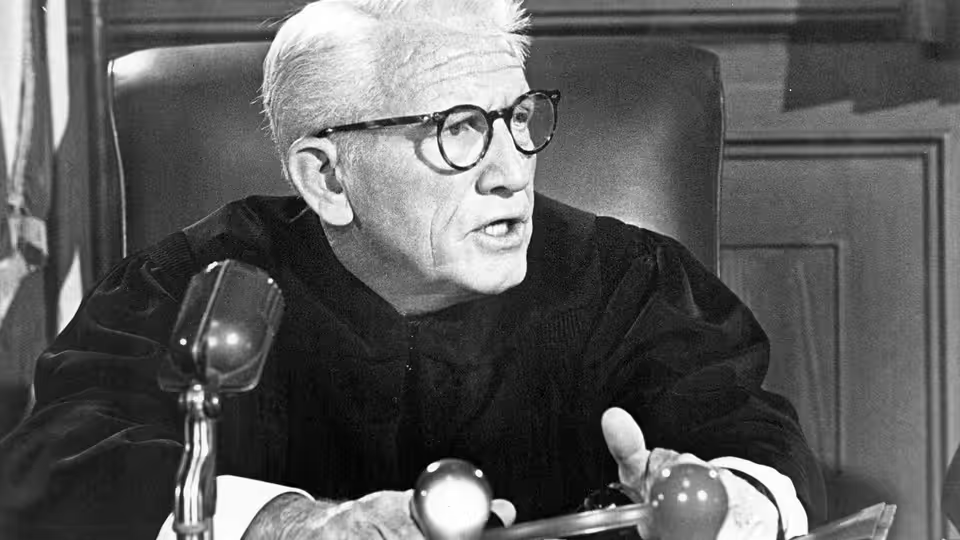
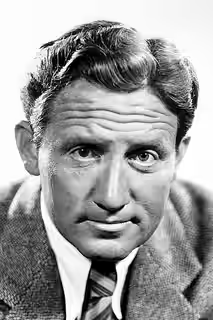
Dan Haywood (Spencer Tracy) speaking from the bench into a microphone
Film review

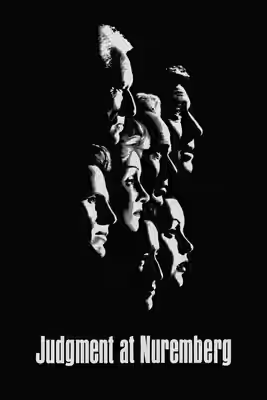
Judgment at Nuremberg

1961 · Directed by Stanley Kramer · 3h 11m · MPA NR

In a sentenceSpencer Tracy listens so well that three hours of other people talking seems a reasonable proposition

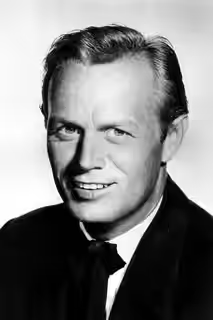
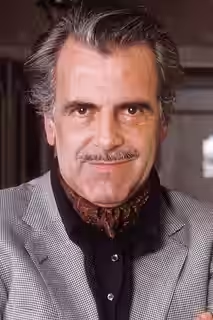
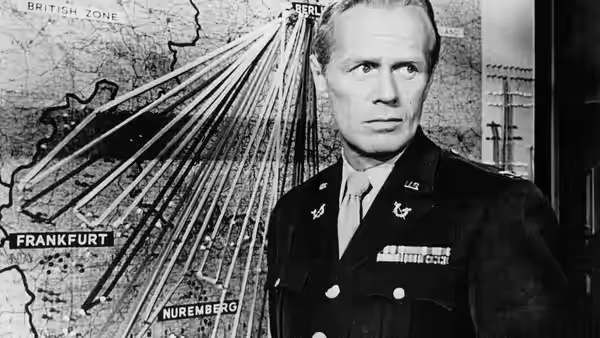
Judge Dan Haywood (Spencer Tracy) presides over a trial concerned with Nazi war guilt. The proceedings raise questions about how responsibility is shared between a state and the people who act in its name. Richard Widmark plays Tad Lawson, Maximilian Schell plays Hans Rolfe, and Burt Lancaster is Ernst Janning. Judy Garland appears as Irene Hoffman Wallner and Montgomery Clift as Rudolph Petersen, with Marlene Dietrich as Mrs Bertholt. As the court considers individual and collective accountability, the characters confront crimes whose consequences extend far beyond a single courtroom.

Plays from YouTube when you press play; nothing loads from them until then.

Fi1m review

Stanley Kramer’s courtroom drama is worth its 191 minutes, despite speeches that labour points already made. Spencer Tracy and Montgomery Clift make its questions about responsibility difficult to put aside.

Stanley Kramer asks a great deal of our patience in Judgment at Nuremberg, and earns most of it. At 191 minutes, this courtroom drama about Nazi war guilt has room to consider individual responsibility seriously, and enough room left over to repeat itself. We recommend it for the performances and for its willingness to make moral reasoning the substance of a long film. Abby Mann’s screenplay can be over-explicit, but it rarely lets the subject become merely respectable background for a gathering of stars.

Spencer Tracy’s Dan Haywood is the chief reason the proceedings remain absorbing. Tracy gives the judge an intelligence that does not need constant advertisement; we believe he is listening, which makes us listen more closely too. Maximilian Schell’s Hans Rolfe supplies a more forceful presence, and the difference gives the courtroom exchanges a useful tension. Tracy’s restraint also gives us somewhere to rest during a film in which so many people are making emphatic points.

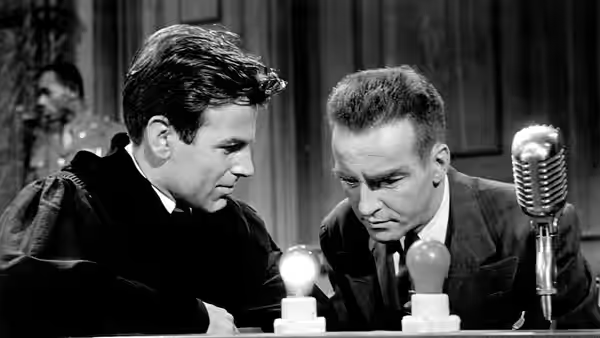
Montgomery Clift’s Rudolph Petersen makes such composure harder to sustain. We were distressed by his emotional collapse, because his difficulty holding himself together makes the court’s orderly discussion of guilt feel almost unbearable. He makes it impossible to forget that the legal arguments concern things done to individual people. The presence of Burt Lancaster, Marlene Dietrich and Judy Garland contributes to the film’s appeal, although the succession of prominent performers occasionally makes us too conscious of the casting.

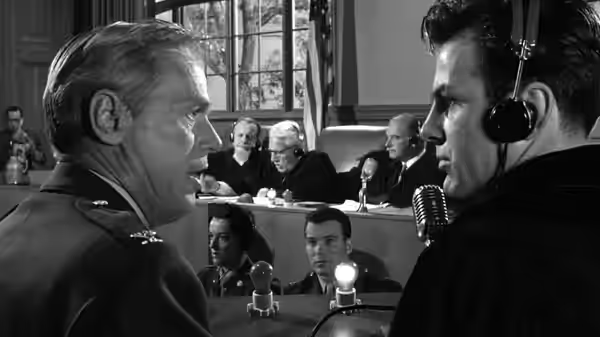
Ernest Laszlo’s cinematography feels properly attentive to the performers, while Rudolph Sternad’s production design gives the courtroom considerable dignity. That formality helps us take the proceedings seriously, although it sometimes makes the film too comfortable to look at. Frederic Knudtson’s editing allows the actors room, but is too indulgent of the repeated arguments. Ernest Gold’s music adds to the solemnity, with mixed results. The subject has enough weight already, and the acting needs little assistance.

Mann is strongest on the ease with which people can explain away their own responsibility. He takes those explanations seriously enough to make us examine them, and Kramer has the conviction to hold our attention through discussions that could readily become a lecture. Sometimes they do. The writing can be glib when it tidies a difficult question into a point we are expected to accept, and the film’s confidence in its own decency occasionally feels too easy.

The question worth carrying through the long speeches is a plain one: how much responsibility can a person hand over to the state? Kramer makes it difficult to dismiss as somebody else’s problem. That is enough to distinguish the film from courtroom dramas built chiefly around a clever reversal, even if the distinguished cast makes the encounter more comfortable than it ought to be. Give it an evening when nobody is hoping for an early night.
Critical consensus AI synthesised

77
Positive
9
Mixed
0
Negative
0

All nine reviews are favourable, and none is mixed or hostile. The praise clusters on two things. The first is the film’s seriousness about its subject: critics credit Kramer and Abby Mann with putting the question of how guilty those who followed orders were, and with refusing to answer it too neatly. The second is the cast. Spencer Tracy’s judge is singled out again and again as the calm centre of a three-hour picture, with Montgomery Clift’s shattered witness and Maximilian Schell mentioned almost as often.

The spread is narrow, and the reservations are about craft rather than purpose. Several reviews find the direction and screenplay conventional, with the courtroom material stretched and occasionally glib. Variety judges the film slower and baggier than the television version it grew from, and Radio Times thinks Kramer sweetens a grim story. The New Yorker rates it higher as a record of argument than as drama. Notably, the warmest reviews are the most recent; the notices from 1961 are more measured.

The Guardian
30 January 2013 · B+ (entertainment), A (history)
90*

Stanley Kramer's film is an exceptionally good historical drama that intelligently fictionalises the judges' trial while raising complex questions about responsibility, obedience and justice without easy answers.

Read the full review →
Los Angeles Times
28 April 1994 · Patrick Mott
80*

The critic praises the 1961 courtroom drama for riveting attention on the moral issues of the Nuremberg trials and its ensemble cast. He singles out Stanley Kramer's taut direction and Abby Mann's screenplay for evoking moral outrage while depicting Germany's struggle with its past.

Read the full review →
Radio Times
★★★★ · Tony Sloman
80

The trial material might not seem obvious for a film, but Kramer makes this three-hour saga mesmerising through dramatic flair and an all-star cast led by Tracy. The film has great dignity and star power that makes the grim tale watchable, though Kramer is accused of sugaring the pill.

Read the full review →
The Times
1 May 2004
80*

Kramer's courtroom epic is distinguished by its lack of absolutism as it explores even-handedly how culpable those who followed orders were; it features an impressive heavyweight cast including Tracy, Schell and others.

Read the full review →
The New Yorker
16 December 1961 · Brendan Gill
70*

The picture is bold and continuously exciting despite its great length, posing formidable questions about individual and collective accountability that it intends viewers to answer seriously. As courtroom fiction it is only moderately successful, but forensically and as real life it is superb.

Read the full review →
The New York Times
20 December 1961 · Bosley Crowther
70*

The film pins a powerful persuasive statement on the fundamental issue of Nazi war guilt. It cuts through specious arguments to accomplish a fine dramatic statement of moral probity, though it is sometimes compressive and glib.

Read the full review →

Straight answers AI written, from our review

Is Judgment at Nuremberg worth watching?
Judgment at Nuremberg is worth watching for anyone prepared to give 191 minutes to a courtroom drama about Nazi war guilt, and we scored it 82. Spencer Tracy and Montgomery Clift keep its questions about responsibility hard to put aside. Abby Mann's speeches labour points already made, so save it for an evening when nobody wants an early night.

How long is Judgment at Nuremberg, and what is it rated?
Judgment at Nuremberg runs 3h 11m and is rated NR by the MPA in the US. It is a drama and history film.
Where can I watch Judgment at Nuremberg in the US?
Judgment at Nuremberg is streaming on Tubi, The Roku Channel and Amazon Prime Video in the US, and it is also available to buy from Amazon Prime Video from $7.99. It leaves Tubi on 1 October. Availability is checked daily; the links above go straight to each service.
How does Judgment at Nuremberg compare to 12 Angry Men?
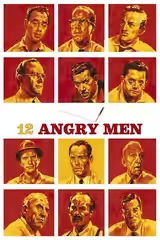
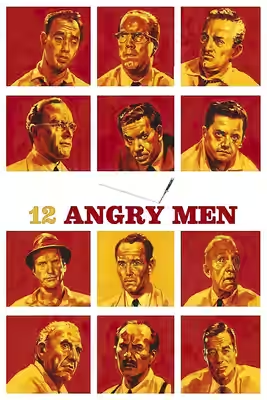
Judgment at Nuremberg is the longer, weightier and more repetitive of the two, while 12 Angry Men is the tighter film and the one we would recommend to almost anyone. Both turn on listening carefully as a public duty. Choose Kramer's film for its moral argument and cast; choose Lumet's for a single gripping evening.
What should I watch after Judgment at Nuremberg?
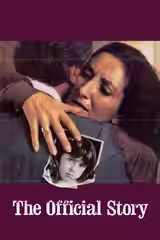
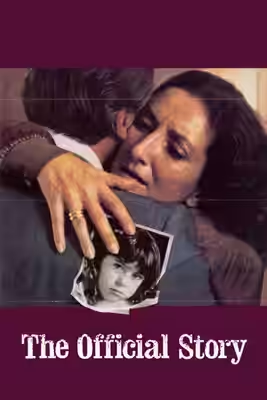
After Judgment at Nuremberg, try 12 Angry Men (1957, Fi1m 91): Another room where listening carefully becomes the most important public duty. Then The Official Story (1985, Fi1m 81): An Argentine family’s comforts become harder to defend as buried questions surface; and A Separation (2011, Fi1m 93): Competing accounts of an ordinary dispute make assigning blame painfully difficult.

Cast

Awards

Academy Awards, 1962

Nominated
Best Art Direction, Black and White
Nominated
Best Cinematography, Black-and-White
Nominated
Best Costume Design, Black-and-White
Nominated
Best Director
Nominated
Best Film Editing
Nominated
Best Supporting Actor
Nominated
Best Supporting Actress
Won
Best Actor
Won
Best Writing, Adapted Screenplay

Golden Globes, 1962

Nominated
Best Film Promoting International Understanding

Silver nugget for the best foreign film, 1962

Won
Silver nugget for the best foreign film

If you liked this, try…

  1. 12 Angry Men (1957, Fi1m 91)Another room where listening carefully becomes the most important public duty.

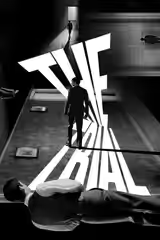
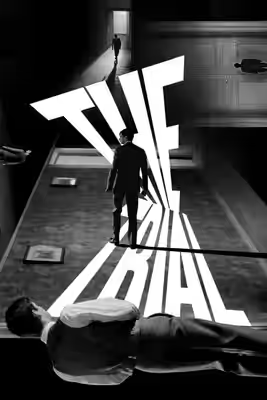
  2. The Trial (1962) · not reviewed yetOrson Welles makes legal procedure frightening long before anyone explains the charge.

  3. The Official Story (1985, Fi1m 81)An Argentine family’s comforts become harder to defend as buried questions surface.

  4. A Separation (2011, Fi1m 93)Competing accounts of an ordinary dispute make assigning blame painfully difficult.

  5. Saint Omer (2022) · not reviewed yetA writer attends a trial and finds her own certainties becoming uncomfortable.

Free account

Know what to watch tonight

Two lists that know where things are streaming, collections you can share, your own score beside ours, and Discover that remembers what you have seen.

  • Want to see, sorted by what is streaming now
  • Seen, with your score out of ten
  • No adverts, ever