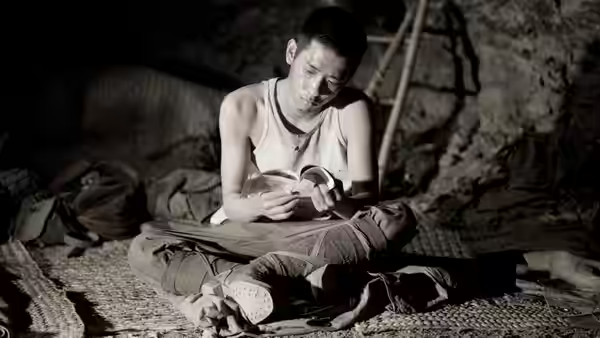
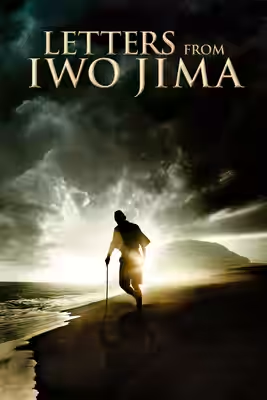
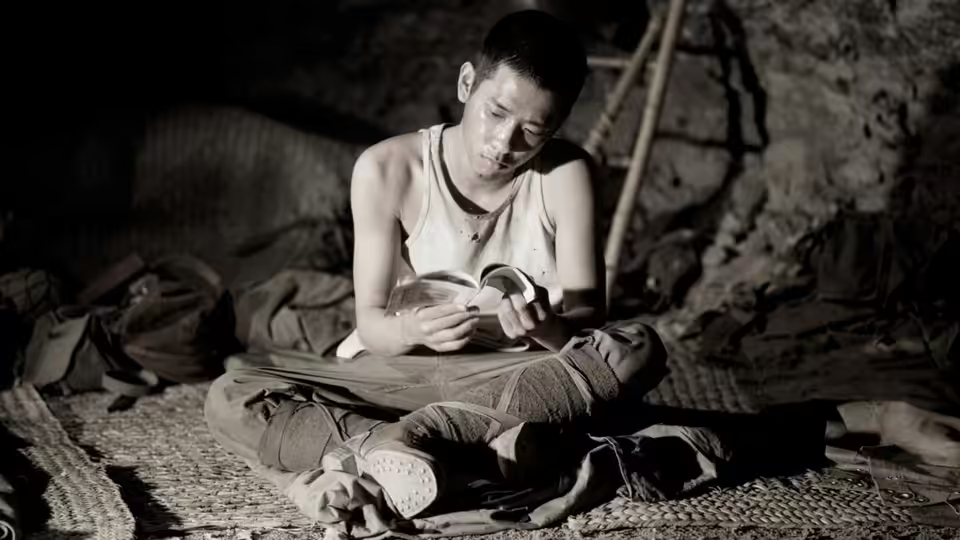
Private Saigo reading a letter while seated cross-legged in a cave
Film review

Letters from Iwo Jima

2006 · Directed by Clint Eastwood · 2h 21m · MPA R

In a sentenceKen Watanabe could persuade us to follow an order, and this war film makes that a frightening thought

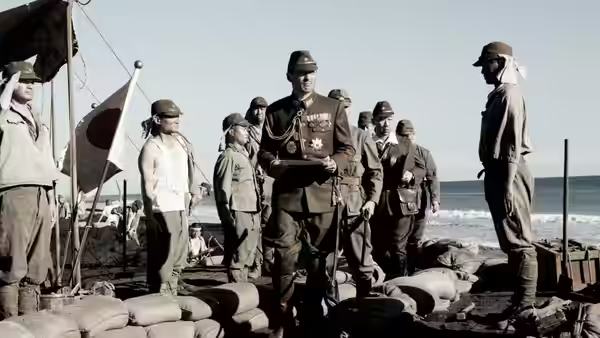
On Iwo Jima, Japanese soldiers face a battle that places officers and enlisted men under the same threat. General Tadamichi Kuribayashi (Ken Watanabe) commands them, while Private Saigo (Kazunari Ninomiya) experiences the conflict from the ranks. Colonel Baron Nishi (Tsuyoshi Ihara), Private Shimizu (Ryo Kase) and Lieutenant Ito (Shido Nakamura) are among the men whose responses to military duty shape the story. Clint Eastwood directs this account of the battle from the Japanese side, following soldiers of different ranks as they confront the demands of command, obedience and survival.

Fi1m review

Clint Eastwood’s account of Iwo Jima from the Japanese side is patient, humane and deeply affecting, with Ken Watanabe and Kazunari Ninomiya giving its military ranks individual faces. The script sometimes explains feelings the performances have already made clear.

Letters from Iwo Jima is a war film willing to spend time with men whose uniforms might otherwise do all the explaining. Clint Eastwood approaches the battle from the Japanese side, asking us to consider what military duty requires of the people expected to carry it out. We recommend it warmly: it is grave, attentive and often painful, though it occasionally tells us what we have already understood. Its strength is the patience it gives Ken Watanabe and Kazunari Ninomiya to establish separate, recognisable people.

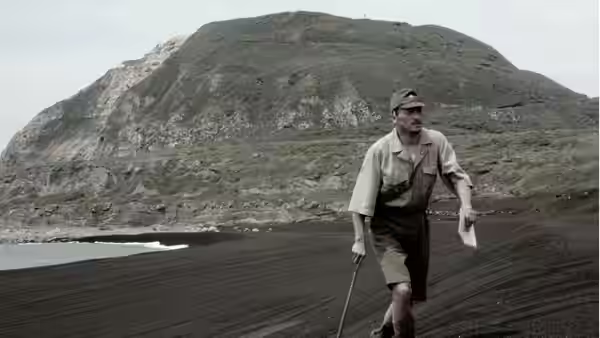
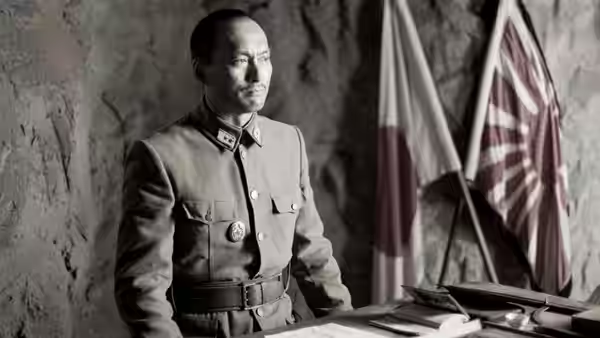
Watanabe’s General Tadamichi Kuribayashi has the authority the part requires, but the performance is most interesting when that authority cannot settle his doubts. Watanabe makes being responsible for other men look exhausting. He gives orders the weight of decisions somebody will have to live with, and keeps the general’s decency from becoming an excuse to stop examining him. The film respects Kuribayashi, sometimes too readily, but Watanabe never makes him comfortable company.

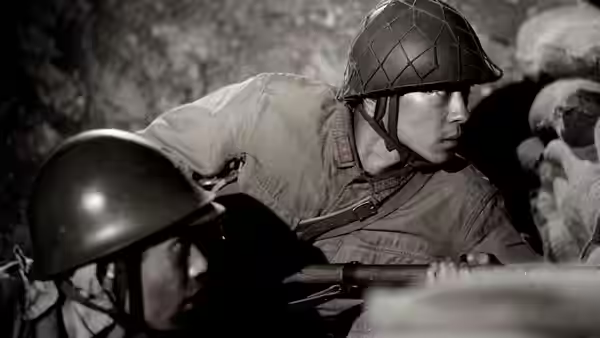
Ninomiya’s Private Saigo is crucial because the film needs someone who cannot make duty sound so persuasive. His unease gives the military talk a practical consequence: we keep thinking about the man who must do what has been decided. We were moved by Saigo’s fear; Ninomiya lets it show without making him plead for our sympathy. Eastwood allows the performance to remain ordinary enough that caring about Saigo never feels like a reward for exceptional bravery.

Tom Stern’s cinematography drains the battlefield towards charcoal, making the men seem worn down before any speech can tell us so. The restricted colour keeps faces and uniforms within the same sombre range, without making the people indistinguishable. Production designers James J. Murakami and Henry Bumstead give the soldiers’ surroundings a constricting, practical feel. There is little encouragement to admire the scenery. Their work helps keep the fighting close to the people inside it.

Joel Cox’s editing gives performances enough time to affect how we see the battle. At 141 minutes, the film asks for patience, and Cox is generally right to let the actors determine the pace. Some pauses last beyond the point at which a scene has made itself clear, although the larger problem is how firmly we are guided towards a response. Michael Stevens and Kyle Eastwood’s music can be touching, but its encouragement towards sadness is occasionally unnecessary. The performances have already given us enough reason to care.

Iris Yamashita’s screenplay, from a story credited to Yamashita and Paul Haggis, is weakest when it presses the lesson about recognising ourselves in an enemy. The flashbacks sometimes provide emotional instructions where a little uncertainty would have served the characters better. Eastwood’s restraint does not quite disguise how carefully these men have been arranged to earn our understanding. We do not need to be shown quite so firmly that they deserve it.

The war-film tradition often asks us to admire endurance, and Eastwood pays close attention to what enduring actually costs these men. His restraint can verge on excessive respect, particularly around Kuribayashi, but it also leaves space for fear without treating fear as a failure of character. That makes the familiar military ranks and questions of obedience worth returning to. Give it an evening when there is no need to be cheered up, and no temptation to keep checking the clock.

Critical consensus AI synthesised

80
Positive
7
Mixed
1
Negative
0

Most critics respond warmly to Letters from Iwo Jima, with praise centred on Eastwood’s sympathetic portrayal of Japanese soldiers and his restrained treatment of combat. The reviews repeatedly value the intimate character portraits, which make shared humanity tangible without softening the horror of war. Several find the narrative more focused and affecting than Flags of Our Fathers. Performances are another point of agreement, with The Times singling out Ken Watanabe and Kazunari Ninomiya for making the soldiers recognisable as people rather than representatives of an enemy army.

The reservations concern sentimentality, explicit moral lessons and flashbacks that explain too much. The AV Club finds manipulative touches within an otherwise nuanced account of difficult choices. The Guardian offers the clearest dissent, respecting the film’s generosity but finding too little passion or flair to make it fully involving. The spread is largely positive: most critics admire the restraint that this dissenting review finds limiting.

The New York Times
20 December 2006 · Manohla Dargis
90*

The film is a radical yet traditional war movie that humanizes the Japanese soldiers and presents their inevitable defeat with originality and insight, standing as one of the year's best.

Read the full review →
Empire
23 January 2007 · Dan Jolin
85*

The critic calls it considerably superior to Flags of Our Fathers due to its tighter, more focused narrative from the Japanese perspective and inherently dramatic story of outnumbered defenders. It balances unflinching war horrors with touching portrayals of characters like General Kuribayashi and conscript Saigo, emphasizing shared humanity on both sides.

Read the full review →
Los Angeles Times
20 December 2006 · Kenneth Turan
85*

Eastwood achieves a remarkable empathetic cross-cultural feat by telling the story in Japanese from the adversaries' viewpoint, highlighting shared humanity, honor, and the futility of war with characteristic restraint.

Read the full review →
RogerEbert.com
11 January 2007 · Jim Emerson
85*

Eastwood's companion piece to Flags of Our Fathers offers a Japanese perspective on the battle, emphasizing the humanity and doomed resolve of the soldiers through intimate character portraits and stark battlefield realism.

Read the full review →
The AV Club
20 December 2006 · B+ · Noel Murray
83

The critic argues the film is better than its companion Flags of Our Fathers because it focuses on the war itself rather than its ironies, praising Eastwood’s sympathetic portrayal of Japanese soldiers and nuanced handling of difficult choices, while noting some manipulative sentimentality and on-the-nose moments.

Read the full review →
The Times
25 February 2007 · ★★★★ · Cosmo Landesman
80

Eastwood's film succeeds in putting viewers at the centre of events from the Japanese perspective and humanises the enemy soldiers in a way few Hollywood war films have managed before. Superb performances, particularly from Ken Watanabe and Kazunari Ninomiya, make the characters relatable and the point that they were not so different from us compelling.

Read the full review →

Straight answers AI written, from our review

Is Letters from Iwo Jima worth watching?
Letters from Iwo Jima is worth watching for anyone prepared for a grave, patient war film, and we scored it 84. Clint Eastwood follows the Japanese side of the battle, and Ken Watanabe and Kazunari Ninomiya make general and private into separate, recognisable men. The script sometimes explains feelings the performances have already made clear, and it does not cheer anyone up.
How long is Letters from Iwo Jima, and what is it rated?
Letters from Iwo Jima runs 2h 21m and is rated R by the MPA in the US. It is an action and drama film.
Where can I watch Letters from Iwo Jima in the US?
Letters from Iwo Jima is available to rent from Amazon Prime Video from $4.99. Availability is checked daily; the links above go straight to each service.
How violent or frightening is Letters from Iwo Jima, and is it suitable for children?
Letters from Iwo Jima carries a 15 certificate in the UK and is not suitable for children. It is a battlefield film, sombre from the first frame, and it dwells on fear, exhaustion and what obedience costs the men in the ranks. Older teenagers who can sit with 141 minutes of dread will find it painful rather than sensational.
How does Letters from Iwo Jima compare to The Thin Red Line?
Letters from Iwo Jima and The Thin Red Line both give a Pacific battle room for fear and doubt, but Eastwood's film is the more disciplined of the two. Malick wanders and asks questions, and some of his soldiers barely emerge as people; Eastwood fixes on a general and a private and lets us know them. Choose Malick for the photography, Eastwood for the performances.
What should I watch after Letters from Iwo Jima?
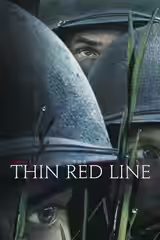
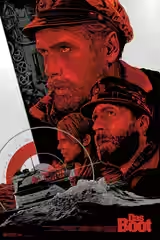
After Letters from Iwo Jima, try The Thin Red Line (1998, Fi1m 84): Terrence Malick gives another Pacific battle time for fear, doubt and thought. Then The Ascent (1977, Fi1m 88): A harsher examination of what survival asks people to excuse in themselves; and Das Boot (1981, Fi1m 89): The cramped quarters make military duty feel exhausting long before combat begins.

Cast

Awards

Academy Awards, 2007

Nominated
Best Director
Nominated
Best Picture
Nominated
Best Writing, Original Screenplay
Won
Best Sound Editing

If you liked this, try…

  1. The Thin Red Line (1998, Fi1m 84)Terrence Malick gives another Pacific battle time for fear, doubt and thought.

  2. The Ascent (1977, Fi1m 88)A harsher examination of what survival asks people to excuse in themselves.

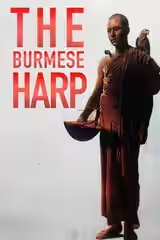
  3. The Burmese Harp (1956) · not reviewed yetKon Ichikawa follows Japanese soldiers towards a quieter reckoning with the war.

  4. Das Boot (1981, Fi1m 89)The cramped quarters make military duty feel exhausting long before combat begins.

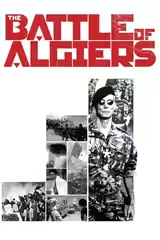
  5. The Battle of Algiers (1966, Fi1m 93)For another war film that makes opposing loyalties difficult to dismiss.

Free account

Know what to watch tonight

Two lists that know where things are streaming, collections you can share, your own score beside ours, and Discover that remembers what you have seen.

  • Want to see, sorted by what is streaming now
  • Seen, with your score out of ten
  • No adverts, ever