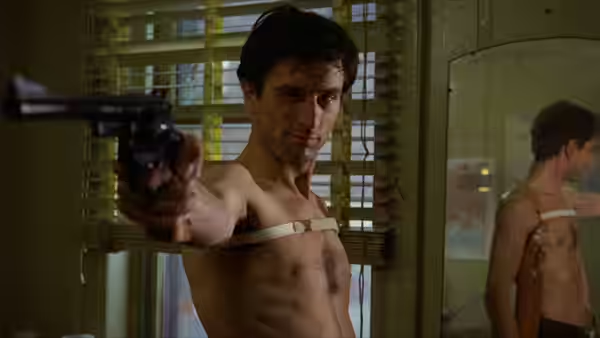
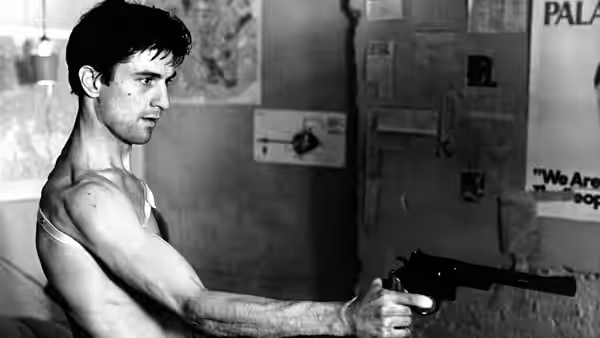
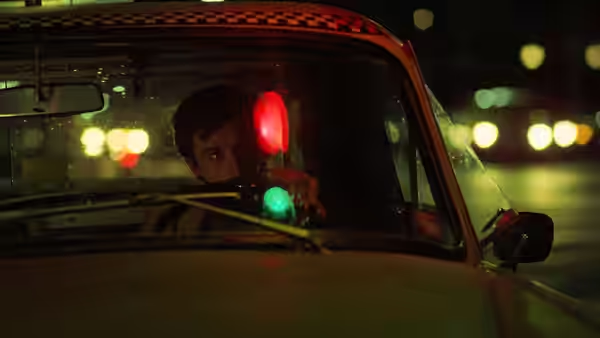
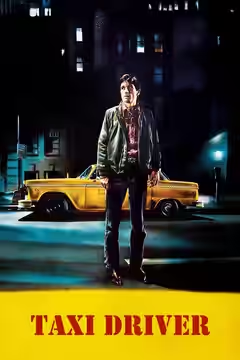
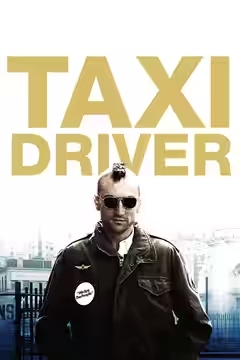
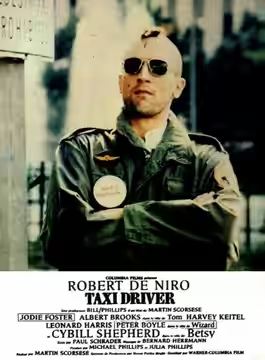
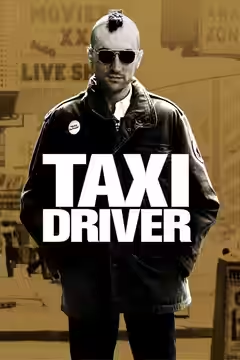
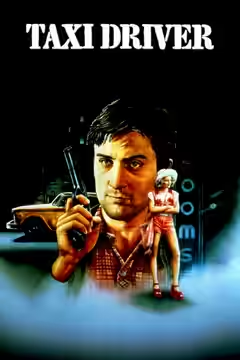
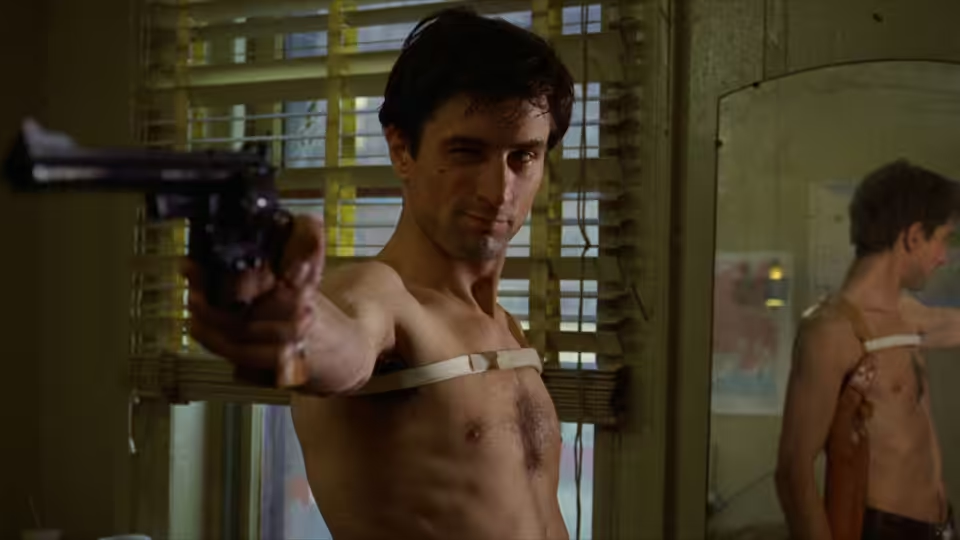
Travis Bickle (Robert De Niro) aiming a gun while shirtless in a room
Film review

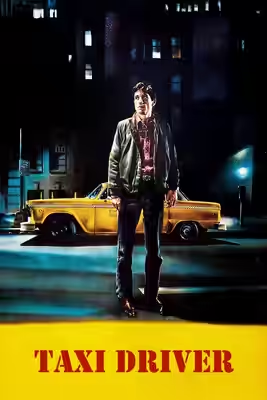
Taxi Driver

1976 · Directed by Martin Scorsese · 1h 54m · MPA R

In a sentenceRobert De Niro makes us nervous before he has done anything we could sensibly complain about

Travis Bickle (Robert De Niro) is a lonely man in New York who wants to prove that his life counts for something. Martin Scorsese’s crime drama, written by Paul Schrader, follows his troubled view of the city and the people around him. Cybill Shepherd plays Betsy, Jodie Foster plays Iris, Harvey Keitel plays Sport and Peter Boyle plays Wizard. Travis wants to become somebody, but has little sense of how to reach another person. The film stays close to his thoughts, watching the city through the eyes of a man who struggles to belong.

Plays from YouTube when you press play; nothing loads from them until then.

Fi1m review

Martin Scorsese’s crime drama makes a lonely man’s company frightening through Robert De Niro’s restraint and Bernard Herrmann’s music. We recommend it strongly, with one reservation: its attention to Travis leaves too little room for everyone else.

Taxi Driver is a frightening film about loneliness, and we would recommend it even to someone with little interest in crime drama. Martin Scorsese and writer Paul Schrader stay so close to Travis Bickle that his view of other people begins to crowd out our own. The film asks us to spend time with him before we have decided how much we trust him. Robert De Niro plays Travis with a reserve that makes those 114 minutes uncomfortable.

De Niro’s guarded manner keeps us watching for something that might explain Travis. We felt frightened by how little he needed to do. His restraint, set against Bernard Herrmann’s ominous music, makes the quietness itself troubling. There is no reassuring sense that we have been allowed to see everything important about this man. Scorsese lets that uncertainty persist without supplying explanations.

Michael Chapman’s cinematography gives New York the credibility of a place observed in available light. Yet the camera is so closely attached to Travis’s way of seeing that the streets never feel like neutral evidence about the city. We are being asked to look where he looks, with all the limitations that brings. Chapman makes the setting persuasive enough for this to be unsettling: we have to keep reminding ourselves that Travis’s judgement is not reliable.

Schrader’s dark humour matters because a film this intent on one troubled man could become solemn and repetitive. The jokes briefly interrupt the dread, then leave us with the same difficult man. Editors Tom Rolf and Melvin Shapiro sustain the concentration on him; we rarely get the relief of feeling that someone else has taken charge of our attention. Herrmann’s music follows the shifts in Travis’s mood, and its more open expressiveness gives us something to listen for beneath De Niro’s reserve.

Our reservation is how little room this leaves for anyone else. Cybill Shepherd’s Betsy and Jodie Foster’s Iris have to compete with a central performance that keeps pulling us back, and we wanted more time to consider them separately from Travis. Both are welcome presences because they make us curious about someone other than him. Scorsese’s determination to keep Travis at the centre sometimes prevents that curiosity from going anywhere.

The crime-film question of who deserves our loyalty becomes difficult here. De Niro holds our attention so completely that we can find ourselves feeling sorry for Travis before asking whether we trust him. Schrader and Scorsese make us examine that response, rather than treating loneliness as sufficient grounds to excuse a man. We can understand the wish to be somebody and still be alarmed by the person asking us to recognise him.

It carries an 18 certificate, and we would take its capacity to disturb seriously. This is a film to watch when there is time afterwards to talk, not something to put on for company while doing something else. We recommend it without promising an agreeable evening.

Critical consensus AI synthesised

89
Positive
16
Mixed
0
Negative
0

The critics agree, and have done for fifty years. All sixteen reviews are positive, and the praise settles in the same places: Robert De Niro’s wired, withheld performance as Travis Bickle, Bernard Herrmann’s score, and a twitchy, seedy Seventies New York shot largely in natural light. Several single out Paul Schrader’s script for building a case history without lecturing, and Scorsese’s camera for keeping us locked inside Bickle’s head. Most say the film has grown more unsettling with age, and mean it as praise.

The spread is narrow, from strong approval to unqualified, and the differences are of emphasis rather than verdict. RogerEbert.com insists it is a portrait of one mind rather than a New York story; Den of Geek makes the city itself the monster. The AV Club notes its history of being misread as glorifying violence. The Ringer, the coolest of the group, reads it mainly through present-day lonely male rage and finds the ending unsettling rather than satisfying. Nobody calls it comfortable viewing.

RogerEbert.com
1 January 1976 · ★★★★/4 · Roger Ebert
100

The film is a brilliant nightmare portrait of Travis Bickle's inner world rather than a New York story. It singles out the subjective camerawork and De Niro's veiled, compelling performance for praise.

Read the full review →
The Times
3 July 2026 · ★★★★★
100

The critic finds the film a difficult but essential watch on its 50th anniversary re-release, highlighting Robert De Niro's blistering performance and the twitchy depiction of Seventies New York as key strengths.

Read the full review →
Time Out
6 February 2017 · ★★★★★ · Tom Huddleston
100

The critic calls the film an unflinching plunge into the human soul whose anti-hero Travis Bickle remains painfully relevant, treating him with empathy as a war-scarred, isolated man. They single out Bernard Herrmann’s ominous score and De Niro’s restrained, honest performance as creating an impossibly perfect, evocative tone of dread, pity and New York cool.

Read the full review →
Empire
1 January 2011 · William Thomas
90*

The critic praises the film's enduring power to unnerve and rivet audiences decades later. Highlights include the tight, darkly funny script by Paul Schrader, Scorsese's directorial fireworks, and De Niro's wired central performance.

Read the full review →
Los Angeles Times
11 February 1996 · Kenneth Turan
90*

The film remains a powerful and significant work decades later, with its shocking script, De Niro's gutsy performance, and masterful score still making a strong impression. It has become woven into American cultural mythology and its themes of violence and isolation feel increasingly relevant.

Read the full review →
Slant Magazine
10 April 2011 · Rob Humanick
90*

The critic calls the film a high-water mark of American cinema and Scorsese's possible finest work, commending its immersive subjectivity through Travis Bickle's perspective, De Niro's performance, Bernard Herrmann's score, and its lasting relevance as a character study and commentary on violence and media.

Read the full review →

Straight answers AI written, from our review

Is Taxi Driver worth watching?
Taxi Driver is worth watching for almost anyone prepared to be frightened by a lonely man rather than by action, and we scored it 92. Robert De Niro's restraint and Bernard Herrmann's music make the quiet stretches the most troubling. Our one reservation is that the film leaves too little room for Cybill Shepherd and Jodie Foster.
How long is Taxi Driver, and what is it rated?
Taxi Driver runs 1h 54m and is rated R by the MPA in the US. It is a crime and drama film.
Where can I watch Taxi Driver in the US?
Taxi Driver is not on any streaming or rental service in the US at the moment. It is available in 31 other countries; change your country at the top of the page to see where. Availability is checked daily.
How violent or frightening is Taxi Driver, and is it suitable for children?
Taxi Driver carries an 18 certificate in the UK and is not suitable for children, nor in our view for most teenagers. The fear comes less from what is shown than from spending 114 minutes inside the head of a man whose judgement cannot be trusted. Watch it when there is time afterwards to talk about it.
How does Taxi Driver compare to The Conversation?
Taxi Driver and The Conversation both follow isolated men whose way of watching other people becomes hard to share, but they work differently. Coppola's film is a suspense thriller, more tightly plotted and easier to recommend as a gripping evening. Scorsese's is the more disturbing and the stronger, though it is the harder company to keep.
What should I watch after Taxi Driver?
After Taxi Driver, try The Conversation (1974, Fi1m 92): Another isolated man whose attention to other people becomes frighteningly difficult to share. Then Le Samouraï (1967, Fi1m 88): For another guarded performance, with loneliness made visible through rooms and routines; and The King of Comedy (1982, Fi1m 88): Scorsese and De Niro make the desire for recognition painfully funny.

Cast

Awards

Academy Awards, 1977

Nominated
Best Actor
Nominated
Best Original Score
Nominated
Best Picture
Nominated
Best Supporting Actress

Cannes Film Festival, 1976

Won
Palme d'Or

If you liked this, try…

  1. The Conversation (1974, Fi1m 92)Another isolated man whose attention to other people becomes frighteningly difficult to share.

  2. Le Samouraï (1967, Fi1m 88)For another guarded performance, with loneliness made visible through rooms and routines.

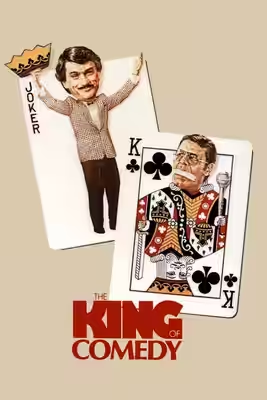
  3. The King of Comedy (1982, Fi1m 88)Scorsese and De Niro make the desire for recognition painfully funny.

  4. Oslo, August 31st (2011) · not reviewed yetAnother city seen through loneliness, with more tenderness and fewer threats.

  5. Burning (2018, Fi1m 72)For patient observation of loneliness and resentment, without easy explanations for either.

Free account

Know what to watch tonight

Two lists that know where things are streaming, collections you can share, your own score beside ours, and Discover that remembers what you have seen.

  • Want to see, sorted by what is streaming now
  • Seen, with your score out of ten
  • No adverts, ever