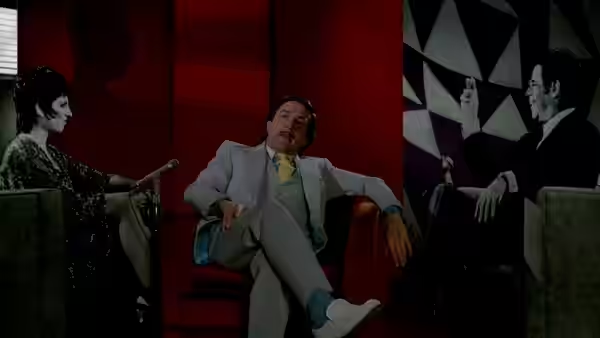
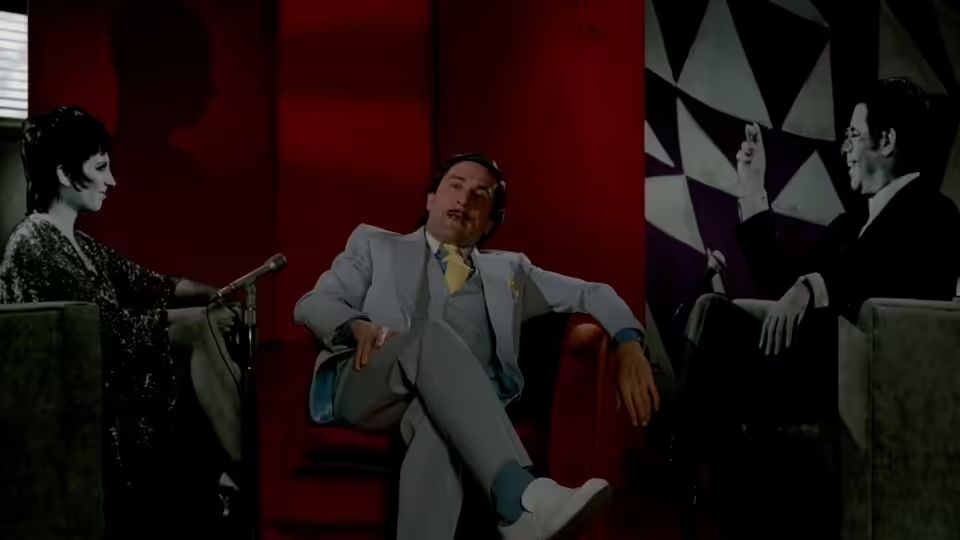
Rupert Pupkin reclining in a red armchair between a woman and a man
Film review

The King of Comedy

1982 · Directed by Martin Scorsese · 1h 49m · MPA PG

In a sentenceRobert De Niro keeps smiling long after everyone else has found a reason to stop

Rupert Pupkin (Robert De Niro) wants to become a stand-up comedian and sees television host Jerry Langford (Jerry Lewis) as his route to an audience. He imagines a friendship with Jerry that bears little resemblance to their actual acquaintance, treating setbacks as reasons to persist. Rita (Diahnne Abbott) and Masha (Sandra Bernhard) also figure in Rupert’s pursuit of recognition. Martin Scorsese directs from Paul D. Zimmerman’s screenplay, moving between Rupert’s fantasies and his encounters with people who do not share them. His wish to be noticed leaves increasingly little room for anyone else’s wishes.

Fi1m review

Robert De Niro and Jerry Lewis make Martin Scorsese’s sour comedy about unwanted attention painfully funny. We recommend it, though the repeated humiliations can make its 109 minutes feel rather longer.

Martin Scorsese’s The King of Comedy is a painfully funny film, and we recommend it to anyone prepared to spend an evening feeling embarrassed for a stranger. Robert De Niro plays Rupert Pupkin, an aspiring comedian who wants television host Jerry Langford to give him his chance. Rupert has already imagined the welcome; other people keep getting their responses wrong. Scorsese stays close enough to this man for his optimism to become oppressive. There is no need to like him, but a tolerance for prolonged social discomfort helps.

De Niro makes Rupert’s confidence unsettling because it seems impervious to information. His smile keeps soliciting a response long after the eagerness has stopped being endearing, and he gives even his apparent friendliness an uncomfortable insistence. The fantasy sequences let his expectations expand without making Rupert easier to dismiss as a harmless eccentric. We can recognise the ordinary wish for approval inside the delusion, which makes the performance harder to laugh off and gives his persistence an unpleasant familiarity.

Jerry Lewis gives Langford a fatigue that feels settled deep in his face. His dead-eyed response to Rupert is funny until it begins to look like a reasonable defence against someone who will not stop. We felt trapped watching Lewis’s expression fail to discourage De Niro’s eagerness. The discomfort comes from the actors’ unwillingness to meet each other halfway: Rupert keeps offering his imagined friendship, and Jerry has no interest in performing gratitude for it.

Fred Schuler’s cinematography is most effective in its attention to the actors’ faces. De Niro’s pleased expression gives us plenty to inspect, without any need for the image to insist that he is strange. Boris Leven’s production design makes the television surroundings seem like workplaces, which usefully limits their glamour. Rupert’s conviction that getting inside would transform his life looks less reasonable against that ordinariness, and the setting helps us understand why Jerry might have other things to do.

Thelma Schoonmaker’s editing makes an awkward exchange feel as though it has outlasted every possible polite escape. There is time to understand the embarrassment and then considerably more time to sit with it, a rhythm that allows both actors to become thoroughly uncomfortable company. Robbie Robertson’s music gives the comedy little sentimental cushioning, a useful decision when De Niro can already suggest the hurt beneath Rupert’s confidence. These choices work, although the sustained pressure eventually makes some passages feel repetitive.

Paul D. Zimmerman’s screenplay returns so often to Rupert’s inability to take a hint that some encounters add little to what we already know. The narrow emotional range sometimes becomes tiring, even when the writing remains sharp and the performances committed. Sandra Bernhard gives Masha enough exposed unhappiness to keep the film’s lonely people from seeming interchangeable. That repetition is the main reservation: Scorsese’s patience is not equally rewarding in every scene, and another demonstration of Rupert’s delusion is not always necessary.

As black comedy, the film is unusually willing to let recognition spoil a laugh. Its reluctance to offer relief will also frustrate anyone waiting for a more conventional thriller to get moving. Lewis makes that severity worthwhile: his refusal to indulge Rupert gives their exchanges a force that a more welcoming performance would lose. At 109 minutes, it can still feel like a long evening in difficult company. Save it for a night when neither person on the sofa needs cheering up.

Critical consensus AI synthesised

66
Positive
8
Mixed
1
Negative
3

Most critics come down in favour, though the spread is unusually wide. The praise gathers around the two leads: Robert De Niro’s needy, obnoxious Rupert Pupkin, played without a flicker of charm, and Jerry Lewis’s dead-eyed, self-protective star, which more than one review thinks comes close to stealing the film. Later critics admire how far ahead of its time the film’s view of fame and delusion now looks, and several note that its deadpan, locked-down style, mimicking the television it depicts, is the point rather than a failing.

The reservations cluster around emptiness. The three negative notices are all from the film’s first release: The New Yorker finds it enervating and its characters repellent, RogerEbert.com faults it for withholding any emotional release, and Variety objects to unlikeable characters who stand for nothing. Empire sits in the middle, calling it an interesting misfire that is neither funny nor frightening enough. The reviews written since are consistently warmer.

Radio Times
★★★★★ · Andrew Collins
100

It's an unsung masterpiece, with powerful complex performances from De Niro and Lewis, blending farce and tragedy in a strange Scorsese-De Niro collaboration.

Read the full review →
Time Out
6 January 2012 · PT
85*

The critic finds it the creepiest and one of the best movies of the year, praising its unsettling excesses and De Niro's performance as a delusional fantasist, while noting it's hilariously not a comedy.

Read the full review →
Los Angeles Times
5 November 1992 · Mark Chalon Smith
80*

The re-release review calls the film a hilarious and smart riff on American celebrity culture as a form of salvation, praising De Niro's loopy, committed turn as the obsessive Pupkin and Lewis's liberated, creepy caricature of a self-protective star. It highlights the wild escalation of Pupkin's fantasies and schemes as the core appeal.

Read the full review →
The AV Club
22 August 2013 · Mike D'Angelo
80*

The film marks an unconventional departure for Scorsese and De Niro, with De Niro delivering an obnoxious, pathetic performance as the needy Rupert Pupkin and Scorsese using a flat, locked-down style mimicking TV programming. It offers a bold, prescient look at how the desire for fame and adulation can warp people, ending with a coda that now seems entirely credible.

Read the full review →
The Guardian
18 February 2023
80*

The critic views the film as a dry, painful comedy about ambition and celebrity obsession, with Robert De Niro's scheming mediocrity as the central focus. It singles out the film's deadpan style and prescient take on fame for praise.

Read the full review →
The New York Times
18 February 1983 · Vincent Canby
70*

Canby calls the film very funny and satisfying in its surprise ending, with an original screenplay that is witty even in its fantasy sequences. He highlights De Niro's complex, flamboyant performance as the standout element.

Read the full review →

Straight answers AI written, from our review

Is The King of Comedy worth watching?
The King of Comedy is worth watching for anyone prepared to spend an evening feeling embarrassed for a stranger, and we scored it 88. Robert De Niro and Jerry Lewis make Martin Scorsese's sour comedy about unwanted attention painfully funny, though the repeated humiliations can make its 109 minutes feel longer. Save it for a night when nobody on the sofa needs cheering up.

How long is The King of Comedy, and what is it rated?
The King of Comedy runs 1h 49m and is rated PG by the MPA in the US. It is a drama and comedy film.
Where can I watch The King of Comedy in the US?
The King of Comedy is available to rent from Amazon Prime Video from $3.99. Availability is checked daily; the links above go straight to each service.
How does The King of Comedy compare to Network?
The King of Comedy is the quieter and more uncomfortable of the two, staying close to one deluded man rather than attacking an institution. Network is louder, broader and built on speeches, which can crowd out its people but suit anyone who wants a satire of television itself. We think Scorsese's film is the sharper study of a person; Lumet's is the bigger target and the easier evening.

Cast

Awards

BAFTA Film Awards, 1984

Nominated
Best Actor in a Leading Role
Nominated
Best Actor in a Supporting Role
Nominated
Best Direction
Nominated
Best Editing
Won
Best Original Screenplay

London Film Critics Circle Award for Film of the Year, 1983

Won
London Film Critics Circle Award for Film of the Year

NAACP Image Award for Outstanding Actress in a Motion Picture, 1983

Nominated
NAACP Image Award for Outstanding Actress in a Motion Picture

National Society of Film Critics Award for Best Supporting Actress, 1983

Won
National Society of Film Critics Award for Best Supporting Actress

If you liked this, try…

  1. A Face in the Crowd (1957) · not reviewed yetAnother sharp account of television fame, with charm that grows steadily less reassuring.

  2. The Firemen's Ball (1967) · not reviewed yetPublic embarrassment spreads through a whole community, observed with merciless comic patience.

  3. Network (1976, Fi1m 86)Television rewards bad behaviour again, with louder speeches and a broader institutional target.

  4. The Forest for the Trees (2003) · not reviewed yetSocial neediness becomes almost unbearable in a quieter, more sympathetic study of loneliness.

  5. Ingrid Goes West (2017) · not reviewed yetA lonely admirer mistakes access for intimacy, with social media supplying fresh opportunities.

Free account

Know what to watch tonight

Two lists that know where things are streaming, collections you can share, your own score beside ours, and Discover that remembers what you have seen.

  • Want to see, sorted by what is streaming now
  • Seen, with your score out of ten
  • No adverts, ever