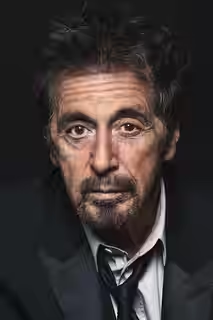
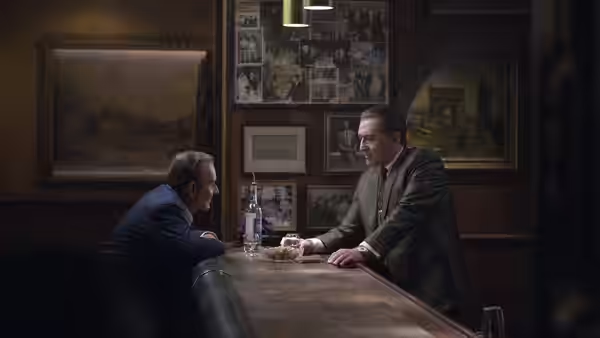
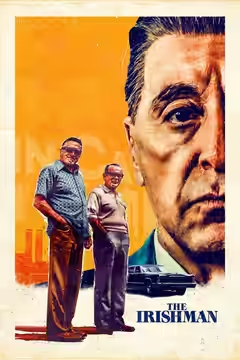
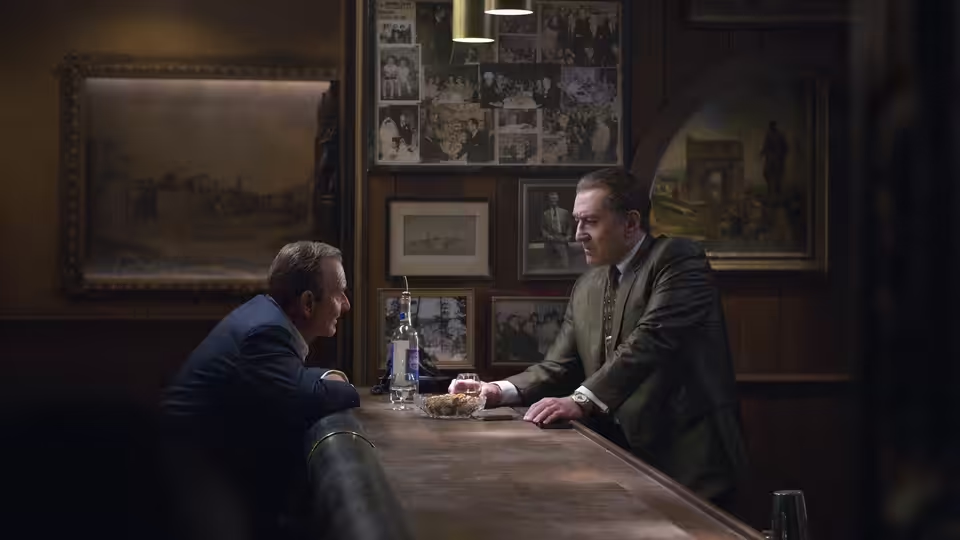
Frank Sheeran (Robert De Niro) and Jimmy Hoffa (Al Pacino) seated at a bar
Film review

The Irishman

2019 · Directed by Martin Scorsese · 3h 29m · MPA R

In a sentenceJoe Pesci keeps his voice down, which is no reason for anyone else to relax

Frank Sheeran (Robert De Niro) moves between Russell Bufalino (Joe Pesci), a quietly spoken mob fixer, and Jimmy Hoffa (Al Pacino), whose forceful manner leaves less room for compromise. Frank treats violence as work and friendship as a matter of loyalty. He wants to be useful to the men around him, but the demands of criminal business press against those personal ties. His relationships involve favours, obligations and the domestic life that continues around them, as the men decide what they can ask of one another and what they are prepared to do.

Plays from YouTube when you press play; nothing loads from them until then.

Fi1m review

Martin Scorsese makes a patient, troubling crime drama about men accustomed to treating violence as work. The length occasionally tests us and the digital faces distract, but the performances justify a long evening.

The Irishman is a patient, troubling crime film, and we recommend it with a warning about the time it asks for. Across 209 minutes, Martin Scorsese watches men conduct violent business with the habits and assumptions of working life. The interest lies in how easily they make their arrangements, and how poorly equipped they seem to discuss guilt. We do not need to find these men sympathetic to become absorbed in the effort they put into avoiding that subject.

Robert De Niro plays Frank Sheeran with a reserve that can initially look like a shortage of things to express. Look longer and the performance becomes troubling: Frank’s apparent dependability gives us little confidence that he has considered what being dependable requires. Al Pacino gives Jimmy Hoffa the expansive energy the film needs, pushing against all that guarded conversation. He is entertaining company, but the force of the performance also makes compromise seem difficult.

Joe Pesci is the reason to keep watching even when the surrounding business becomes dense. His Russell Bufalino speaks quietly, and the lack of visible effort makes the authority more convincing. We were unsettled by that quietness, because he makes it difficult to imagine a safe way of disagreeing with him. Steven Zaillian’s screenplay gives friendship and loyalty enough attention to make us wary of both words; the actors make us hear the obligations attached to them.

Rodrigo Prieto gives the tracking shots an unhurried movement that suits men accustomed to being listened to. We have time to watch a performance rather than simply register an entrance. Bob Shaw’s production design supplies convincing period surroundings, and sensibly allows the faces to remain the attraction. Robbie Robertson’s music supports the sombre mood without encouraging us to find these people grand or admirable.

Thelma Schoonmaker’s editing deserves much of the credit for keeping the conversations alive across such a length. The film can slow down without losing our attention, particularly when it gives the central actors time to respond to one another. Some digressions are harder to defend, and the procedural material occasionally makes us impatient to return to the relationships. At those points, the running time begins to feel like an indulgence.

The digital de-ageing is the more persistent distraction. Its unevenness encourages us to inspect faces when we should be attending to what they express, an awkward cost in a film so dependent on withheld reactions. The performances survive it, although the effort to make age disappear can seem unnecessary when age is so much of the film’s subject. We would rather spend those moments concentrating on the actors, whose smallest changes of expression reward attention.

The gangster film often rewards patience with another burst of excitement, and this one’s quieter pace asks for a different kind of attention. Martin Scorsese is interested in the limitations of men who know how to conduct business and struggle to examine themselves. The humour and the pleasure of the acting make that difficult company worth keeping. Give it an uninterrupted evening, provided the prospect of long conversations between dangerous men sounds more promising than another shoot-out.

Critical consensus AI synthesised

88
Positive
13
Mixed
0
Negative
0

The consensus is strongly positive, with praise centred on Scorsese’s treatment of ageing, loyalty and regret. Most critics see The Irishman as a reflective return to his crime films, finding its quieter passages about the consequences of violence especially moving. De Niro, Pacino and Pesci draw consistent praise, with Pesci’s restrained performance singled out repeatedly; the reviews also admire the shift away from flashy technique towards a colder, more patient style.

The differences concern how well that patience serves the film, rather than its broader achievement. Radio Times finds the pacing sharp but the soul-searching limited, while The Hollywood Reporter admires the craft yet finds the length self-indulgent and misses the forward drive of earlier Scorsese crime films. The digital de-ageing also divides opinion: Time Out finds it uneven, whereas The Wrap praises its near-flawless execution. These reservations sit within a firmly favourable spread, with enthusiasm varying more than the underlying assessment.

IndieWire
27 September 2019 · A · Eric Kohn
95

Kohn calls it Scorsese’s best crime movie since Goodfellas and a pure illustration of his distinctive voice. It is praised as an ambitious epic that captures the filmmaker’s strengths over nearly 50 years.

Read the full review →
Total Film
26 November 2019
90*

The Irishman is unmistakably a Scorsese picture but colder and more distant than predecessors, with themes of ageing, guilt and death. It is his summation and twilight masterpiece.

Read the full review →
Empire
13 October 2019 · Ian Freer
85*

Scorsese delivers a mature, compelling meditation on time, ageing, connections and guilt that goes beyond a standard gangster film. It ends as a powerful, painful study of regret in a man who has lost his ability to feel.

Read the full review →
Radio Times
★★★★ · Emma Simmonds
80

Scorsese returns to the gangster genre in fine form with sharp pacing across an epic runtime, strong ensemble performances and playful nods to his past work. The film is seen as entertaining but not quite reaching classic status, with limited genuine soul-searching.

Read the full review →
The i Paper
14 October 2019 · ★★★★ · Geoffrey Macnab
80

Scorsese and his stars have made a rich, complex and moving gangster epic that belongs alongside The Godfather and Goodfellas. It is as much about friendship, loyalty and the passing of time as it is a crime thriller.

Read the full review →
Time Out
1 November 2019 · ★★★★ · Joshua Rothkopf
80

The review commends the film's strongest quieter passages on self-reproach and the dying of the light, along with terrific work from De Niro, Pesci and an unleashed Pacino. It criticises the overstuffed tangents and uneven digital de-ageing effects.

Read the full review →

Straight answers AI written, from our review

Is The Irishman worth watching?
The Irishman is worth watching for anyone prepared to give 209 minutes to long conversations between dangerous men, and we scored it 86. Joe Pesci's quiet Russell Bufalino is the reason to keep going when the procedural material slows things down. The digital de-ageing distracts, but the performances survive it.
How long is The Irishman, and what is it rated?
The Irishman runs 3h 29m and is rated R by the MPA in the US. It is a crime and drama film.
Where can I watch The Irishman in the US?
The Irishman is streaming on Netflix in the US. Availability is checked daily; the links above go straight to each service.
How violent or frightening is The Irishman, and is it suitable for children?
The Irishman is a 15 in the UK and rated R in the US, and it is not suitable for children. The violence is treated as routine work rather than spectacle, which is unsettling in its own way, and the film is long, talkative and sombre. Older teenagers with patience for slow crime drama should be fine; the squeamish will find less here than in a shoot-out picture.
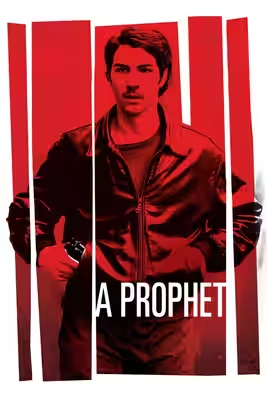
How does The Irishman compare to A Prophet?
The Irishman is the slower and more reflective of the two, while A Prophet is the tighter and more gripping. Both watch men advance through crime by favours that carry a cost, but Scorsese lingers on what his men cannot say about guilt, and Audiard concentrates on how one prisoner learns to use power. Choose the Scorsese for a long evening of performances; choose the Audiard for tension.
What should I watch after The Irishman?
After The Irishman, try A Prophet (2009, Fi1m 86): Another patient account of criminal advancement, attentive to favours and their eventual cost. Then Le samouraï (1967, Fi1m 88): Quiet criminal routines and controlled performances, with even less room for ordinary affection; and Once Upon a Time in America (1984, Fi1m 81): A dreamlike reckoning with criminal friendship and the damage that passing time exposes.

Cast

Awards

Academy Awards, 2020

Nominated
Best Picture

APRECI Award for Best International Premiere, 2019

Won
APRECI Award for Best International Premiere

If you liked this, try…

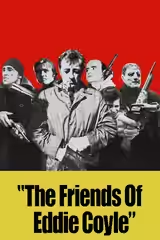
  1. The Friends of Eddie Coyle (1973) · not reviewed yetCriminal work looks weary, insecure and badly paid, with loyalty offering little protection.

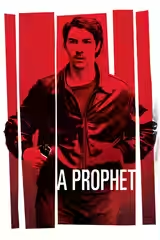
  2. A Prophet (2009, Fi1m 86)Another patient account of criminal advancement, attentive to favours and their eventual cost.

  3. Still Walking (2008) · not reviewed yetFamily resentments and ordinary conversation make ageing painful without a gangster in sight.

  4. Le samouraï (1967, Fi1m 88)Quiet criminal routines and controlled performances, with even less room for ordinary affection.

  5. Once Upon a Time in America (1984, Fi1m 81)A dreamlike reckoning with criminal friendship and the damage that passing time exposes.

Free account

Know what to watch tonight

Two lists that know where things are streaming, collections you can share, your own score beside ours, and Discover that remembers what you have seen.

  • Want to see, sorted by what is streaming now
  • Seen, with your score out of ten
  • No adverts, ever