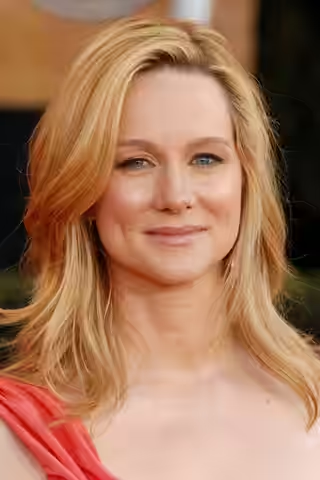
Laura Linney lets irritation show through affection without making either feeling seem false. We rate her highly, especially when the writing gives her controlled, difficult women enough time to become more than the sensible person in somebody else’s story.
Fi1m perspective
In The Truman Show (1998), Laura Linney’s Meryl offers apparent warmth even when an advertisement interrupts the conversation. We laughed at the sales pitches, then felt uncomfortable because Truman was expecting affection. Peter Weir lets the awkwardness last, and Linney makes the relationship convincing enough for Truman’s uncertainty to hurt. It is a useful place to start with an actor who can make someone seem welcoming without making them trustworthy.
By You Can Count on Me (2000), she was receiving major critical attention for a leading role. The supporting parts that followed did not always give her enough space. In Richard Curtis’s Love Actually (2003), her Sarah suggests a life beyond the scenes allotted to her. We wanted Curtis to stay with her longer, but Linney cannot provide the time his crowded screenplay withholds.
Noah Baumbach’s The Squid and the Whale (2005) uses her impatience more sharply. As Joan Berkman, she gives the mother in this divorce comedy enough hurt and irritation to prevent her becoming merely the reasonable alternative to Jeff Daniels’s Bernard. The film is painfully funny, but Baumbach keeps returning to Bernard when Joan deserves more attention. Joan is allowed to be difficult, and Linney does not soften her for our convenience.
John Adams (2008) gives her Abigail a more substantial place beside Paul Giamatti’s John. She makes the effort of living with him worth considering in its own right, rather than leaving us waiting for the next famous name. Their conversations hold our attention through a seven-episode drama whose wandering structure and self-importance can be wearing. Her performance is a strong reason to be patient with it.
The longer stretch of Ozark (2017) allows a different development. Linney lets Wendy Byrde’s appetite emerge by degrees, while Jason Bateman’s Marty keeps calculating. His direction favours long, still shots of people deciding whether to lie, giving an actor’s smallest decisions time to register. Wendy’s gradual change is the most interesting thing the series sustains, even as it becomes merely efficient after two gripping seasons. For a first sustained look at what Linney does, though, give John Adams an episode at a time.
Biography
Laura Linney is an American actress and director. She was born on 5 February 1964 in Manhattan, New York City.
Linney made her film debut in Lorenzo's Oil (1992) and received Academy Award nominations for You Can Count on Me (2000), Kinsey (2004) and The Savages (2007). Her other film roles include Primal Fear (1996), The Truman Show (1998), Mystic River (2003), Love Actually (2003), Sully (2016) and Nocturnal Animals (2016). On television she starred as Wendy Byrde in Ozark (2017–2022) and has received four Primetime Emmy Awards, including one for that series. She has also received two Golden Globe Awards.
Linney has directed episodes of Ozark and directed episodes 3 and 4 of the 2025 Netflix limited series Black Rabbit. She made her Broadway debut in 1990 and has received five Tony Award nominations.