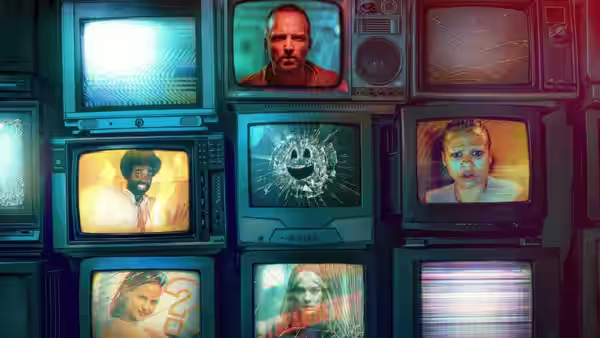
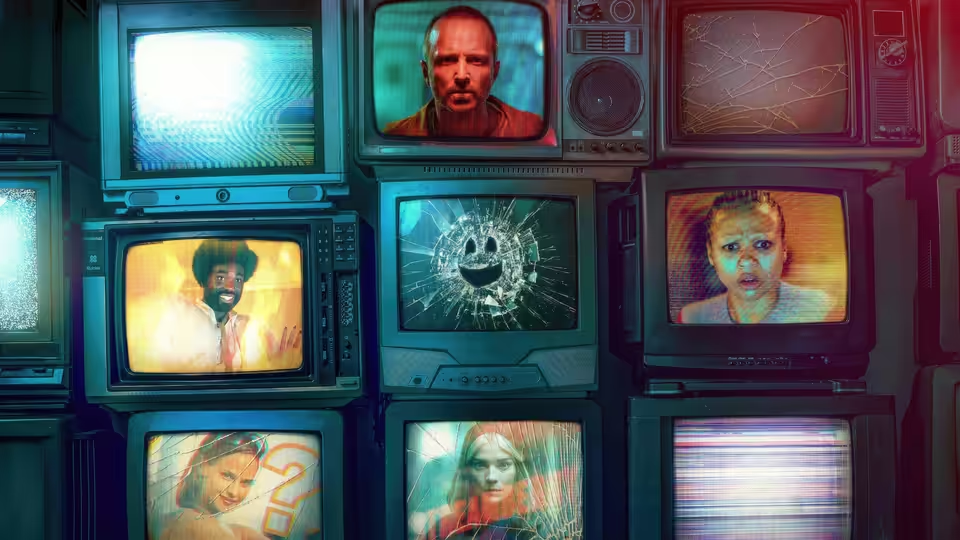
grid of vintage television monitors showing distorted faces and glitch patterns
Series review

Black Mirror

2011 · Created by Charlie Brooker · Series · MPA TV-MA

In a sentenceThe prime minister is in distress, and the public would like a better view

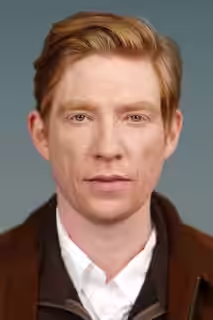
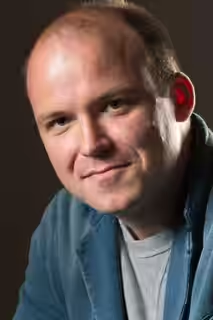
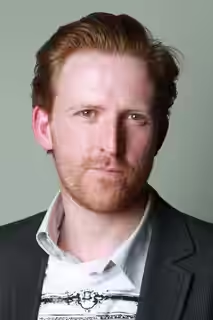
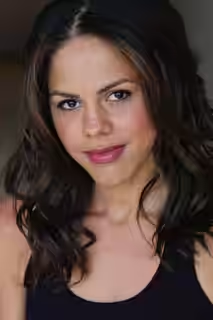
Black Mirror is an anthology of stories about modern anxieties, public opinion and life shaped by media and technology. Written by Charlie Brooker and other contributors, it moves between science fiction, drama, horror and black comedy. The opening story follows a prime minister facing an impossible dilemma as a media frenzy develops around him. Rory Kinnear plays Michael Callow, with Lindsay Duncan as Alex Cairns. Elsewhere, the cast includes Hayley Atwell as Martha Starmer, Domhnall Gleeson as Ash Starmer and Toby Kebbell as Liam Foxwell. The stories approach their subjects through satire, suspense and personal drama.

Plays from YouTube when you press play; nothing loads from them until then.

Fi1m review

We recommend Black Mirror for its straight-faced absurdity and performances that make the distress matter. Its weakness is a tendency to keep tightening the screws after the point is already clear.

Black Mirror is a sharp, upsetting anthology that we recommend with one reservation: it can be too pleased with how much it makes its characters suffer. Charlie Brooker and his fellow writers examine familiar appetites for amusement and other people’s trouble through science fiction and satire. The opening story establishes the method through a political crisis played with an almost unreasonable degree of seriousness. The ridiculous premise gets its chance because the people inside it cannot afford to find it ridiculous.

Rory Kinnear’s Michael Callow is a prime minister facing an impossible dilemma, while public opinion and the media help make his situation worse. Kinnear gives the distress enough weight to prevent the episode becoming merely an extended offensive joke. We laughed at the solemn handling of the predicament, then felt uncomfortable about laughing, because he makes the man caught in it seem painfully credible. The surrounding media frenzy is recognisable enough to make the episode difficult to dismiss as mere provocation.

The cinematographers include Lol Crawley and Zac Nicholson, and the photography is most convincing in its attention to faces. Embarrassment and fear need to register for these stories to work, and the visual restraint helps them do so. The production design, with Joel Collins among its contributors, is similarly effective when the surroundings feel ordinary enough to accept without inspection. A recognisable setting gives us less excuse to dismiss the behaviour as something belonging to an impossible future.

The editing, with Tony Kearns among its contributors, is good at making an unpleasant prospect feel steadily harder to avoid. Waiting becomes part of the discomfort, and the stronger stretches let us sit with it rather than hurrying towards another surprise. Daniel Pemberton is among the composers, and the music supports the seriousness with which these stories treat their unlikely situations. The tension works, though the insistence can become tiring when a story has already made its danger quite clear.

The limitation is that the writing sometimes seems more interested in securing our horror than in letting people behave unexpectedly. Once the likely consequences are clear, another stretch of distress can feel repetitive, however skilfully it is staged. Brooker and his fellow writers do not always give the characters enough freedom to complicate the lesson. This is where the severity becomes wearing: we start noticing how firmly everything has been arranged to produce our next appalled reaction.

The Twilight Zone is the useful comparison, because the appeal lies in entering a separate disturbing story and discovering which ordinary weakness it has chosen to examine. Black Mirror earns that company through its ability to make an outrageous starting point feel plausible. Its less successful stretches are easier to anticipate than they should be, especially when suspicion has already become our default response. The satire is sharper when the behaviour surprises us instead of merely confirming that people can be cruel.

The acting and straight-faced humour are good enough to justify the occasional bout of over-insistence. We would take these stories one at a time, allowing the discomfort to settle before inviting more. Choose it for an evening when an argument afterwards would count as part of the entertainment.

Critical consensus AI synthesised

85
Positive
10
Mixed
0
Negative
0

The reviews are uniformly positive and unusually of one mind. Most critics see Charlie Brooker’s anthology as a 21st-century Twilight Zone, dark satire played with a straight face, and they admire how the opening episode takes an absurd premise about a prime minister and treats it as sober drama, making it both funny and tragic. The praise clusters on the writing, on its observations about social media and the crowd, and on the performances, with Rory Kinnear and Lindsay Duncan singled out.

The spread is narrow, from good to very good, and nobody dissents. What differs is how much each critic has seen. Most reviews cover only the premiere. Empire, having watched all three episodes, rates the final one as the standout. Paste, looking back a decade on, argues that the first series’ standalone stories and refusal of neat endings are what later runs lost. The reservation, such as it is, concerns what came after, not these episodes.

Empire
5 March 2012 · William Thomas
90*

Charlie Brooker’s three-part series is a dark, thought-provoking 21st-century Twilight Zone spin that mixes horror and satire. The final episode stands out as a heartbreaking triumph.

Read the full review →
Radio Times
90*

The premiere is filthy, hilarious and darkly satirical, with a shocking premise about a prime minister facing an impossible dilemma that unfolds with straight-faced absurdity and a thick-of-it edge.

Read the full review →
Variety
8 November 2013 · Brian Lowry
90*

The anthology is creepy, clever and unsettling, capturing modern anxieties through a near-future lens with darkly satiric overtones; it compares favorably to The Twilight Zone.

Read the full review →
Vulture
4 December 2014
90*

The critic calls the dystopian anthology miniseries cynical, searing, shockingly good, and often disturbing, praising its aggressive political take on Western society and how it says more in six episodes than most shows do in dozens.

Read the full review →
The Telegraph
4 December 2011 · Michael Hogan
85*

The review calls the first episode a daring, shocking and ballsy blackly comic study of modern media and social networking that becomes oddly believable and tragic. It singles out the audacious satire and its Twilight Zone-like effect for praise.

Read the full review →
The Times
5 December 2011
85*

The critic praises the episode as brilliant satire that reveals the ugly faces of those in power and society's rotten aspects through its shocking premise. It is one of the smartest pieces of drama on television in a long time, played with magnificent solemnity.

Read the full review →

Straight answers AI written, from our review

Is Black Mirror worth watching?
Black Mirror is worth watching for anyone who can take satire that goes out of its way to make them uncomfortable, and we scored it 81. Rory Kinnear and the other performers give the distress enough weight to keep the outrageous premises from becoming mere provocation. Our reservation is that some stories keep tightening the screws after the point is already clear, so we would take them one at a time.
How long is Black Mirror, and what is it rated?
Black Mirror is rated TV-MA by the MPA in the US. It is a sci-fi & fantasy and drama series.
Where can I watch Black Mirror in the US?
Black Mirror is streaming on Netflix in the US, and it is also available to buy from Amazon Prime Video and Apple TV. Availability is checked daily; the links above go straight to each service.
How violent or frightening is Black Mirror, and is it suitable for children?
Black Mirror carries an 18 certificate in the UK and is not suitable for children. The opening story builds its horror from an offensive predicament handled with complete seriousness, and the discomfort is the point, so the squeamish and the easily upset should think twice. Older teenagers and adults who can stand being appalled for an evening are the audience it suits.
How does Black Mirror compare to The Twilight Zone?
Black Mirror stands beside The Twilight Zone as an anthology of self-contained stories that make ordinary human failings hard to shrug off. Brooker's series is the more upsetting and more openly satirical, and it is better at making an absurd premise feel plausible, though it can labour a lesson the earlier show would have left alone. Serling's series is the more disciplined; choose it if you want unease without the cruelty.
What should I watch after Black Mirror?
After Black Mirror, try The Twilight Zone (1959, Fi1m 84): For self-contained stories that make familiar human failings difficult to shrug off. Then Cure (1997, Fi1m 85): For another patient examination of how ordinary people become frightening; and The Truman Show (1998, Fi1m 88): Media cruelty and audience complicity, with more warmth and no less unease.

Cast

Awards

Primetime Emmy Awards, 2019

Won
Outstanding Interactive Program
Won
Outstanding Television Movie

Primetime Emmy Awards, 2018

Won
Outstanding Single-Camera Picture Editing for a Limited Series or Movie
Won
Outstanding Sound Editing for a Limited or Anthology Series, Movie or Special

Peabody Awards, 2014

Won
Peabody Awards

If you liked this, try…

  1. The Twilight Zone (1959, Fi1m 84)For self-contained stories that make familiar human failings difficult to shrug off.

  2. World on a Wire (1973) · not reviewed yetA slower, stranger approach to the suspicion that reality has been manufactured.

  3. Cure (1997, Fi1m 85)For another patient examination of how ordinary people become frightening.

  4. The Truman Show (1998, Fi1m 88)Media cruelty and audience complicity, with more warmth and no less unease.

  5. Years and Years (2019) · not reviewed yetNear-future anxiety given continuity through a family worth caring about.

Free account

Know what to watch tonight

Two lists that know where things are streaming, collections you can share, your own score beside ours, and Discover that remembers what you have seen.

  • Want to see, sorted by what is streaming now
  • Seen, with your score out of ten
  • No adverts, ever