Sam Mendes’s suburban satire is funny and well acted, especially by Annette Bening. We recommend it for the performances, with a reservation: Alan Ball’s screenplay treats familiar complaints about middle-class life as discoveries.
American Beauty is a good, sourly funny suburban drama that puts rather too much confidence in its own wisdom. Sam Mendes directs Alan Ball’s screenplay as though every frustration deserves attention, even when the people expressing it are behaving badly. That generosity matters, because the unhappy middle-class household is an easy target, and the film sometimes settles for the easy shot. We recommend it for the actors, who make more of these complaints than the writing always gives them.
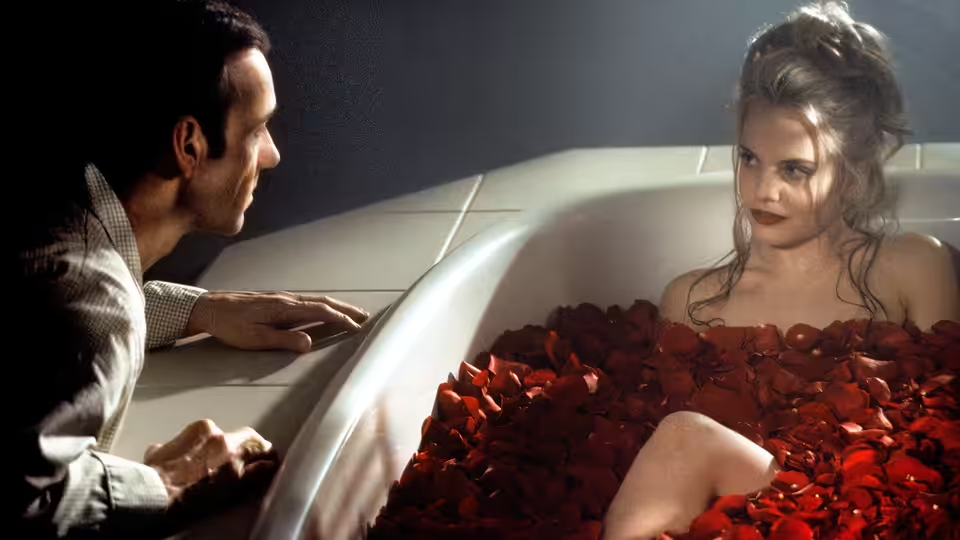
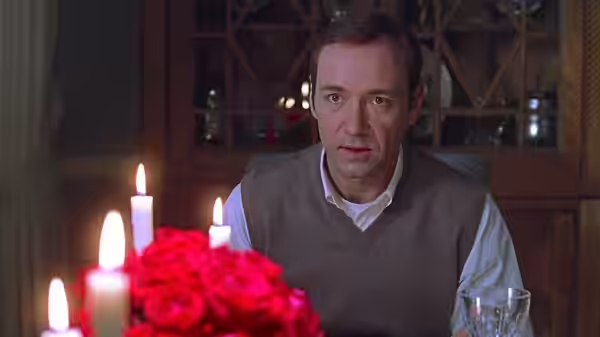
Kevin Spacey’s Lester Burnham is central to that success. Spacey gives discontent a comic fluency that makes it entertaining even when we begin to question how much sympathy it deserves. There is pleasure in watching an actor make self-absorption so companionable, and a danger that the film will mistake his charm for a justification. Mendes does not always keep enough distance from Lester, but Spacey’s performance gives the satire an ease that prevents it becoming a lecture.
Annette Bening is the stronger reason to watch. As Carolyn, she makes unhappiness feel like exhausting work, with a tightness in her delivery that complicates the comedy. We laughed at Spacey’s self-satisfaction, then felt uncomfortable because Bening made the same relationship look so punishing. She does not ask us to find Carolyn agreeable before taking her seriously, and that exposes a weakness in Ball’s writing: we sometimes rely on the actor to provide sympathy the jokes have not earned.
Conrad Hall’s cinematography gives the suburban setting a controlled, polished look that suits Mendes’s scrutiny of the people living there. Naomi Shohan’s production design makes domestic respectability feel stifling; it helps us understand why these characters are dissatisfied without needing the dialogue to explain it. The images reward attention even when Ball’s observations are obvious. Sometimes, though, the polish distances us from the people whose unhappiness is supposed to matter.
Editors Christopher Greenbury and Tariq Anwar keep the humour and unhappiness in workable proportion, letting performances register without making each change of mood a separate event. Thomas Newman’s music helps the film’s gentler feelings come through, although it cannot make every bid for profundity convincing. The difficulty lies in Ball’s wish to combine satirical complaint with a more forgiving view of these people. The more solemn passages ask for a degree of belief the sharper jokes have made difficult.
Suburban satire needs more than unhappy people living respectable lives, and this is where American Beauty falls short of its ambitions. Ball is alert to hypocrisy, but conformity is too often treated as a sufficient explanation for everything that hurts. That reduces the surprise: once we understand the target, we can anticipate too much of the complaint. Mendes’s sympathy and the ensemble’s skill keep individual passages alive, yet they cannot entirely overcome the familiarity of what is being said.
The film remains worth an evening if dark domestic comedy appeals, and its 122 minutes give the actors room to complicate the broad strokes. The insistence on finding significance can grow tiresome, particularly when the performances have already made the unhappiness clear. Watch it for Bening in particular, without feeling obliged to accept every lesson.